

2.3 The Quantum Atom
Energy is as important as the electron density. The Schrödinger equation presents
the energy and the wave function as prime quantities, joined at the hip and being of
equal status. For each eigenvalue (energy), there is an eigenfunction (wave function) and they both come as an inseparable pair. Because the electron density
immediately derives from the wave function, the molecular electron density and the
molecule’s energy are also twinned. Hence, because this electron density is of
prime importance due to the first Hohenberg-Kohn theorem, energy shares this
importance. Indeed, energy is in charge of the way a molecular system behaves and
understanding it is therefore crucial. Phenomena, such as steric hindrance, ultimately reduce to energy considerations, even if sterics appear irreducible intuitively
(based on daily life experience). The natural way to understand something (at least
in the Western tradition of doing science) is to study its parts. Such an approach
calls for the spatial partitioning of energy.
The key question is how to define a molecular fragment that has a well-defined
kinetic energy. This question is attacked by starting with local kinetic energy,
which is the kinetic energy at a particular point per unit volume. This quantity is
thus a kinetic energy density, which when integrated over a volume, gives the
kinetic energy of the electrons in that volume. The kinetic energy of a molecular
fragment is then obtained from a 3D integral of the kinetic energy density over the
volume of that fragment. However, there is a practical problem in that there is no
“the” kinetic energy density; at best, there is “a” kinetic energy density. We write
“at best” because if one starts from the quasiprobability distribution function the
quantum mechanical treatment of kinetic energy, partitioned or not, is actually
problematic. Local kinetic energy is then ambiguous. However, within the paradigm that Anderson et al. [50] call the ‘‘Laplacian family of local kinetic energies’’,
the deduction below is valid [51].
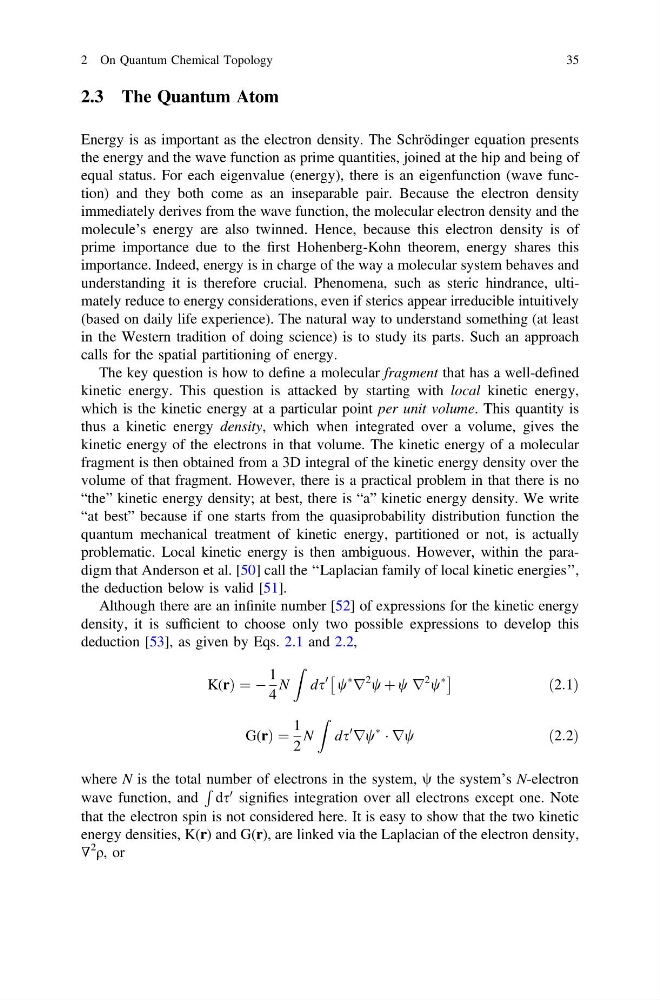
Although there are an infinite number [52] of expressions for the kinetic energy
density, it is sufficient to choose only two possible expressions to develop this
deduction [53], as given by Eqs. 2.1 and 2.2,
K(rÞ ¼ À
1
4
N
Z
ds
0
w
Ã
r
2
w þ w r
2
w
Ã
Â
Ã
ð2:1Þ
G(rÞ ¼
1
2
N
Z
ds
0
rw
Ã
Á rw
ð2:2Þ
where N is the total number of electrons in the system, w the system’s N-electron
wave function, and
R
ds
0 signifies integration over all electrons except one. Note
that the electron spin is not considered here. It is easy to show that the two kinetic
energy densities, K(r) and G(r), are linked via the Laplacian of the electron density,
∇
2
ρ, or
2 On Quantum Chemical Topology
35
Energy is as important as the electron density. The Schrödinger equation presents
the energy and the wave function as prime quantities, joined at the hip and being of
equal status. For each eigenvalue (energy), there is an eigenfunction (wave function) and they both come as an inseparable pair. Because the electron density
immediately derives from the wave function, the molecular electron density and the
molecule’s energy are also twinned. Hence, because this electron density is of
prime importance due to the first Hohenberg-Kohn theorem, energy shares this
importance. Indeed, energy is in charge of the way a molecular system behaves and
understanding it is therefore crucial. Phenomena, such as steric hindrance, ultimately reduce to energy considerations, even if sterics appear irreducible intuitively
(based on daily life experience). The natural way to understand something (at least
in the Western tradition of doing science) is to study its parts. Such an approach
calls for the spatial partitioning of energy.
The key question is how to define a molecular fragment that has a well-defined
kinetic energy. This question is attacked by starting with local kinetic energy,
which is the kinetic energy at a particular point per unit volume. This quantity is
thus a kinetic energy density, which when integrated over a volume, gives the
kinetic energy of the electrons in that volume. The kinetic energy of a molecular
fragment is then obtained from a 3D integral of the kinetic energy density over the
volume of that fragment. However, there is a practical problem in that there is no
“the” kinetic energy density; at best, there is “a” kinetic energy density. We write
“at best” because if one starts from the quasiprobability distribution function the
quantum mechanical treatment of kinetic energy, partitioned or not, is actually
problematic. Local kinetic energy is then ambiguous. However, within the paradigm that Anderson et al. [50] call the ‘‘Laplacian family of local kinetic energies’’,
the deduction below is valid [51].
Although there are an infinite number [52] of expressions for the kinetic energy
density, it is sufficient to choose only two possible expressions to develop this
deduction [53], as given by Eqs. 2.1 and 2.2,
K(rÞ ¼ À
1
4
N
Z
ds
0
w
Ã
r
2
w þ w r
2
w
Ã
Â
Ã
ð2:1Þ
G(rÞ ¼
1
2
N
Z
ds
0
rw
Ã
Á rw
ð2:2Þ
where N is the total number of electrons in the system, w the system’s N-electron
wave function, and
R
ds
0 signifies integration over all electrons except one. Note
that the electron spin is not considered here. It is easy to show that the two kinetic
energy densities, K(r) and G(r), are linked via the Laplacian of the electron density,
∇
2
ρ, or
2 On Quantum Chemical Topology
35