

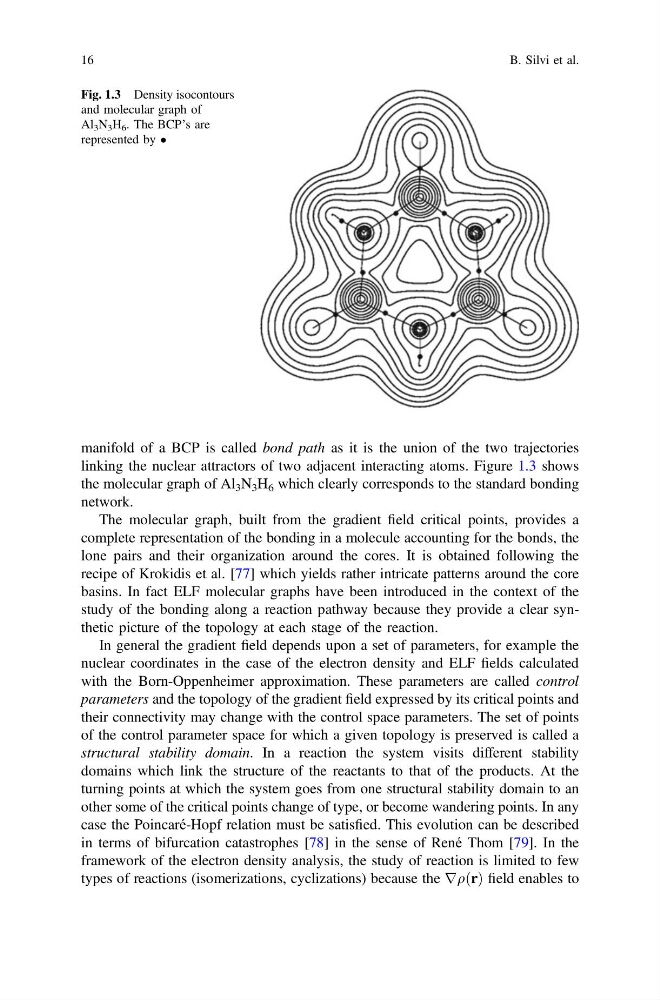
manifold of a BCP is called bond path as it is the union of the two trajectories
linking the nuclear attractors of two adjacent interacting atoms. Figure 1.3 shows
the molecular graph of Al 3 N 3 H 6 which clearly corresponds to the standard bonding
network.
The molecular graph, built from the gradient field critical points, provides a
complete representation of the bonding in a molecule accounting for the bonds, the
lone pairs and their organization around the cores. It is obtained following the
recipe of Krokidis et al. [77] which yields rather intricate patterns around the core
basins. In fact ELF molecular graphs have been introduced in the context of the
study of the bonding along a reaction pathway because they provide a clear synthetic picture of the topology at each stage of the reaction.
In general the gradient field depends upon a set of parameters, for example the
nuclear coordinates in the case of the electron density and ELF fields calculated
with the Born-Oppenheimer approximation. These parameters are called control
parameters and the topology of the gradient field expressed by its critical points and
their connectivity may change with the control space parameters. The set of points
of the control parameter space for which a given topology is preserved is called a
structural stability domain. In a reaction the system visits different stability
domains which link the structure of the reactants to that of the products. At the
turning points at which the system goes from one structural stability domain to an
other some of the critical points change of type, or become wandering points. In any
case the Poincaré-Hopf relation must be satisfied. This evolution can be described
in terms of bifurcation catastrophes [78] in the sense of René Thom [79]. In the
framework of the electron density analysis, the study of reaction is limited to few
types of reactions (isomerizations, cyclizations) because the rqðrÞ field enables to
Fig. 1.3 Density isocontours
and molecular graph of
Al 3 N 3 H 6 . The BCP’s are
represented by
16
B. Silvi et al.
linking the nuclear attractors of two adjacent interacting atoms. Figure 1.3 shows
the molecular graph of Al 3 N 3 H 6 which clearly corresponds to the standard bonding
network.
The molecular graph, built from the gradient field critical points, provides a
complete representation of the bonding in a molecule accounting for the bonds, the
lone pairs and their organization around the cores. It is obtained following the
recipe of Krokidis et al. [77] which yields rather intricate patterns around the core
basins. In fact ELF molecular graphs have been introduced in the context of the
study of the bonding along a reaction pathway because they provide a clear synthetic picture of the topology at each stage of the reaction.
In general the gradient field depends upon a set of parameters, for example the
nuclear coordinates in the case of the electron density and ELF fields calculated
with the Born-Oppenheimer approximation. These parameters are called control
parameters and the topology of the gradient field expressed by its critical points and
their connectivity may change with the control space parameters. The set of points
of the control parameter space for which a given topology is preserved is called a
structural stability domain. In a reaction the system visits different stability
domains which link the structure of the reactants to that of the products. At the
turning points at which the system goes from one structural stability domain to an
other some of the critical points change of type, or become wandering points. In any
case the Poincaré-Hopf relation must be satisfied. This evolution can be described
in terms of bifurcation catastrophes [78] in the sense of René Thom [79]. In the
framework of the electron density analysis, the study of reaction is limited to few
types of reactions (isomerizations, cyclizations) because the rqðrÞ field enables to
Fig. 1.3 Density isocontours
and molecular graph of
Al 3 N 3 H 6 . The BCP’s are
represented by
16
B. Silvi et al.