

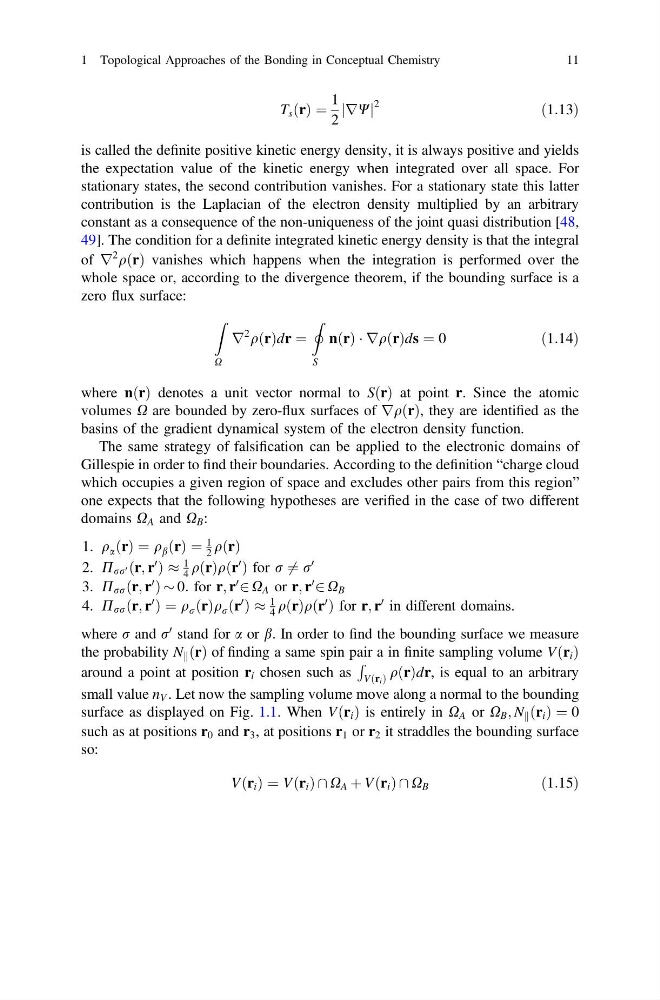
T s ðrÞ ¼
1
2
jrWj
2
ð1:13Þ
is called the definite positive kinetic energy density, it is always positive and yields
the expectation value of the kinetic energy when integrated over all space. For
stationary states, the second contribution vanishes. For a stationary state this latter
contribution is the Laplacian of the electron density multiplied by an arbitrary
constant as a consequence of the non-uniqueness of the joint quasi distribution [48,
49]. The condition for a definite integrated kinetic energy density is that the integral
of r
2
qðrÞ vanishes which happens when the integration is performed over the
whole space or, according to the divergence theorem, if the bounding surface is a
zero flux surface:
Z
X
r
2
qðrÞdr ¼
I
S
nðrÞ Á rqðrÞds ¼ 0
ð1:14Þ
where nðrÞ denotes a unit vector normal to SðrÞ at point r. Since the atomic
volumes X are bounded by zero-flux surfaces of rqðrÞ, they are identified as the
basins of the gradient dynamical system of the electron density function.
The same strategy of falsification can be applied to the electronic domains of
Gillespie in order to find their boundaries. According to the definition “charge cloud
which occupies a given region of space and excludes other pairs from this region”
one expects that the following hypotheses are verified in the case of two different
domains X A and X B :
1. q a ðrÞ ¼ q b ðrÞ ¼
1
2 qðrÞ
2. P rr 0 ðr; r
0
Þ %
1
4 qðrÞqðr
0
Þ for r 6 ¼ r
0
3. P rr ðr; r
0
Þ $ 0: for r; r
0
2 X A or r; r
0
2 X B
4. P rr ðr; r
0
Þ ¼ q r ðrÞq r ðr
0
Þ %
1
4 qðrÞqðr
0
Þ for r; r
0 in different domains.
where r and r
0 stand for a or b. In order to find the bounding surface we measure
the probability N k ðrÞ of finding a same spin pair a in finite sampling volume Vðr i Þ
around a point at position r i chosen such as
R
Vðr i Þ qðrÞdr, is equal to an arbitrary
small value n V . Let now the sampling volume move along a normal to the bounding
surface as displayed on Fig. 1.1. When Vðr i Þ is entirely in X A or X B ; N k ðr i Þ ¼ 0
such as at positions r 0 and r 3 , at positions r 1 or r 2 it straddles the bounding surface
so:
Vðr i Þ ¼ Vðr i Þ \ X A þ Vðr i Þ \ X B
ð1:15Þ
1 Topological Approaches of the Bonding in Conceptual Chemistry
11
1
2
jrWj
2
ð1:13Þ
is called the definite positive kinetic energy density, it is always positive and yields
the expectation value of the kinetic energy when integrated over all space. For
stationary states, the second contribution vanishes. For a stationary state this latter
contribution is the Laplacian of the electron density multiplied by an arbitrary
constant as a consequence of the non-uniqueness of the joint quasi distribution [48,
49]. The condition for a definite integrated kinetic energy density is that the integral
of r
2
qðrÞ vanishes which happens when the integration is performed over the
whole space or, according to the divergence theorem, if the bounding surface is a
zero flux surface:
Z
X
r
2
qðrÞdr ¼
I
S
nðrÞ Á rqðrÞds ¼ 0
ð1:14Þ
where nðrÞ denotes a unit vector normal to SðrÞ at point r. Since the atomic
volumes X are bounded by zero-flux surfaces of rqðrÞ, they are identified as the
basins of the gradient dynamical system of the electron density function.
The same strategy of falsification can be applied to the electronic domains of
Gillespie in order to find their boundaries. According to the definition “charge cloud
which occupies a given region of space and excludes other pairs from this region”
one expects that the following hypotheses are verified in the case of two different
domains X A and X B :
1. q a ðrÞ ¼ q b ðrÞ ¼
1
2 qðrÞ
2. P rr 0 ðr; r
0
Þ %
1
4 qðrÞqðr
0
Þ for r 6 ¼ r
0
3. P rr ðr; r
0
Þ $ 0: for r; r
0
2 X A or r; r
0
2 X B
4. P rr ðr; r
0
Þ ¼ q r ðrÞq r ðr
0
Þ %
1
4 qðrÞqðr
0
Þ for r; r
0 in different domains.
where r and r
0 stand for a or b. In order to find the bounding surface we measure
the probability N k ðrÞ of finding a same spin pair a in finite sampling volume Vðr i Þ
around a point at position r i chosen such as
R
Vðr i Þ qðrÞdr, is equal to an arbitrary
small value n V . Let now the sampling volume move along a normal to the bounding
surface as displayed on Fig. 1.1. When Vðr i Þ is entirely in X A or X B ; N k ðr i Þ ¼ 0
such as at positions r 0 and r 3 , at positions r 1 or r 2 it straddles the bounding surface
so:
Vðr i Þ ¼ Vðr i Þ \ X A þ Vðr i Þ \ X B
ð1:15Þ
1 Topological Approaches of the Bonding in Conceptual Chemistry
11