

7.4 Bifurcations of a Dynamical System
The splitting of an SL of the quantum mechanical current densities J
B and J
m I at a
branching point in R
3 can be studied within the framework of bifurcation theory of
dynamical systems, see [94–96] for an introduction to the subject. Accordingly, let
us consider a system of first-order differential equations in matrix form
_
X ¼ F l ðX Þ
ð 7:61Þ
where _
X dX=dt, X 2 R
3 and l 2 R
k . With this notation it is implied that F l
depends on k parameters [94]. The system (7.61) is referred to as a flow in
three-dimensional space. It will be assumed in the following that F l does not
depend explicitly on time, but only on X. For F l ¼ F l ½X ðtÞ, the flow (7.61) is said
to be autonomous. The solutions to the system of algebraic equations
F l ðXÞ ¼ 0
ð7:62Þ
are referred to as fixed, or equilibrium, or stagnation points of the flow.
The existence of roots of F l ðXÞ ¼ 0 can be studied via maps describing their
dependence on l. The solution as a function of the parameter is referred to as a solution
branch and a bifurcation point is a point in R
k from which a set of branches moves out
[94]. The codimension of a bifurcation is defined to be the smallest dimension of R
k in
which a bifurcation can take place [94]. In the following we will limit ourselves to
studying two-dimensional flows of codimension one, taking into account a few
archetypal one-dimensional differential forms listed in Appendix A of Ref. [94].
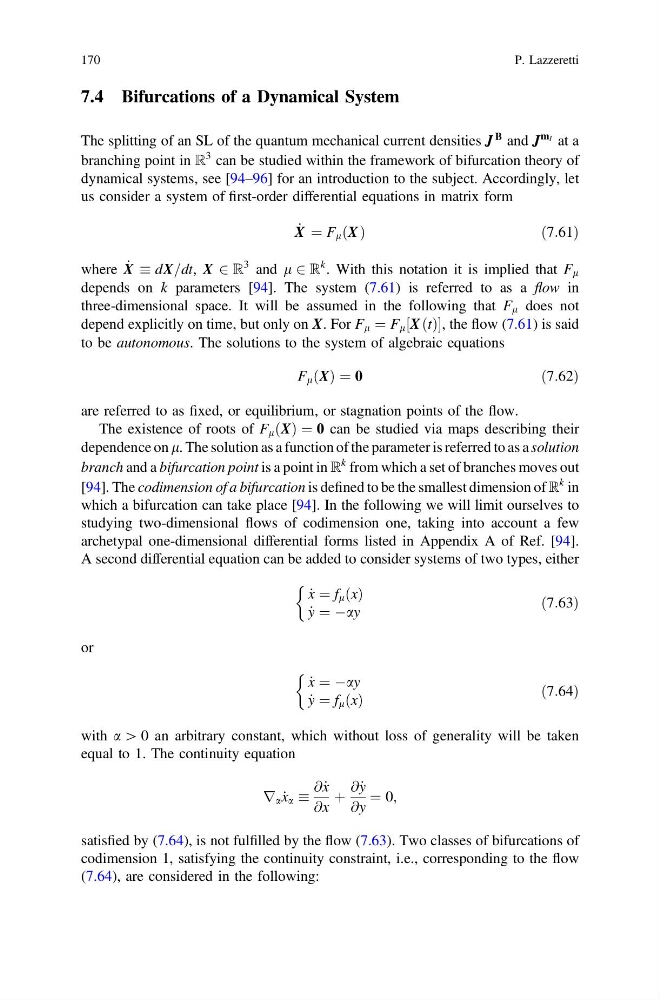
A second differential equation can be added to consider systems of two types, either
_
x ¼ f l ðxÞ
_
y ¼ Àay
&
ð7:63Þ
or
_
x ¼ Àay
_
y ¼ f l ðxÞ
&
ð7:64Þ
with a [ 0 an arbitrary constant, which without loss of generality will be taken
equal to 1. The continuity equation
r a _
x a
@ _
x
@x
þ
@ _
y
@y
¼ 0;
satisfied by (7.64), is not fulfilled by the flow (7.63). Two classes of bifurcations of
codimension 1, satisfying the continuity constraint, i.e., corresponding to the flow
(7.64), are considered in the following:
170
P. Lazzeretti
The splitting of an SL of the quantum mechanical current densities J
B and J
m I at a
branching point in R
3 can be studied within the framework of bifurcation theory of
dynamical systems, see [94–96] for an introduction to the subject. Accordingly, let
us consider a system of first-order differential equations in matrix form
_
X ¼ F l ðX Þ
ð 7:61Þ
where _
X dX=dt, X 2 R
3 and l 2 R
k . With this notation it is implied that F l
depends on k parameters [94]. The system (7.61) is referred to as a flow in
three-dimensional space. It will be assumed in the following that F l does not
depend explicitly on time, but only on X. For F l ¼ F l ½X ðtÞ, the flow (7.61) is said
to be autonomous. The solutions to the system of algebraic equations
F l ðXÞ ¼ 0
ð7:62Þ
are referred to as fixed, or equilibrium, or stagnation points of the flow.
The existence of roots of F l ðXÞ ¼ 0 can be studied via maps describing their
dependence on l. The solution as a function of the parameter is referred to as a solution
branch and a bifurcation point is a point in R
k from which a set of branches moves out
[94]. The codimension of a bifurcation is defined to be the smallest dimension of R
k in
which a bifurcation can take place [94]. In the following we will limit ourselves to
studying two-dimensional flows of codimension one, taking into account a few
archetypal one-dimensional differential forms listed in Appendix A of Ref. [94].
A second differential equation can be added to consider systems of two types, either
_
x ¼ f l ðxÞ
_
y ¼ Àay
&
ð7:63Þ
or
_
x ¼ Àay
_
y ¼ f l ðxÞ
&
ð7:64Þ
with a [ 0 an arbitrary constant, which without loss of generality will be taken
equal to 1. The continuity equation
r a _
x a
@ _
x
@x
þ
@ _
y
@y
¼ 0;
satisfied by (7.64), is not fulfilled by the flow (7.63). Two classes of bifurcations of
codimension 1, satisfying the continuity constraint, i.e., corresponding to the flow
(7.64), are considered in the following:
170
P. Lazzeretti