

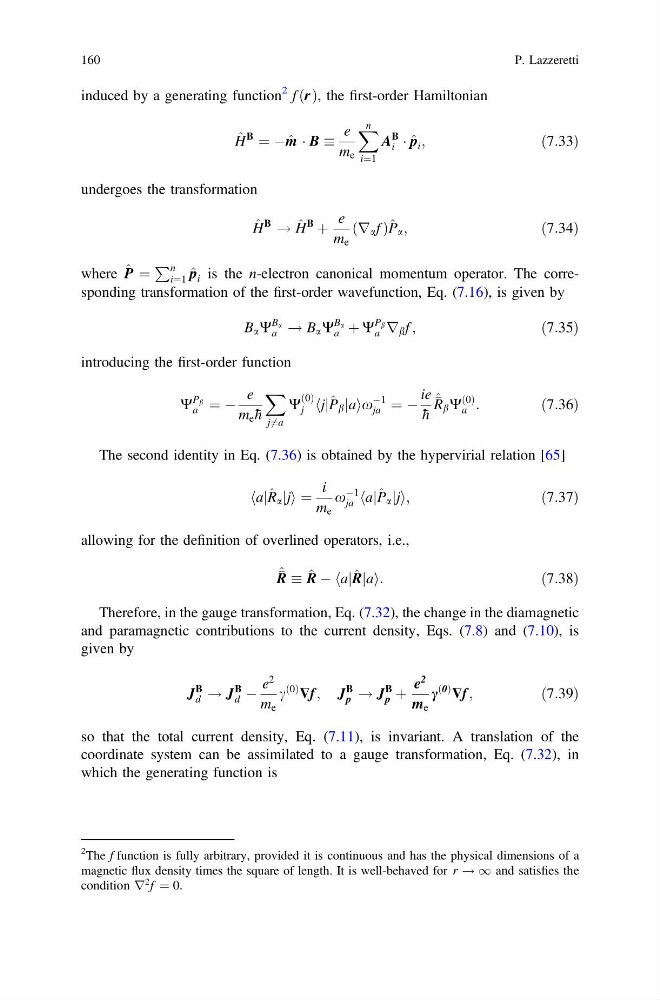
induced by a generating function
2 f ðrÞ, the first-order Hamiltonian
^
H
B
¼ À ^
m Á B
e
m e
X n
i¼1
A
B
i Á ^ p i ;
ð7:33Þ
undergoes the transformation
^
H
B
! ^
H
B
þ
e
m e
ðr a f Þ ^
P a ;
ð7:34Þ
where ^
P ¼
P n
i¼1 ^ p i is the n-electron canonical momentum operator. The corresponding transformation of the first-order wavefunction, Eq. (7.16), is given by
B a W
B a
a ! B a W
B a
a þ W
P b
a r b f ;
ð7:35Þ
introducing the first-order function
W
P b
a ¼ À
e
m e h
X
j6 ¼a
W
ð0Þ
j hjj ^
P b jaix
À1
ja ¼ À
ie
h
^
R b W
ð0Þ
a :
ð7:36Þ
The second identity in Eq. (7.36) is obtained by the hypervirial relation [65]
haj ^
R a jji ¼
i
m e
x
À1
ja haj ^
P a jji;
ð7:37Þ
allowing for the definition of overlined operators, i.e.,
^
R ^
R À haj ^
Rjai:
ð7:38Þ
Therefore, in the gauge transformation, Eq. (7.32), the change in the diamagnetic
and paramagnetic contributions to the current density, Eqs. (7.8) and (7.10), is
given by
J
B
d ! J
B
d À
e
2
m e
c
ð0Þ
$f ; J
B
p ! J
B
p þ
e
2
m e
c
ð0Þ
$f ;
ð7:39Þ
so that the total current density, Eq. (7.11), is invariant. A translation of the
coordinate system can be assimilated to a gauge transformation, Eq. (7.32), in
which the generating function is
2
The f function is fully arbitrary, provided it is continuous and has the physical dimensions of a
magnetic flux density times the square of length. It is well-behaved for r ! 1 and satisfies the
condition r
2 f ¼ 0.
160
P. Lazzeretti
2 f ðrÞ, the first-order Hamiltonian
^
H
B
¼ À ^
m Á B
e
m e
X n
i¼1
A
B
i Á ^ p i ;
ð7:33Þ
undergoes the transformation
^
H
B
! ^
H
B
þ
e
m e
ðr a f Þ ^
P a ;
ð7:34Þ
where ^
P ¼
P n
i¼1 ^ p i is the n-electron canonical momentum operator. The corresponding transformation of the first-order wavefunction, Eq. (7.16), is given by
B a W
B a
a ! B a W
B a
a þ W
P b
a r b f ;
ð7:35Þ
introducing the first-order function
W
P b
a ¼ À
e
m e h
X
j6 ¼a
W
ð0Þ
j hjj ^
P b jaix
À1
ja ¼ À
ie
h
^
R b W
ð0Þ
a :
ð7:36Þ
The second identity in Eq. (7.36) is obtained by the hypervirial relation [65]
haj ^
R a jji ¼
i
m e
x
À1
ja haj ^
P a jji;
ð7:37Þ
allowing for the definition of overlined operators, i.e.,
^
R ^
R À haj ^
Rjai:
ð7:38Þ
Therefore, in the gauge transformation, Eq. (7.32), the change in the diamagnetic
and paramagnetic contributions to the current density, Eqs. (7.8) and (7.10), is
given by
J
B
d ! J
B
d À
e
2
m e
c
ð0Þ
$f ; J
B
p ! J
B
p þ
e
2
m e
c
ð0Þ
$f ;
ð7:39Þ
so that the total current density, Eq. (7.11), is invariant. A translation of the
coordinate system can be assimilated to a gauge transformation, Eq. (7.32), in
which the generating function is
2
The f function is fully arbitrary, provided it is continuous and has the physical dimensions of a
magnetic flux density times the square of length. It is well-behaved for r ! 1 and satisfies the
condition r
2 f ¼ 0.
160
P. Lazzeretti