

In a number of instances, the MLL formulation is quite useful, e.g., it yields
powerful tools for studying molecular magnetic response, which can be rationalized
via the electronic current density induced by a spatially uniform, time-independent
external magnetic field B and by intramolecular magnetic dipoles m I , I ¼ 1; 2. . .N
at the nuclei. The practical advantages of dealing with a vector function of position
in real space, instead of a complex wave function depending on 6n space-spin
coordinates for an n particle problem, are evident.
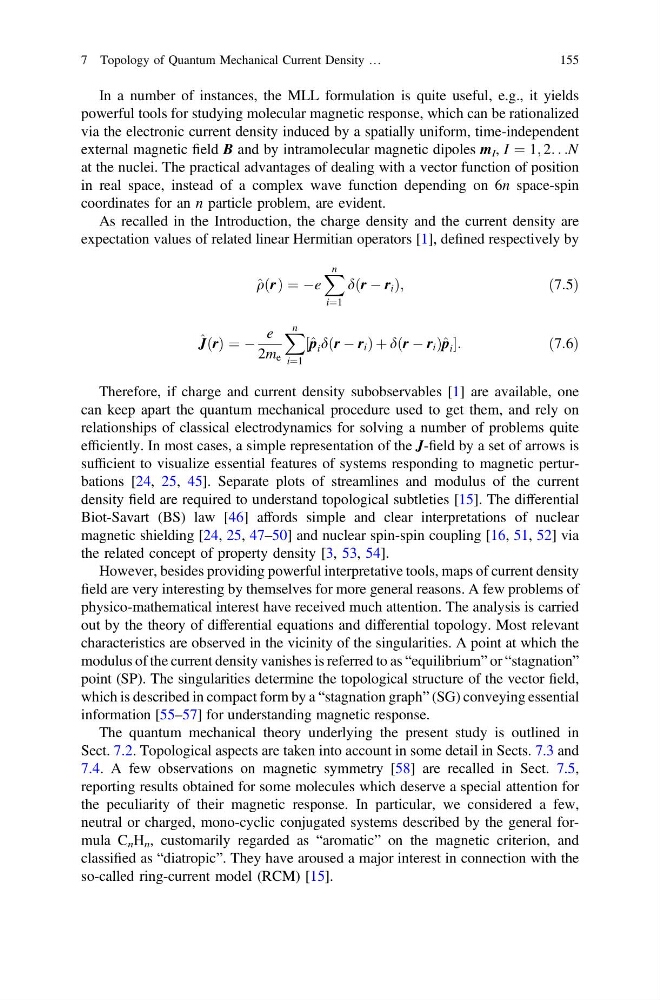
As recalled in the Introduction, the charge density and the current density are
expectation values of related linear Hermitian operators [1], defined respectively by
^
qðrÞ ¼ Àe
X n
i¼1
dðr À r i Þ;
ð7:5Þ
^
JðrÞ ¼ À
e
2m e
X n
i¼1
^ p i dðr À r i Þ þ dðr À r i Þ^ p i
½
:
ð7:6Þ
Therefore, if charge and current density subobservables [1] are available, one
can keep apart the quantum mechanical procedure used to get them, and rely on
relationships of classical electrodynamics for solving a number of problems quite
efficiently. In most cases, a simple representation of the J-field by a set of arrows is
sufficient to visualize essential features of systems responding to magnetic perturbations [24, 25, 45]. Separate plots of streamlines and modulus of the current
density field are required to understand topological subtleties [15]. The differential
Biot-Savart (BS) law [46] affords simple and clear interpretations of nuclear
magnetic shielding [24, 25, 47–50] and nuclear spin-spin coupling [16, 51, 52] via
the related concept of property density [3, 53, 54].
However, besides providing powerful interpretative tools, maps of current density
field are very interesting by themselves for more general reasons. A few problems of
physico-mathematical interest have received much attention. The analysis is carried
out by the theory of differential equations and differential topology. Most relevant
characteristics are observed in the vicinity of the singularities. A point at which the
modulus of the current density vanishes is referred to as “equilibrium” or “stagnation”
point (SP). The singularities determine the topological structure of the vector field,
which is described in compact form by a “stagnation graph” (SG) conveying essential
information [55–57] for understanding magnetic response.
The quantum mechanical theory underlying the present study is outlined in
Sect. 7.2. Topological aspects are taken into account in some detail in Sects. 7.3 and
7.4. A few observations on magnetic symmetry [58] are recalled in Sect. 7.5,
reporting results obtained for some molecules which deserve a special attention for
the peculiarity of their magnetic response. In particular, we considered a few,
neutral or charged, mono-cyclic conjugated systems described by the general formula C n H n , customarily regarded as “aromatic” on the magnetic criterion, and
classified as “diatropic”. They have aroused a major interest in connection with the
so-called ring-current model (RCM) [15].
7 Topology of Quantum Mechanical Current Density …
155
powerful tools for studying molecular magnetic response, which can be rationalized
via the electronic current density induced by a spatially uniform, time-independent
external magnetic field B and by intramolecular magnetic dipoles m I , I ¼ 1; 2. . .N
at the nuclei. The practical advantages of dealing with a vector function of position
in real space, instead of a complex wave function depending on 6n space-spin
coordinates for an n particle problem, are evident.
As recalled in the Introduction, the charge density and the current density are
expectation values of related linear Hermitian operators [1], defined respectively by
^
qðrÞ ¼ Àe
X n
i¼1
dðr À r i Þ;
ð7:5Þ
^
JðrÞ ¼ À
e
2m e
X n
i¼1
^ p i dðr À r i Þ þ dðr À r i Þ^ p i
½
:
ð7:6Þ
Therefore, if charge and current density subobservables [1] are available, one
can keep apart the quantum mechanical procedure used to get them, and rely on
relationships of classical electrodynamics for solving a number of problems quite
efficiently. In most cases, a simple representation of the J-field by a set of arrows is
sufficient to visualize essential features of systems responding to magnetic perturbations [24, 25, 45]. Separate plots of streamlines and modulus of the current
density field are required to understand topological subtleties [15]. The differential
Biot-Savart (BS) law [46] affords simple and clear interpretations of nuclear
magnetic shielding [24, 25, 47–50] and nuclear spin-spin coupling [16, 51, 52] via
the related concept of property density [3, 53, 54].
However, besides providing powerful interpretative tools, maps of current density
field are very interesting by themselves for more general reasons. A few problems of
physico-mathematical interest have received much attention. The analysis is carried
out by the theory of differential equations and differential topology. Most relevant
characteristics are observed in the vicinity of the singularities. A point at which the
modulus of the current density vanishes is referred to as “equilibrium” or “stagnation”
point (SP). The singularities determine the topological structure of the vector field,
which is described in compact form by a “stagnation graph” (SG) conveying essential
information [55–57] for understanding magnetic response.
The quantum mechanical theory underlying the present study is outlined in
Sect. 7.2. Topological aspects are taken into account in some detail in Sects. 7.3 and
7.4. A few observations on magnetic symmetry [58] are recalled in Sect. 7.5,
reporting results obtained for some molecules which deserve a special attention for
the peculiarity of their magnetic response. In particular, we considered a few,
neutral or charged, mono-cyclic conjugated systems described by the general formula C n H n , customarily regarded as “aromatic” on the magnetic criterion, and
classified as “diatropic”. They have aroused a major interest in connection with the
so-called ring-current model (RCM) [15].
7 Topology of Quantum Mechanical Current Density …
155