

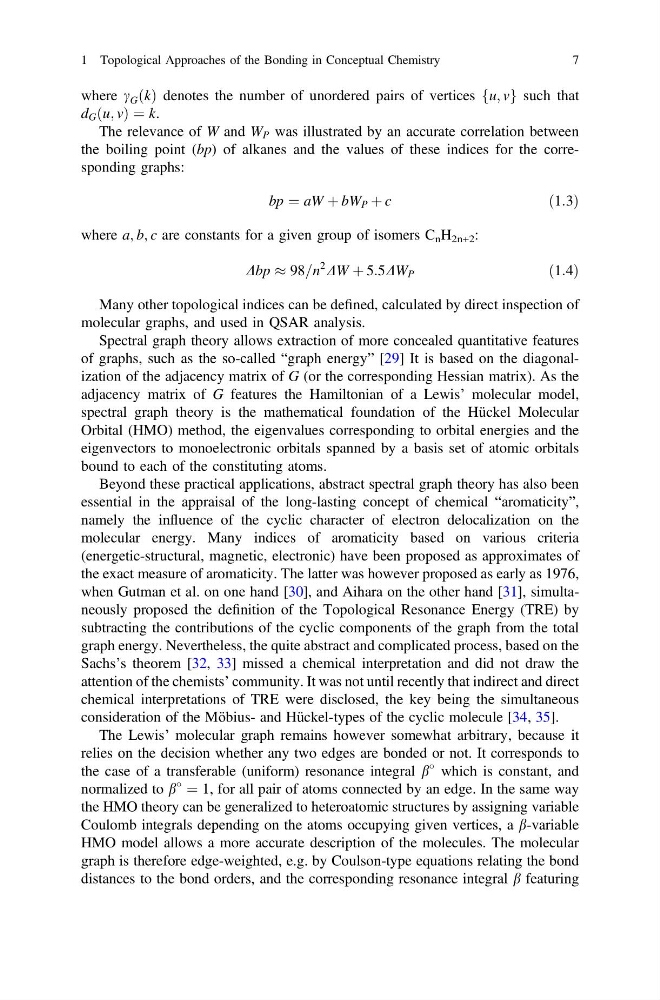
where c G ðkÞ denotes the number of unordered pairs of vertices fu; vg such that
d G ðu; vÞ ¼ k.
The relevance of W and W P was illustrated by an accurate correlation between
the boiling point (bp) of alkanes and the values of these indices for the corresponding graphs:
bp ¼ aW þ bW P þ c
ð1:3Þ
where a; b; c are constants for a given group of isomers C n H 2n+2 :
Dbp % 98=n
2
DW þ 5:5DW P
ð1:4Þ
Many other topological indices can be defined, calculated by direct inspection of
molecular graphs, and used in QSAR analysis.
Spectral graph theory allows extraction of more concealed quantitative features
of graphs, such as the so-called “graph energy” [29] It is based on the diagonalization of the adjacency matrix of G (or the corresponding Hessian matrix). As the
adjacency matrix of G features the Hamiltonian of a Lewis’ molecular model,
spectral graph theory is the mathematical foundation of the Hückel Molecular
Orbital (HMO) method, the eigenvalues corresponding to orbital energies and the
eigenvectors to monoelectronic orbitals spanned by a basis set of atomic orbitals
bound to each of the constituting atoms.
Beyond these practical applications, abstract spectral graph theory has also been
essential in the appraisal of the long-lasting concept of chemical “aromaticity”,
namely the influence of the cyclic character of electron delocalization on the
molecular energy. Many indices of aromaticity based on various criteria
(energetic-structural, magnetic, electronic) have been proposed as approximates of
the exact measure of aromaticity. The latter was however proposed as early as 1976,
when Gutman et al. on one hand [30], and Aihara on the other hand [31], simultaneously proposed the definition of the Topological Resonance Energy (TRE) by
subtracting the contributions of the cyclic components of the graph from the total
graph energy. Nevertheless, the quite abstract and complicated process, based on the
Sachs’s theorem [32, 33] missed a chemical interpretation and did not draw the
attention of the chemists’ community. It was not until recently that indirect and direct
chemical interpretations of TRE were disclosed, the key being the simultaneous
consideration of the Möbius- and Hückel-types of the cyclic molecule [34, 35].
The Lewis’ molecular graph remains however somewhat arbitrary, because it
relies on the decision whether any two edges are bonded or not. It corresponds to
the case of a transferable (uniform) resonance integral b
which is constant, and
normalized to b
¼ 1, for all pair of atoms connected by an edge. In the same way
the HMO theory can be generalized to heteroatomic structures by assigning variable
Coulomb integrals depending on the atoms occupying given vertices, a b-variable
HMO model allows a more accurate description of the molecules. The molecular
graph is therefore edge-weighted, e.g. by Coulson-type equations relating the bond
distances to the bond orders, and the corresponding resonance integral b featuring
1 Topological Approaches of the Bonding in Conceptual Chemistry
7
d G ðu; vÞ ¼ k.
The relevance of W and W P was illustrated by an accurate correlation between
the boiling point (bp) of alkanes and the values of these indices for the corresponding graphs:
bp ¼ aW þ bW P þ c
ð1:3Þ
where a; b; c are constants for a given group of isomers C n H 2n+2 :
Dbp % 98=n
2
DW þ 5:5DW P
ð1:4Þ
Many other topological indices can be defined, calculated by direct inspection of
molecular graphs, and used in QSAR analysis.
Spectral graph theory allows extraction of more concealed quantitative features
of graphs, such as the so-called “graph energy” [29] It is based on the diagonalization of the adjacency matrix of G (or the corresponding Hessian matrix). As the
adjacency matrix of G features the Hamiltonian of a Lewis’ molecular model,
spectral graph theory is the mathematical foundation of the Hückel Molecular
Orbital (HMO) method, the eigenvalues corresponding to orbital energies and the
eigenvectors to monoelectronic orbitals spanned by a basis set of atomic orbitals
bound to each of the constituting atoms.
Beyond these practical applications, abstract spectral graph theory has also been
essential in the appraisal of the long-lasting concept of chemical “aromaticity”,
namely the influence of the cyclic character of electron delocalization on the
molecular energy. Many indices of aromaticity based on various criteria
(energetic-structural, magnetic, electronic) have been proposed as approximates of
the exact measure of aromaticity. The latter was however proposed as early as 1976,
when Gutman et al. on one hand [30], and Aihara on the other hand [31], simultaneously proposed the definition of the Topological Resonance Energy (TRE) by
subtracting the contributions of the cyclic components of the graph from the total
graph energy. Nevertheless, the quite abstract and complicated process, based on the
Sachs’s theorem [32, 33] missed a chemical interpretation and did not draw the
attention of the chemists’ community. It was not until recently that indirect and direct
chemical interpretations of TRE were disclosed, the key being the simultaneous
consideration of the Möbius- and Hückel-types of the cyclic molecule [34, 35].
The Lewis’ molecular graph remains however somewhat arbitrary, because it
relies on the decision whether any two edges are bonded or not. It corresponds to
the case of a transferable (uniform) resonance integral b
which is constant, and
normalized to b
¼ 1, for all pair of atoms connected by an edge. In the same way
the HMO theory can be generalized to heteroatomic structures by assigning variable
Coulomb integrals depending on the atoms occupying given vertices, a b-variable
HMO model allows a more accurate description of the molecules. The molecular
graph is therefore edge-weighted, e.g. by Coulson-type equations relating the bond
distances to the bond orders, and the corresponding resonance integral b featuring
1 Topological Approaches of the Bonding in Conceptual Chemistry
7