

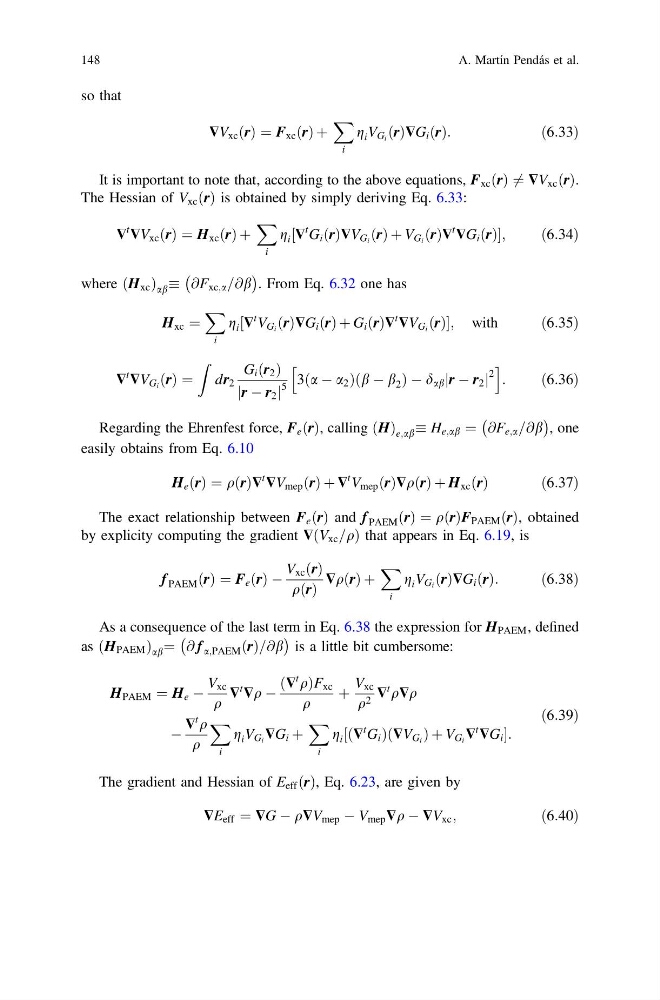
so that
$V xc r
ð Þ ¼ F xc r
ð Þ þ
X
i
g i V G i r
ð Þ$G i r
ð Þ:
ð6:33Þ
It is important to note that, according to the above equations, F xc r
ð Þ 6 ¼ $V xc r
ð Þ.
The Hessian of V xc r
ð Þ is obtained by simply deriving Eq. 6.33:
$
t
$V xc r
ð Þ ¼ H xc r
ð Þ þ
X
i
g i $
t G i r
ð Þ$V G i r
ð Þ þ V G i r
ð Þ$
t
$G i r
ð Þ
½
;
ð6:34Þ
where H xc
ð
Þ ab @F xc;a =@b
À
Á
. From Eq. 6.32 one has
H xc ¼
X
i
g i $
t V G i r
ð Þ$G i r
ð Þ þ G i r
ð Þ$
t
$V G i r
ð Þ
½
; with
ð6:35Þ
$
t
$V G i r
ð Þ ¼
Z
dr 2
G i r 2
ð Þ
jr À r 2 j
5
3 a À a 2
ð
Þ b À b 2
ð
ÞÀd ab jr À r 2 j
2
h
i
:
ð6:36Þ
Regarding the Ehrenfest force, F e r
ð Þ, calling H
ð Þ e;ab H e;ab ¼ @F e;a =@b
À
Á
, one
easily obtains from Eq. 6.10
H e r
ð Þ ¼ q r
ð Þ$
t
$V mep r
ð Þ þ $
t V mep r
ð Þ$q r
ð Þ þ H xc r
ð Þ
ð6:37Þ
The exact relationship between F e r
ð Þ and f PAEM r
ð Þ ¼ q r
ð ÞF PAEM r
ð Þ, obtained
by explicity computing the gradient $ V xc =q
ð
Þ that appears in Eq. 6.19, is
f PAEM r
ð Þ ¼ F e r
ð Þ À
V xc r
ð Þ
q r
ð Þ
$q r
ð Þ þ
X
i
g i V G i r
ð Þ$G i r
ð Þ:
ð6:38Þ
As a consequence of the last term in Eq. 6.38 the expression for H PAEM , defined
as H PAEM
ð
Þ ab ¼ @ f a;PAEM r
ð Þ=@b
À
Á
is a little bit cumbersome:
H PAEM ¼ H e À
V xc
q
$
t
$q À
$
t
q
ð ÞF xc
q
þ
V xc
q 2 $
t
q$q
À
$
t
q
q
X
i
g i V G i $G i þ
X
i
g i $
t G i
ð
Þ $V G i
ð
ÞþV G i $
t
$G i
½
:
ð6:39Þ
The gradient and Hessian of E eff r
ð Þ, Eq. 6.23, are given by
$E eff ¼ $G À q$V mep À V mep $q À $V xc ;
ð6:40Þ
148
A. Martín Pendás et al.
$V xc r
ð Þ ¼ F xc r
ð Þ þ
X
i
g i V G i r
ð Þ$G i r
ð Þ:
ð6:33Þ
It is important to note that, according to the above equations, F xc r
ð Þ 6 ¼ $V xc r
ð Þ.
The Hessian of V xc r
ð Þ is obtained by simply deriving Eq. 6.33:
$
t
$V xc r
ð Þ ¼ H xc r
ð Þ þ
X
i
g i $
t G i r
ð Þ$V G i r
ð Þ þ V G i r
ð Þ$
t
$G i r
ð Þ
½
;
ð6:34Þ
where H xc
ð
Þ ab @F xc;a =@b
À
Á
. From Eq. 6.32 one has
H xc ¼
X
i
g i $
t V G i r
ð Þ$G i r
ð Þ þ G i r
ð Þ$
t
$V G i r
ð Þ
½
; with
ð6:35Þ
$
t
$V G i r
ð Þ ¼
Z
dr 2
G i r 2
ð Þ
jr À r 2 j
5
3 a À a 2
ð
Þ b À b 2
ð
ÞÀd ab jr À r 2 j
2
h
i
:
ð6:36Þ
Regarding the Ehrenfest force, F e r
ð Þ, calling H
ð Þ e;ab H e;ab ¼ @F e;a =@b
À
Á
, one
easily obtains from Eq. 6.10
H e r
ð Þ ¼ q r
ð Þ$
t
$V mep r
ð Þ þ $
t V mep r
ð Þ$q r
ð Þ þ H xc r
ð Þ
ð6:37Þ
The exact relationship between F e r
ð Þ and f PAEM r
ð Þ ¼ q r
ð ÞF PAEM r
ð Þ, obtained
by explicity computing the gradient $ V xc =q
ð
Þ that appears in Eq. 6.19, is
f PAEM r
ð Þ ¼ F e r
ð Þ À
V xc r
ð Þ
q r
ð Þ
$q r
ð Þ þ
X
i
g i V G i r
ð Þ$G i r
ð Þ:
ð6:38Þ
As a consequence of the last term in Eq. 6.38 the expression for H PAEM , defined
as H PAEM
ð
Þ ab ¼ @ f a;PAEM r
ð Þ=@b
À
Á
is a little bit cumbersome:
H PAEM ¼ H e À
V xc
q
$
t
$q À
$
t
q
ð ÞF xc
q
þ
V xc
q 2 $
t
q$q
À
$
t
q
q
X
i
g i V G i $G i þ
X
i
g i $
t G i
ð
Þ $V G i
ð
ÞþV G i $
t
$G i
½
:
ð6:39Þ
The gradient and Hessian of E eff r
ð Þ, Eq. 6.23, are given by
$E eff ¼ $G À q$V mep À V mep $q À $V xc ;
ð6:40Þ
148
A. Martín Pendás et al.