

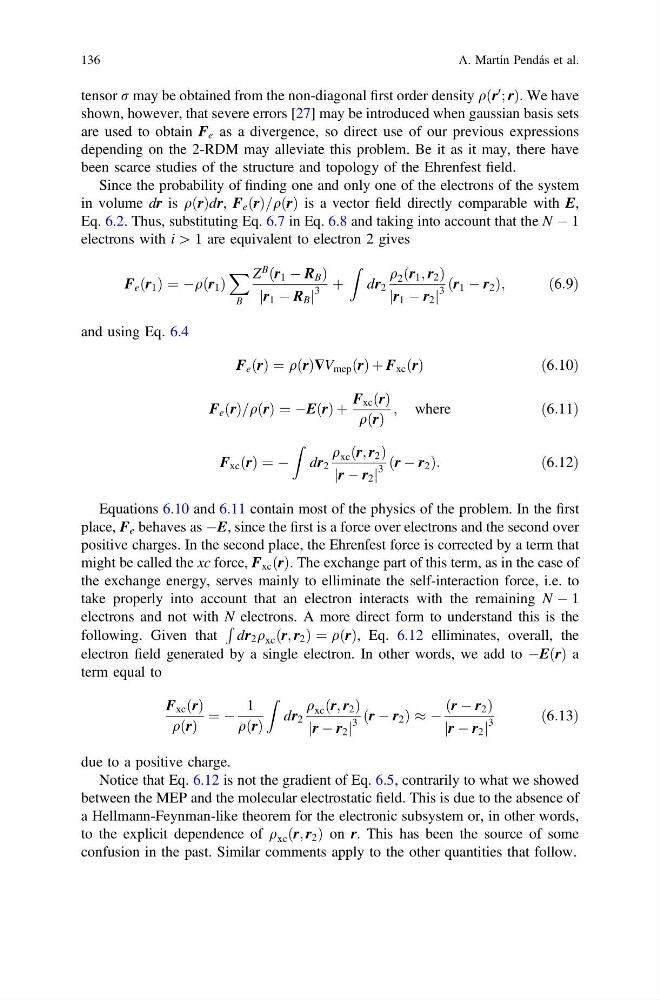
tensor r may be obtained from the non-diagonal first order density q r
0
; r
ð Þ. We have
shown, however, that severe errors [27] may be introduced when gaussian basis sets
are used to obtain F e as a divergence, so direct use of our previous expressions
depending on the 2-RDM may alleviate this problem. Be it as it may, there have
been scarce studies of the structure and topology of the Ehrenfest field.
Since the probability of finding one and only one of the electrons of the system
in volume dr is q r
ð Þdr, F e r
ð Þ=q r
ð Þ is a vector field directly comparable with E,
Eq. 6.2. Thus, substituting Eq. 6.7 in Eq. 6.8 and taking into account that the N À 1
electrons with i [ 1 are equivalent to electron 2 gives
F e r 1
ð Þ ¼ Àq r 1
ð Þ
X
B
Z
B r 1 À R B
ð
Þ
jr 1 À R B j
3
þ
Z
dr 2
q 2 r 1 ; r 2
ð
Þ
jr 1 À r 2 j
3
r 1 À r 2
ð
Þ;
ð6:9Þ
and using Eq. 6.4
F e r
ð Þ ¼ q r
ð Þ$V mep r
ð Þ þ F xc r
ð Þ
ð6:10Þ
F e r
ð Þ=q r
ð Þ ¼ ÀE r
ð Þ þ
F xc r
ð Þ
q r
ð Þ
; where
ð6:11Þ
F xc ðrÞ ¼ À
Z
dr 2
q xc r; r 2
ð
Þ
jr À r 2 j
3
r À r 2
ð
Þ:
ð6:12Þ
Equations 6.10 and 6.11 contain most of the physics of the problem. In the first
place, F e behaves as ÀE, since the first is a force over electrons and the second over
positive charges. In the second place, the Ehrenfest force is corrected by a term that
might be called the xc force, F xc r
ð Þ. The exchange part of this term, as in the case of
the exchange energy, serves mainly to elliminate the self-interaction force, i.e. to
take properly into account that an electron interacts with the remaining N À 1
electrons and not with N electrons. A more direct form to understand this is the
following. Given that
R
dr 2 q xc r; r 2
ð
Þ ¼ q r
ð Þ, Eq. 6.12 elliminates, overall, the
electron field generated by a single electron. In other words, we add to ÀE r
ð Þ a
term equal to
F xc r
ð Þ
q r
ð Þ
¼ À
1
q r
ð Þ
Z
dr 2
q xc r; r 2
ð
Þ
jr À r 2 j
3
r À r 2
ð
Þ%À
r À r 2
ð
Þ
jr À r 2 j
3
ð6:13Þ
due to a positive charge.
Notice that Eq. 6.12 is not the gradient of Eq. 6.5, contrarily to what we showed
between the MEP and the molecular electrostatic field. This is due to the absence of
a Hellmann-Feynman-like theorem for the electronic subsystem or, in other words,
to the explicit dependence of q xc r; r 2
ð
Þ on r. This has been the source of some
confusion in the past. Similar comments apply to the other quantities that follow.
136
A. Martín Pendás et al.
0
; r
ð Þ. We have
shown, however, that severe errors [27] may be introduced when gaussian basis sets
are used to obtain F e as a divergence, so direct use of our previous expressions
depending on the 2-RDM may alleviate this problem. Be it as it may, there have
been scarce studies of the structure and topology of the Ehrenfest field.
Since the probability of finding one and only one of the electrons of the system
in volume dr is q r
ð Þdr, F e r
ð Þ=q r
ð Þ is a vector field directly comparable with E,
Eq. 6.2. Thus, substituting Eq. 6.7 in Eq. 6.8 and taking into account that the N À 1
electrons with i [ 1 are equivalent to electron 2 gives
F e r 1
ð Þ ¼ Àq r 1
ð Þ
X
B
Z
B r 1 À R B
ð
Þ
jr 1 À R B j
3
þ
Z
dr 2
q 2 r 1 ; r 2
ð
Þ
jr 1 À r 2 j
3
r 1 À r 2
ð
Þ;
ð6:9Þ
and using Eq. 6.4
F e r
ð Þ ¼ q r
ð Þ$V mep r
ð Þ þ F xc r
ð Þ
ð6:10Þ
F e r
ð Þ=q r
ð Þ ¼ ÀE r
ð Þ þ
F xc r
ð Þ
q r
ð Þ
; where
ð6:11Þ
F xc ðrÞ ¼ À
Z
dr 2
q xc r; r 2
ð
Þ
jr À r 2 j
3
r À r 2
ð
Þ:
ð6:12Þ
Equations 6.10 and 6.11 contain most of the physics of the problem. In the first
place, F e behaves as ÀE, since the first is a force over electrons and the second over
positive charges. In the second place, the Ehrenfest force is corrected by a term that
might be called the xc force, F xc r
ð Þ. The exchange part of this term, as in the case of
the exchange energy, serves mainly to elliminate the self-interaction force, i.e. to
take properly into account that an electron interacts with the remaining N À 1
electrons and not with N electrons. A more direct form to understand this is the
following. Given that
R
dr 2 q xc r; r 2
ð
Þ ¼ q r
ð Þ, Eq. 6.12 elliminates, overall, the
electron field generated by a single electron. In other words, we add to ÀE r
ð Þ a
term equal to
F xc r
ð Þ
q r
ð Þ
¼ À
1
q r
ð Þ
Z
dr 2
q xc r; r 2
ð
Þ
jr À r 2 j
3
r À r 2
ð
Þ%À
r À r 2
ð
Þ
jr À r 2 j
3
ð6:13Þ
due to a positive charge.
Notice that Eq. 6.12 is not the gradient of Eq. 6.5, contrarily to what we showed
between the MEP and the molecular electrostatic field. This is due to the absence of
a Hellmann-Feynman-like theorem for the electronic subsystem or, in other words,
to the explicit dependence of q xc r; r 2
ð
Þ on r. This has been the source of some
confusion in the past. Similar comments apply to the other quantities that follow.
136
A. Martín Pendás et al.