

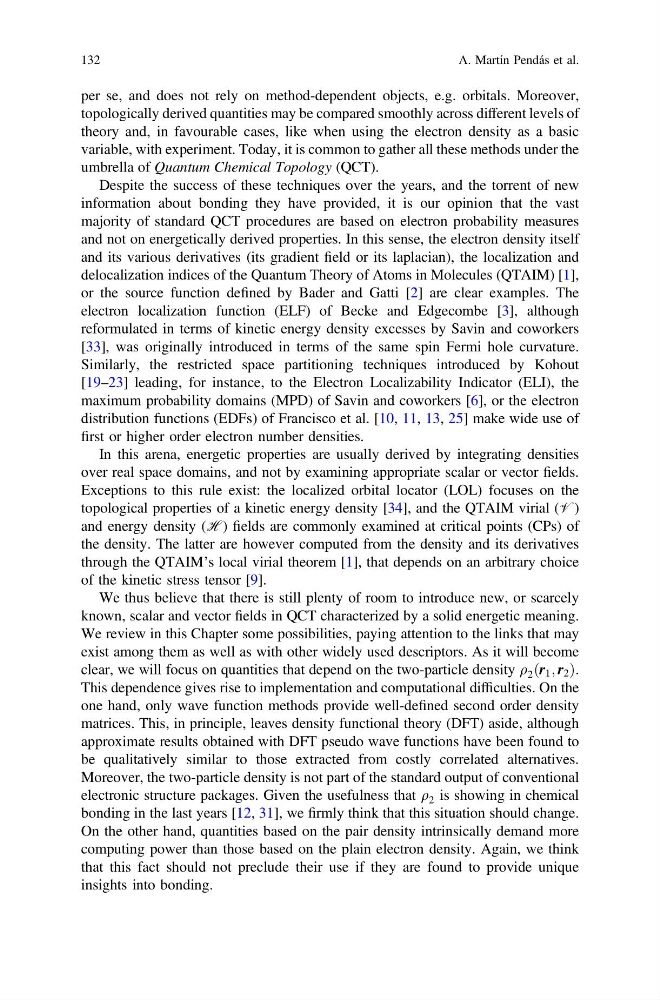
per se, and does not rely on method-dependent objects, e.g. orbitals. Moreover,
topologically derived quantities may be compared smoothly across different levels of
theory and, in favourable cases, like when using the electron density as a basic
variable, with experiment. Today, it is common to gather all these methods under the
umbrella of Quantum Chemical Topology (QCT).
Despite the success of these techniques over the years, and the torrent of new
information about bonding they have provided, it is our opinion that the vast
majority of standard QCT procedures are based on electron probability measures
and not on energetically derived properties. In this sense, the electron density itself
and its various derivatives (its gradient field or its laplacian), the localization and
delocalization indices of the Quantum Theory of Atoms in Molecules (QTAIM) [1],
or the source function defined by Bader and Gatti [2] are clear examples. The
electron localization function (ELF) of Becke and Edgecombe [3], although
reformulated in terms of kinetic energy density excesses by Savin and coworkers
[33], was originally introduced in terms of the same spin Fermi hole curvature.
Similarly, the restricted space partitioning techniques introduced by Kohout
[19–23] leading, for instance, to the Electron Localizability Indicator (ELI), the
maximum probability domains (MPD) of Savin and coworkers [6], or the electron
distribution functions (EDFs) of Francisco et al. [10, 11, 13, 25] make wide use of
first or higher order electron number densities.
In this arena, energetic properties are usually derived by integrating densities
over real space domains, and not by examining appropriate scalar or vector fields.
Exceptions to this rule exist: the localized orbital locator (LOL) focuses on the
topological properties of a kinetic energy density [34], and the QTAIM virial (V)
and energy density (H) fields are commonly examined at critical points (CPs) of
the density. The latter are however computed from the density and its derivatives
through the QTAIM’s local virial theorem [1], that depends on an arbitrary choice
of the kinetic stress tensor [9].
We thus believe that there is still plenty of room to introduce new, or scarcely
known, scalar and vector fields in QCT characterized by a solid energetic meaning.
We review in this Chapter some possibilities, paying attention to the links that may
exist among them as well as with other widely used descriptors. As it will become
clear, we will focus on quantities that depend on the two-particle density q 2 r 1 ; r 2
ð
Þ.
This dependence gives rise to implementation and computational difficulties. On the
one hand, only wave function methods provide well-defined second order density
matrices. This, in principle, leaves density functional theory (DFT) aside, although
approximate results obtained with DFT pseudo wave functions have been found to
be qualitatively similar to those extracted from costly correlated alternatives.
Moreover, the two-particle density is not part of the standard output of conventional
electronic structure packages. Given the usefulness that q 2 is showing in chemical
bonding in the last years [12, 31], we firmly think that this situation should change.
On the other hand, quantities based on the pair density intrinsically demand more
computing power than those based on the plain electron density. Again, we think
that this fact should not preclude their use if they are found to provide unique
insights into bonding.
132
A. Martín Pendás et al.
topologically derived quantities may be compared smoothly across different levels of
theory and, in favourable cases, like when using the electron density as a basic
variable, with experiment. Today, it is common to gather all these methods under the
umbrella of Quantum Chemical Topology (QCT).
Despite the success of these techniques over the years, and the torrent of new
information about bonding they have provided, it is our opinion that the vast
majority of standard QCT procedures are based on electron probability measures
and not on energetically derived properties. In this sense, the electron density itself
and its various derivatives (its gradient field or its laplacian), the localization and
delocalization indices of the Quantum Theory of Atoms in Molecules (QTAIM) [1],
or the source function defined by Bader and Gatti [2] are clear examples. The
electron localization function (ELF) of Becke and Edgecombe [3], although
reformulated in terms of kinetic energy density excesses by Savin and coworkers
[33], was originally introduced in terms of the same spin Fermi hole curvature.
Similarly, the restricted space partitioning techniques introduced by Kohout
[19–23] leading, for instance, to the Electron Localizability Indicator (ELI), the
maximum probability domains (MPD) of Savin and coworkers [6], or the electron
distribution functions (EDFs) of Francisco et al. [10, 11, 13, 25] make wide use of
first or higher order electron number densities.
In this arena, energetic properties are usually derived by integrating densities
over real space domains, and not by examining appropriate scalar or vector fields.
Exceptions to this rule exist: the localized orbital locator (LOL) focuses on the
topological properties of a kinetic energy density [34], and the QTAIM virial (V)
and energy density (H) fields are commonly examined at critical points (CPs) of
the density. The latter are however computed from the density and its derivatives
through the QTAIM’s local virial theorem [1], that depends on an arbitrary choice
of the kinetic stress tensor [9].
We thus believe that there is still plenty of room to introduce new, or scarcely
known, scalar and vector fields in QCT characterized by a solid energetic meaning.
We review in this Chapter some possibilities, paying attention to the links that may
exist among them as well as with other widely used descriptors. As it will become
clear, we will focus on quantities that depend on the two-particle density q 2 r 1 ; r 2
ð
Þ.
This dependence gives rise to implementation and computational difficulties. On the
one hand, only wave function methods provide well-defined second order density
matrices. This, in principle, leaves density functional theory (DFT) aside, although
approximate results obtained with DFT pseudo wave functions have been found to
be qualitatively similar to those extracted from costly correlated alternatives.
Moreover, the two-particle density is not part of the standard output of conventional
electronic structure packages. Given the usefulness that q 2 is showing in chemical
bonding in the last years [12, 31], we firmly think that this situation should change.
On the other hand, quantities based on the pair density intrinsically demand more
computing power than those based on the plain electron density. Again, we think
that this fact should not preclude their use if they are found to provide unique
insights into bonding.
132
A. Martín Pendás et al.