

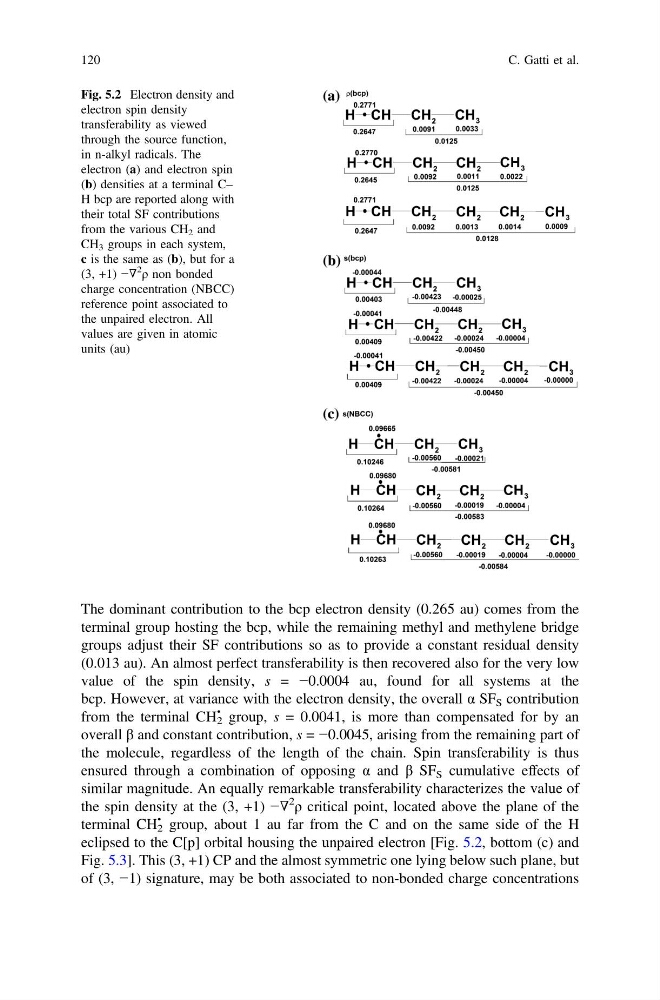
The dominant contribution to the bcp electron density (0.265 au) comes from the
terminal group hosting the bcp, while the remaining methyl and methylene bridge
groups adjust their SF contributions so as to provide a constant residual density
(0.013 au). An almost perfect transferability is then recovered also for the very low
value of the spin density, s = −0.0004 au, found for all systems at the
bcp. However, at variance with the electron density, the overall α SF S contribution
from the terminal CH 2
• group, s = 0.0041, is more than compensated for by an
overall β and constant contribution, s = −0.0045, arising from the remaining part of
the molecule, regardless of the length of the chain. Spin transferability is thus
ensured through a combination of opposing α and β SF S cumulative effects of
similar magnitude. An equally remarkable transferability characterizes the value of
the spin density at the (3, +1) −∇
2
ρ critical point, located above the plane of the
terminal CH 2
• group, about 1 au far from the C and on the same side of the H
eclipsed to the C[p] orbital housing the unpaired electron [Fig. 5.2, bottom (c) and
Fig. 5.3]. This (3, +1) CP and the almost symmetric one lying below such plane, but
of (3, −1) signature, may be both associated to non-bonded charge concentrations
Fig. 5.2 Electron density and
electron spin density
transferability as viewed
through the source function,
in n-alkyl radicals. The
electron (a) and electron spin
(b) densities at a terminal C–
H bcp are reported along with
their total SF contributions
from the various CH 2 and
CH 3 groups in each system,
c is the same as (b), but for a
(3, +1) −∇
2
ρ non bonded
charge concentration (NBCC)
reference point associated to
the unpaired electron. All
values are given in atomic
units (au)
120
C. Gatti et al.
terminal group hosting the bcp, while the remaining methyl and methylene bridge
groups adjust their SF contributions so as to provide a constant residual density
(0.013 au). An almost perfect transferability is then recovered also for the very low
value of the spin density, s = −0.0004 au, found for all systems at the
bcp. However, at variance with the electron density, the overall α SF S contribution
from the terminal CH 2
• group, s = 0.0041, is more than compensated for by an
overall β and constant contribution, s = −0.0045, arising from the remaining part of
the molecule, regardless of the length of the chain. Spin transferability is thus
ensured through a combination of opposing α and β SF S cumulative effects of
similar magnitude. An equally remarkable transferability characterizes the value of
the spin density at the (3, +1) −∇
2
ρ critical point, located above the plane of the
terminal CH 2
• group, about 1 au far from the C and on the same side of the H
eclipsed to the C[p] orbital housing the unpaired electron [Fig. 5.2, bottom (c) and
Fig. 5.3]. This (3, +1) CP and the almost symmetric one lying below such plane, but
of (3, −1) signature, may be both associated to non-bonded charge concentrations
Fig. 5.2 Electron density and
electron spin density
transferability as viewed
through the source function,
in n-alkyl radicals. The
electron (a) and electron spin
(b) densities at a terminal C–
H bcp are reported along with
their total SF contributions
from the various CH 2 and
CH 3 groups in each system,
c is the same as (b), but for a
(3, +1) −∇
2
ρ non bonded
charge concentration (NBCC)
reference point associated to
the unpaired electron. All
values are given in atomic
units (au)
120
C. Gatti et al.