

largely used, but also seriously criticised (for a comprehensive and critical review
on aromatic indices, the reader is referred to Ref. [34]). Such a plethora of
descriptors often disagree even in ranking classical aromatic compounds on an
absolute (overall and local) aromaticity scale, sometimes raising even more confusion. According to Bultinck [34] this divergence is not a consequence of a real
multidimensional character of aromaticity [35], but it is rather due to “confusion
and vagueness of the term (local) aromaticity”.
Recently we showed that the SF descriptor is able to reveal, order and quantify
π-electron delocalization effects, despite being defined in terms of the ED and its
Laplacian, that is of quantities depending only from the diagonal elements of the
first order density matrix. Our analysis [15] was applied to simple benchmark
organic systems, such as benzene, biphenyl and polycyclic aromatic hydrocarbons
(PAH). The onset of electron delocalization was found to be mirrored into an
enhanced capability of determining the density distribution along a given bond by
the distant, though through-bonds connected, atomic regions. The SF allows to
translate such alteration of sources into an easy-to-catch pictorial representation,
consisting of enhanced and reduced atomic SF contributions to the bcp density
from, respectively, distant and nearby atoms, and relative to cases where electron
delocalization does not realize. Such effects can then be magnified by choosing
suitable rp’s lying above (or below) the plane of the carbon-membered rings, so as
to sample regions where the π-type molecular orbitals can enter directly, and not
just indirectly, into the play [2, 15, 20]. Magnification of effects due to electron
correlation does not imply, as a prerequisite, a perfect σ/π Molecular Orbital separation. Indeed, the SF analysis is currently performed on the full ED and an
analogous outcome would be obtained in terms of an ED sharing the same local
density values, but given numerically on a grid, rather than analytically, from
separate MO contributions.
Eventually, we proposed an our own index based on the SF descriptor (SFLAI,
Source Function Local Aromaticity Index) for quantifying the degree of aromaticity
of 6-membered rings (6MRs) in polycyclic systems. Analogously to the SF analysis
of electron delocalization, such an index might prove to be particularly useful for
application to experimentally-derived ED’s, as, at variance with other commonly
employed quantum-mechanical (local) aromaticity descriptors, it does not require
the knowledge of the pair density.
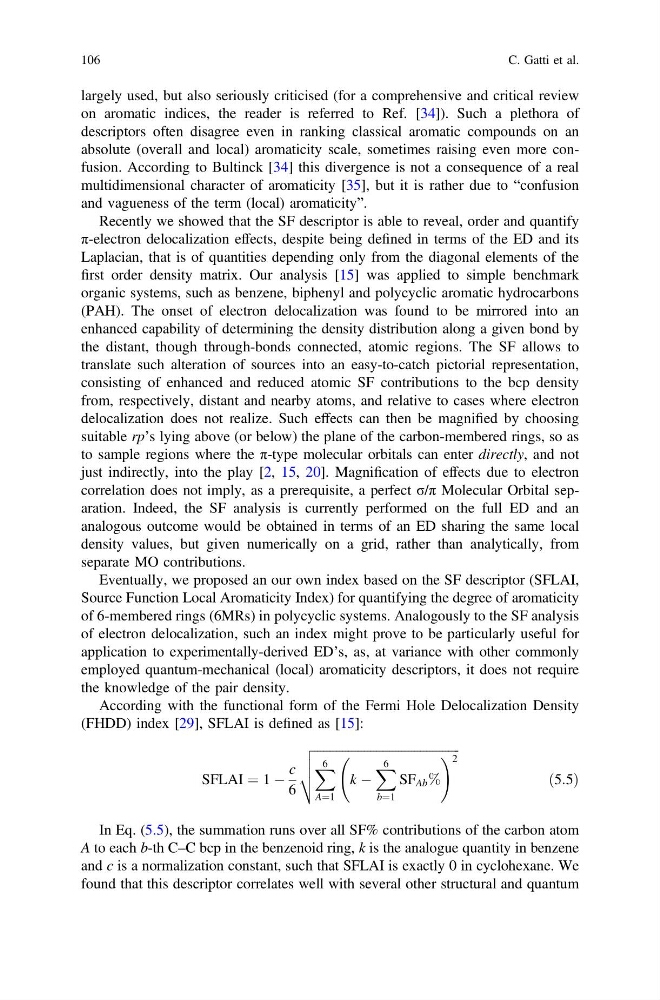
According with the functional form of the Fermi Hole Delocalization Density
(FHDD) index [29], SFLAI is defined as [15]:
SFLAI ¼ 1 À
c
6
ffiffiffiffiffiffiffiffiffiffiffiffiffiffiffiffiffiffiffiffiffiffiffiffiffiffiffiffiffiffiffiffiffiffiffiffiffiffiffiffiffiffiffiffiffiffi ffi
X 6
A¼1
k À
X 6
b¼1
SF Ab %
! 2
v
u
u
t
ð5:5Þ
In Eq. (5.5), the summation runs over all SF% contributions of the carbon atom
A to each b-th C–C bcp in the benzenoid ring, k is the analogue quantity in benzene
and c is a normalization constant, such that SFLAI is exactly 0 in cyclohexane. We
found that this descriptor correlates well with several other structural and quantum
106
C. Gatti et al.
on aromatic indices, the reader is referred to Ref. [34]). Such a plethora of
descriptors often disagree even in ranking classical aromatic compounds on an
absolute (overall and local) aromaticity scale, sometimes raising even more confusion. According to Bultinck [34] this divergence is not a consequence of a real
multidimensional character of aromaticity [35], but it is rather due to “confusion
and vagueness of the term (local) aromaticity”.
Recently we showed that the SF descriptor is able to reveal, order and quantify
π-electron delocalization effects, despite being defined in terms of the ED and its
Laplacian, that is of quantities depending only from the diagonal elements of the
first order density matrix. Our analysis [15] was applied to simple benchmark
organic systems, such as benzene, biphenyl and polycyclic aromatic hydrocarbons
(PAH). The onset of electron delocalization was found to be mirrored into an
enhanced capability of determining the density distribution along a given bond by
the distant, though through-bonds connected, atomic regions. The SF allows to
translate such alteration of sources into an easy-to-catch pictorial representation,
consisting of enhanced and reduced atomic SF contributions to the bcp density
from, respectively, distant and nearby atoms, and relative to cases where electron
delocalization does not realize. Such effects can then be magnified by choosing
suitable rp’s lying above (or below) the plane of the carbon-membered rings, so as
to sample regions where the π-type molecular orbitals can enter directly, and not
just indirectly, into the play [2, 15, 20]. Magnification of effects due to electron
correlation does not imply, as a prerequisite, a perfect σ/π Molecular Orbital separation. Indeed, the SF analysis is currently performed on the full ED and an
analogous outcome would be obtained in terms of an ED sharing the same local
density values, but given numerically on a grid, rather than analytically, from
separate MO contributions.
Eventually, we proposed an our own index based on the SF descriptor (SFLAI,
Source Function Local Aromaticity Index) for quantifying the degree of aromaticity
of 6-membered rings (6MRs) in polycyclic systems. Analogously to the SF analysis
of electron delocalization, such an index might prove to be particularly useful for
application to experimentally-derived ED’s, as, at variance with other commonly
employed quantum-mechanical (local) aromaticity descriptors, it does not require
the knowledge of the pair density.
According with the functional form of the Fermi Hole Delocalization Density
(FHDD) index [29], SFLAI is defined as [15]:
SFLAI ¼ 1 À
c
6
ffiffiffiffiffiffiffiffiffiffiffiffiffiffiffiffiffiffiffiffiffiffiffiffiffiffiffiffiffiffiffiffiffiffiffiffiffiffiffiffiffiffiffiffiffiffi ffi
X 6
A¼1
k À
X 6
b¼1
SF Ab %
! 2
v
u
u
t
ð5:5Þ
In Eq. (5.5), the summation runs over all SF% contributions of the carbon atom
A to each b-th C–C bcp in the benzenoid ring, k is the analogue quantity in benzene
and c is a normalization constant, such that SFLAI is exactly 0 in cyclohexane. We
found that this descriptor correlates well with several other structural and quantum
106
C. Gatti et al.