

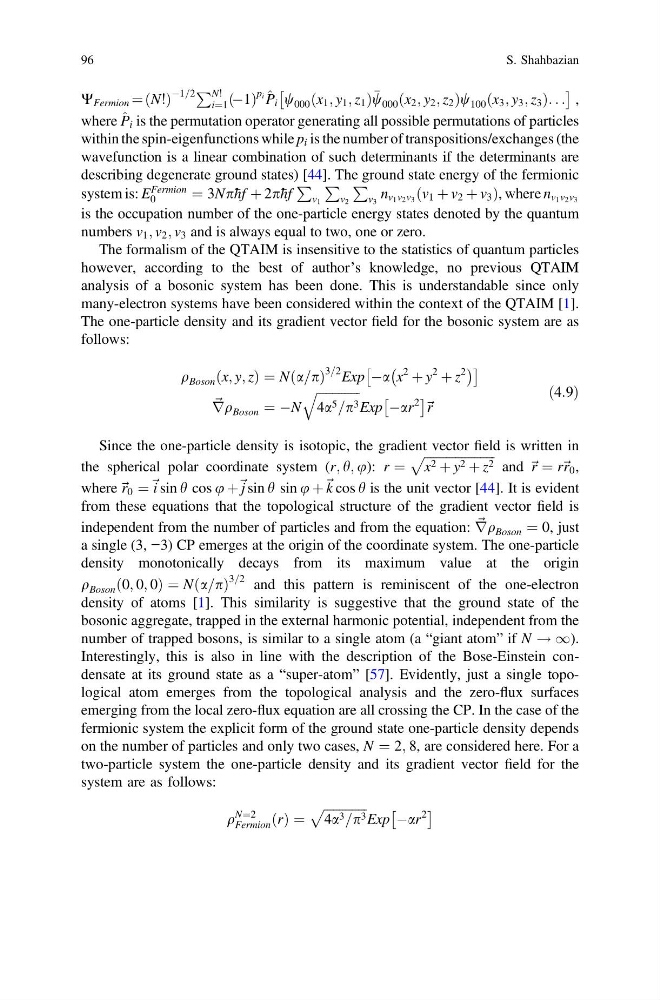
W Fermion ¼ N!
ð Þ
À1=2 P N!
i¼1 À1
ð Þ
p i ^
P i w 000 x 1 ; y 1 ; z 1
ð
Þ
w 000 x 2 ; y 2 ; z 2
ð
Þ w 100 x 3 ; y 3 ; z 3
ð
Þ . . .
Â
Ã
,
where ^
P i is the permutation operator generating all possible permutations of particles
within the spin-eigenfunctions while p i is the number of transpositions/exchanges (the
wavefunction is a linear combination of such determinants if the determinants are
describing degenerate ground states) [44]. The ground state energy of the fermionic
system is: E
Fermion
0
¼ 3Np hf þ 2p hf
P
v 1
P
v 2
P
v 3
n v 1 v 2 v 3 v 1 þ v 2 þ v 3
ð
Þ , where n v 1 v 2 v 3
is the occupation number of the one-particle energy states denoted by the quantum
numbers v 1 ; v 2 ; v 3 and is always equal to two, one or zero.
The formalism of the QTAIM is insensitive to the statistics of quantum particles
however, according to the best of author’s knowledge, no previous QTAIM
analysis of a bosonic system has been done. This is understandable since only
many-electron systems have been considered within the context of the QTAIM [1].
The one-particle density and its gradient vector field for the bosonic system are as
follows:
q Boson x; y; z
ð
Þ¼N a=p
ð
Þ
3=2 Exp Àa x
2
þ y
2
þ z
2
À
Á
Â
Ã
~
rq Boson ¼ ÀN
ffiffiffiffiffiffiffiffiffiffiffiffiffiffi
4a 5 =p 3
q
Exp Àar
2
Â
Ã
~ r
ð4:9Þ
Since the one-particle density is isotopic, the gradient vector field is written in
the spherical polar coordinate system (r; h; u): r ¼
ffiffiffiffiffiffiffiffiffiffiffiffiffiffiffiffiffiffiffiffiffiffi ffi
x 2 þ y 2 þ z 2
p
and ~ r ¼ r~ r 0 ,
where ~ r 0 ¼ ~ i sin h cos u þ ~ j sin h sin u þ ~ k cos h is the unit vector [44]. It is evident
from these equations that the topological structure of the gradient vector field is
independent from the number of particles and from the equation: ~
rq Boson ¼ 0, just
a single (3, −3) CP emerges at the origin of the coordinate system. The one-particle
density monotonically decays from its maximum value at the origin
q Boson 0; 0; 0
ð
Þ¼N a=p
ð
Þ
3=2 and this pattern is reminiscent of the one-electron
density of atoms [1]. This similarity is suggestive that the ground state of the
bosonic aggregate, trapped in the external harmonic potential, independent from the
number of trapped bosons, is similar to a single atom (a “giant atom” if N ! 1).
Interestingly, this is also in line with the description of the Bose-Einstein condensate at its ground state as a “super-atom” [57]. Evidently, just a single topological atom emerges from the topological analysis and the zero-flux surfaces
emerging from the local zero-flux equation are all crossing the CP. In the case of the
fermionic system the explicit form of the ground state one-particle density depends
on the number of particles and only two cases, N ¼ 2; 8, are considered here. For a
two-particle system the one-particle density and its gradient vector field for the
system are as follows:
q
N¼2
Fermion r
ð Þ ¼
ffiffiffiffiffiffiffiffiffiffiffiffiffiffi
4a 3 =p 3
p
Exp Àar
2
Â
Ã
96
S. Shahbazian
ð Þ
À1=2 P N!
i¼1 À1
ð Þ
p i ^
P i w 000 x 1 ; y 1 ; z 1
ð
Þ
w 000 x 2 ; y 2 ; z 2
ð
Þ w 100 x 3 ; y 3 ; z 3
ð
Þ . . .
Â
Ã
,
where ^
P i is the permutation operator generating all possible permutations of particles
within the spin-eigenfunctions while p i is the number of transpositions/exchanges (the
wavefunction is a linear combination of such determinants if the determinants are
describing degenerate ground states) [44]. The ground state energy of the fermionic
system is: E
Fermion
0
¼ 3Np hf þ 2p hf
P
v 1
P
v 2
P
v 3
n v 1 v 2 v 3 v 1 þ v 2 þ v 3
ð
Þ , where n v 1 v 2 v 3
is the occupation number of the one-particle energy states denoted by the quantum
numbers v 1 ; v 2 ; v 3 and is always equal to two, one or zero.
The formalism of the QTAIM is insensitive to the statistics of quantum particles
however, according to the best of author’s knowledge, no previous QTAIM
analysis of a bosonic system has been done. This is understandable since only
many-electron systems have been considered within the context of the QTAIM [1].
The one-particle density and its gradient vector field for the bosonic system are as
follows:
q Boson x; y; z
ð
Þ¼N a=p
ð
Þ
3=2 Exp Àa x
2
þ y
2
þ z
2
À
Á
Â
Ã
~
rq Boson ¼ ÀN
ffiffiffiffiffiffiffiffiffiffiffiffiffiffi
4a 5 =p 3
q
Exp Àar
2
Â
Ã
~ r
ð4:9Þ
Since the one-particle density is isotopic, the gradient vector field is written in
the spherical polar coordinate system (r; h; u): r ¼
ffiffiffiffiffiffiffiffiffiffiffiffiffiffiffiffiffiffiffiffiffiffi ffi
x 2 þ y 2 þ z 2
p
and ~ r ¼ r~ r 0 ,
where ~ r 0 ¼ ~ i sin h cos u þ ~ j sin h sin u þ ~ k cos h is the unit vector [44]. It is evident
from these equations that the topological structure of the gradient vector field is
independent from the number of particles and from the equation: ~
rq Boson ¼ 0, just
a single (3, −3) CP emerges at the origin of the coordinate system. The one-particle
density monotonically decays from its maximum value at the origin
q Boson 0; 0; 0
ð
Þ¼N a=p
ð
Þ
3=2 and this pattern is reminiscent of the one-electron
density of atoms [1]. This similarity is suggestive that the ground state of the
bosonic aggregate, trapped in the external harmonic potential, independent from the
number of trapped bosons, is similar to a single atom (a “giant atom” if N ! 1).
Interestingly, this is also in line with the description of the Bose-Einstein condensate at its ground state as a “super-atom” [57]. Evidently, just a single topological atom emerges from the topological analysis and the zero-flux surfaces
emerging from the local zero-flux equation are all crossing the CP. In the case of the
fermionic system the explicit form of the ground state one-particle density depends
on the number of particles and only two cases, N ¼ 2; 8, are considered here. For a
two-particle system the one-particle density and its gradient vector field for the
system are as follows:
q
N¼2
Fermion r
ð Þ ¼
ffiffiffiffiffiffiffiffiffiffiffiffiffiffi
4a 3 =p 3
p
Exp Àar
2
Â
Ã
96
S. Shahbazian