

ð1Þ
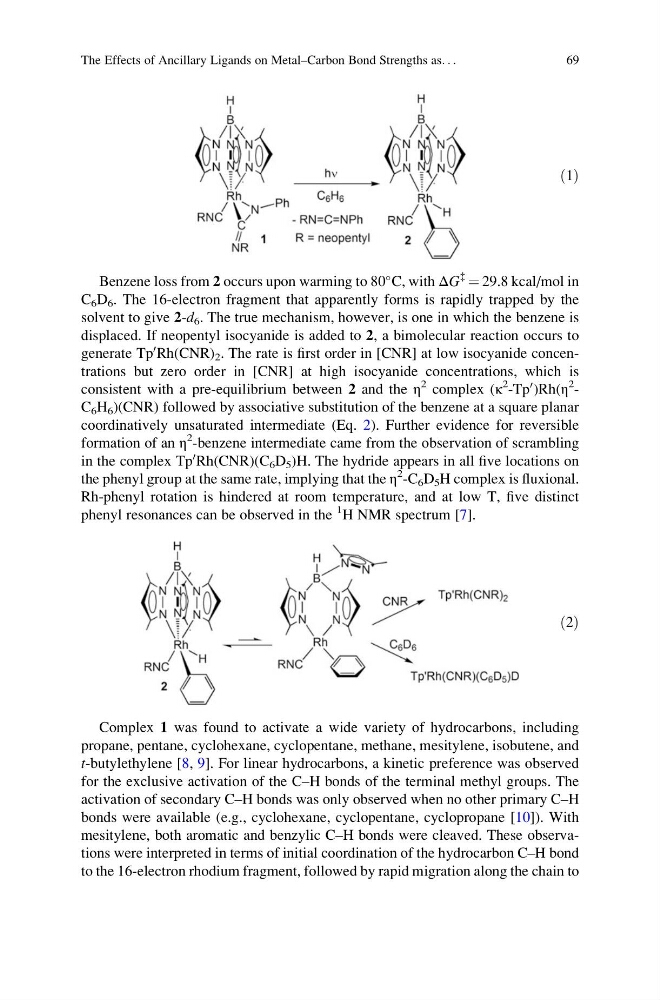
Benzene loss from 2 occurs upon warming to 80
C, with ΔG
{
¼ 29.8 kcal/mol in
C 6 D 6 . The 16-electron fragment that apparently forms is rapidly trapped by the
solvent to give 2-d 6 . The true mechanism, however, is one in which the benzene is
displaced. If neopentyl isocyanide is added to 2, a bimolecular reaction occurs to
generate Tp
0 Rh(CNR) 2 . The rate is first order in [CNR] at low isocyanide concentrations but zero order in [CNR] at high isocyanide concentrations, which is
consistent with a pre-equilibrium between 2 and the η
2 complex (κ
2 -Tp
0 )Rh(η
2 -
C 6 H 6 )(CNR) followed by associative substitution of the benzene at a square planar
coordinatively unsaturated intermediate (Eq. 2). Further evidence for reversible
formation of an η
2 -benzene intermediate came from the observation of scrambling
in the complex Tp
0 Rh(CNR)(C 6 D 5 )H. The hydride appears in all five locations on
the phenyl group at the same rate, implying that the η
2
-C 6 D 5 H complex is fluxional.
Rh-phenyl rotation is hindered at room temperature, and at low T, five distinct
phenyl resonances can be observed in the
1 H NMR spectrum [7].
ð2Þ
Complex 1 was found to activate a wide variety of hydrocarbons, including
propane, pentane, cyclohexane, cyclopentane, methane, mesitylene, isobutene, and
t-butylethylene [8, 9]. For linear hydrocarbons, a kinetic preference was observed
for the exclusive activation of the C–H bonds of the terminal methyl groups. The
activation of secondary C–H bonds was only observed when no other primary C–H
bonds were available (e.g., cyclohexane, cyclopentane, cyclopropane [10]). With
mesitylene, both aromatic and benzylic C–H bonds were cleaved. These observations were interpreted in terms of initial coordination of the hydrocarbon C–H bond
to the 16-electron rhodium fragment, followed by rapid migration along the chain to
The Effects of Ancillary Ligands on Metal–Carbon Bond Strengths as. . .
69
Benzene loss from 2 occurs upon warming to 80
C, with ΔG
{
¼ 29.8 kcal/mol in
C 6 D 6 . The 16-electron fragment that apparently forms is rapidly trapped by the
solvent to give 2-d 6 . The true mechanism, however, is one in which the benzene is
displaced. If neopentyl isocyanide is added to 2, a bimolecular reaction occurs to
generate Tp
0 Rh(CNR) 2 . The rate is first order in [CNR] at low isocyanide concentrations but zero order in [CNR] at high isocyanide concentrations, which is
consistent with a pre-equilibrium between 2 and the η
2 complex (κ
2 -Tp
0 )Rh(η
2 -
C 6 H 6 )(CNR) followed by associative substitution of the benzene at a square planar
coordinatively unsaturated intermediate (Eq. 2). Further evidence for reversible
formation of an η
2 -benzene intermediate came from the observation of scrambling
in the complex Tp
0 Rh(CNR)(C 6 D 5 )H. The hydride appears in all five locations on
the phenyl group at the same rate, implying that the η
2
-C 6 D 5 H complex is fluxional.
Rh-phenyl rotation is hindered at room temperature, and at low T, five distinct
phenyl resonances can be observed in the
1 H NMR spectrum [7].
ð2Þ
Complex 1 was found to activate a wide variety of hydrocarbons, including
propane, pentane, cyclohexane, cyclopentane, methane, mesitylene, isobutene, and
t-butylethylene [8, 9]. For linear hydrocarbons, a kinetic preference was observed
for the exclusive activation of the C–H bonds of the terminal methyl groups. The
activation of secondary C–H bonds was only observed when no other primary C–H
bonds were available (e.g., cyclohexane, cyclopentane, cyclopropane [10]). With
mesitylene, both aromatic and benzylic C–H bonds were cleaved. These observations were interpreted in terms of initial coordination of the hydrocarbon C–H bond
to the 16-electron rhodium fragment, followed by rapid migration along the chain to
The Effects of Ancillary Ligands on Metal–Carbon Bond Strengths as. . .
69