

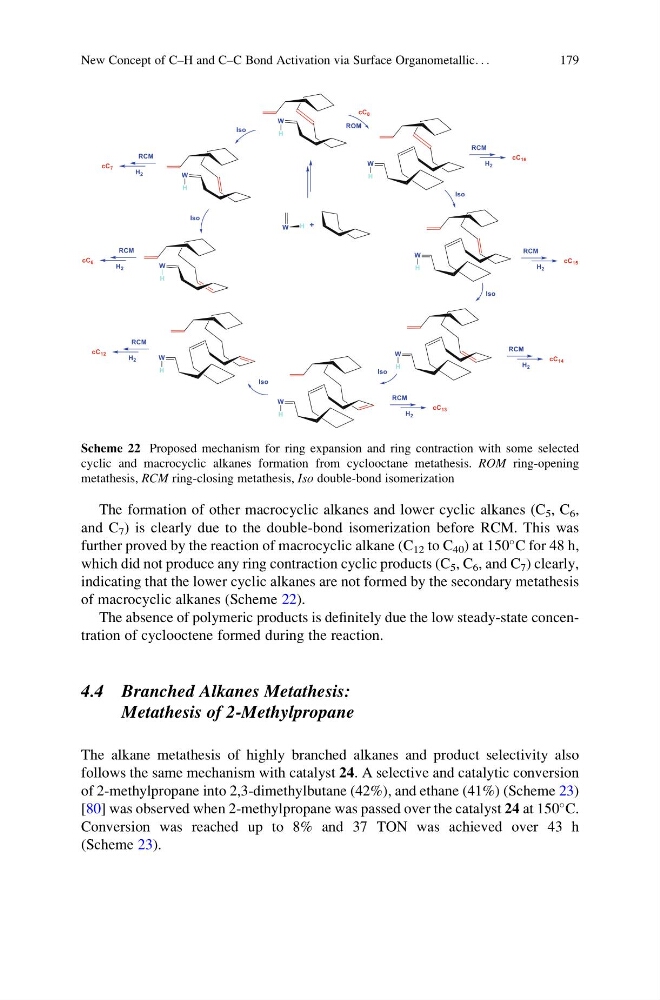
The formation of other macrocyclic alkanes and lower cyclic alkanes (C 5 , C 6 ,
and C 7 ) is clearly due to the double-bond isomerization before RCM. This was
further proved by the reaction of macrocyclic alkane (C 12 to C 40 ) at 150
C for 48 h,
which did not produce any ring contraction cyclic products (C 5 , C 6 , and C 7 ) clearly,
indicating that the lower cyclic alkanes are not formed by the secondary metathesis
of macrocyclic alkanes (Scheme 22).
The absence of polymeric products is definitely due the low steady-state concentration of cyclooctene formed during the reaction.
4.4 Branched Alkanes Metathesis:
Metathesis of 2-Methylpropane
The alkane metathesis of highly branched alkanes and product selectivity also
follows the same mechanism with catalyst 24. A selective and catalytic conversion
of 2-methylpropane into 2,3-dimethylbutane (42%), and ethane (41%) (Scheme 23)
[80] was observed when 2-methylpropane was passed over the catalyst 24 at 150
C.
Conversion was reached up to 8% and 37 TON was achieved over 43 h
(Scheme 23).
Scheme 22 Proposed mechanism for ring expansion and ring contraction with some selected
cyclic and macrocyclic alkanes formation from cyclooctane metathesis. ROM ring-opening
metathesis, RCM ring-closing metathesis, Iso double-bond isomerization
New Concept of C–H and C–C Bond Activation via Surface Organometallic. . .
179
and C 7 ) is clearly due to the double-bond isomerization before RCM. This was
further proved by the reaction of macrocyclic alkane (C 12 to C 40 ) at 150
C for 48 h,
which did not produce any ring contraction cyclic products (C 5 , C 6 , and C 7 ) clearly,
indicating that the lower cyclic alkanes are not formed by the secondary metathesis
of macrocyclic alkanes (Scheme 22).
The absence of polymeric products is definitely due the low steady-state concentration of cyclooctene formed during the reaction.
4.4 Branched Alkanes Metathesis:
Metathesis of 2-Methylpropane
The alkane metathesis of highly branched alkanes and product selectivity also
follows the same mechanism with catalyst 24. A selective and catalytic conversion
of 2-methylpropane into 2,3-dimethylbutane (42%), and ethane (41%) (Scheme 23)
[80] was observed when 2-methylpropane was passed over the catalyst 24 at 150
C.
Conversion was reached up to 8% and 37 TON was achieved over 43 h
(Scheme 23).
Scheme 22 Proposed mechanism for ring expansion and ring contraction with some selected
cyclic and macrocyclic alkanes formation from cyclooctane metathesis. ROM ring-opening
metathesis, RCM ring-closing metathesis, Iso double-bond isomerization
New Concept of C–H and C–C Bond Activation via Surface Organometallic. . .
179