

ligand. Surface can play the role of acid–base ligand as well as redox site. Besides
this, steric constraints in a porous surface also play an important role in catalysis.
Surface organometallic fragments can also be considered as reaction intermediates in heterogeneous catalysis. Thus, the study of their stoichiometric reactivity allows identification of the elementary steps in a precise way. Thus, as short
statement, SOMC is making a strong creative bridge between homogeneous and
classical heterogeneous catalysis.
2.1 Various Oxide Supports and Their Functionalities Used
in SOMC
To graft organometallic complexes in SOMC, various inorganic materials have
been used as a support such as silica, silica–alumina, alumina, magnesia, MCM
41, SBA-15, amino-modified SBA-15, etc. Depending on the nature of the reactive
sites on the surface of these materials, different behaviors were observed, leading to
sometimes completely different catalytic activity. Before considering the reactivity
of metal alkyls with, for example, silica surface, we have to understand the
functional groups present on such surface. First, we will consider flame silica
Aerosil
® from Degussa partially dehydroxylated at various temperatures. This
solid has a surface area of ca. %200 m
2 g
À1 which contains isolated, vicinal, and
geminal hydroxyl groups (Scheme 2).
It was generally believed that reactivity of metal alkyls with the partially
dehydroxylated silica surface occurs by protonolysis of the metal–alkyl bond by
the remaining surface silanols. However, progressively it appeared that this is a
very narrow description of a complex phenomenon. In a partially dehydroxylated
surface, the dehydroxylation produces Si–O–Si groups for which the strain is
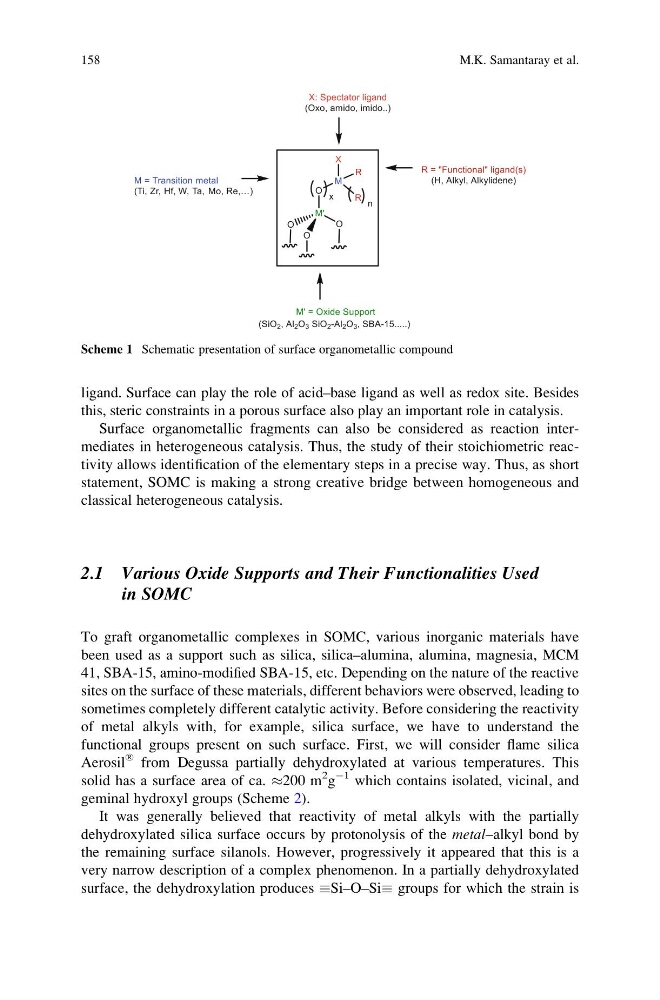
Scheme 1 Schematic presentation of surface organometallic compound
158
M.K. Samantaray et al.
this, steric constraints in a porous surface also play an important role in catalysis.
Surface organometallic fragments can also be considered as reaction intermediates in heterogeneous catalysis. Thus, the study of their stoichiometric reactivity allows identification of the elementary steps in a precise way. Thus, as short
statement, SOMC is making a strong creative bridge between homogeneous and
classical heterogeneous catalysis.
2.1 Various Oxide Supports and Their Functionalities Used
in SOMC
To graft organometallic complexes in SOMC, various inorganic materials have
been used as a support such as silica, silica–alumina, alumina, magnesia, MCM
41, SBA-15, amino-modified SBA-15, etc. Depending on the nature of the reactive
sites on the surface of these materials, different behaviors were observed, leading to
sometimes completely different catalytic activity. Before considering the reactivity
of metal alkyls with, for example, silica surface, we have to understand the
functional groups present on such surface. First, we will consider flame silica
Aerosil
® from Degussa partially dehydroxylated at various temperatures. This
solid has a surface area of ca. %200 m
2 g
À1 which contains isolated, vicinal, and
geminal hydroxyl groups (Scheme 2).
It was generally believed that reactivity of metal alkyls with the partially
dehydroxylated silica surface occurs by protonolysis of the metal–alkyl bond by
the remaining surface silanols. However, progressively it appeared that this is a
very narrow description of a complex phenomenon. In a partially dehydroxylated
surface, the dehydroxylation produces Si–O–Si groups for which the strain is
Scheme 1 Schematic presentation of surface organometallic compound
158
M.K. Samantaray et al.