

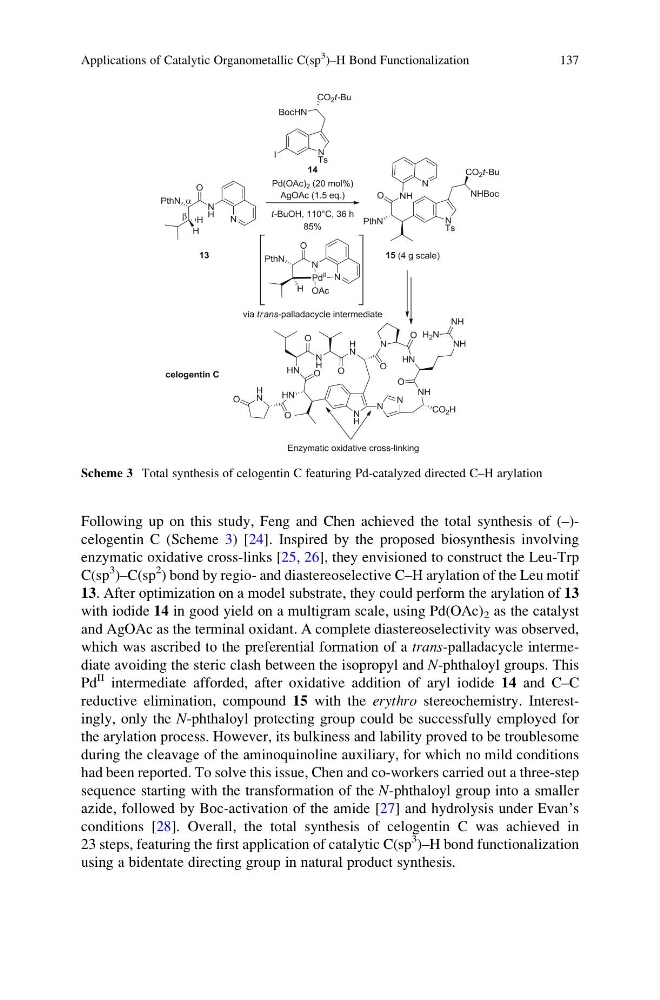
Following up on this study, Feng and Chen achieved the total synthesis of (–)celogentin C (Scheme 3) [24]. Inspired by the proposed biosynthesis involving
enzymatic oxidative cross-links [25, 26], they envisioned to construct the Leu-Trp
C(sp
3 )–C(sp
2 ) bond by regio- and diastereoselective C–H arylation of the Leu motif
13. After optimization on a model substrate, they could perform the arylation of 13
with iodide 14 in good yield on a multigram scale, using Pd(OAc) 2 as the catalyst
and AgOAc as the terminal oxidant. A complete diastereoselectivity was observed,
which was ascribed to the preferential formation of a trans-palladacycle intermediate avoiding the steric clash between the isopropyl and N-phthaloyl groups. This
Pd
II intermediate afforded, after oxidative addition of aryl iodide 14 and C–C
reductive elimination, compound 15 with the erythro stereochemistry. Interestingly, only the N-phthaloyl protecting group could be successfully employed for
the arylation process. However, its bulkiness and lability proved to be troublesome
during the cleavage of the aminoquinoline auxiliary, for which no mild conditions
had been reported. To solve this issue, Chen and co-workers carried out a three-step
sequence starting with the transformation of the N-phthaloyl group into a smaller
azide, followed by Boc-activation of the amide [27] and hydrolysis under Evan’s
conditions [28]. Overall, the total synthesis of celogentin C was achieved in
23 steps, featuring the first application of catalytic C(sp
3 )–H bond functionalization
using a bidentate directing group in natural product synthesis.
Scheme 3 Total synthesis of celogentin C featuring Pd-catalyzed directed C–H arylation
Applications of Catalytic Organometallic C(sp
3
)–H Bond Functionalization
137
enzymatic oxidative cross-links [25, 26], they envisioned to construct the Leu-Trp
C(sp
3 )–C(sp
2 ) bond by regio- and diastereoselective C–H arylation of the Leu motif
13. After optimization on a model substrate, they could perform the arylation of 13
with iodide 14 in good yield on a multigram scale, using Pd(OAc) 2 as the catalyst
and AgOAc as the terminal oxidant. A complete diastereoselectivity was observed,
which was ascribed to the preferential formation of a trans-palladacycle intermediate avoiding the steric clash between the isopropyl and N-phthaloyl groups. This
Pd
II intermediate afforded, after oxidative addition of aryl iodide 14 and C–C
reductive elimination, compound 15 with the erythro stereochemistry. Interestingly, only the N-phthaloyl protecting group could be successfully employed for
the arylation process. However, its bulkiness and lability proved to be troublesome
during the cleavage of the aminoquinoline auxiliary, for which no mild conditions
had been reported. To solve this issue, Chen and co-workers carried out a three-step
sequence starting with the transformation of the N-phthaloyl group into a smaller
azide, followed by Boc-activation of the amide [27] and hydrolysis under Evan’s
conditions [28]. Overall, the total synthesis of celogentin C was achieved in
23 steps, featuring the first application of catalytic C(sp
3 )–H bond functionalization
using a bidentate directing group in natural product synthesis.
Scheme 3 Total synthesis of celogentin C featuring Pd-catalyzed directed C–H arylation
Applications of Catalytic Organometallic C(sp
3
)–H Bond Functionalization
137