

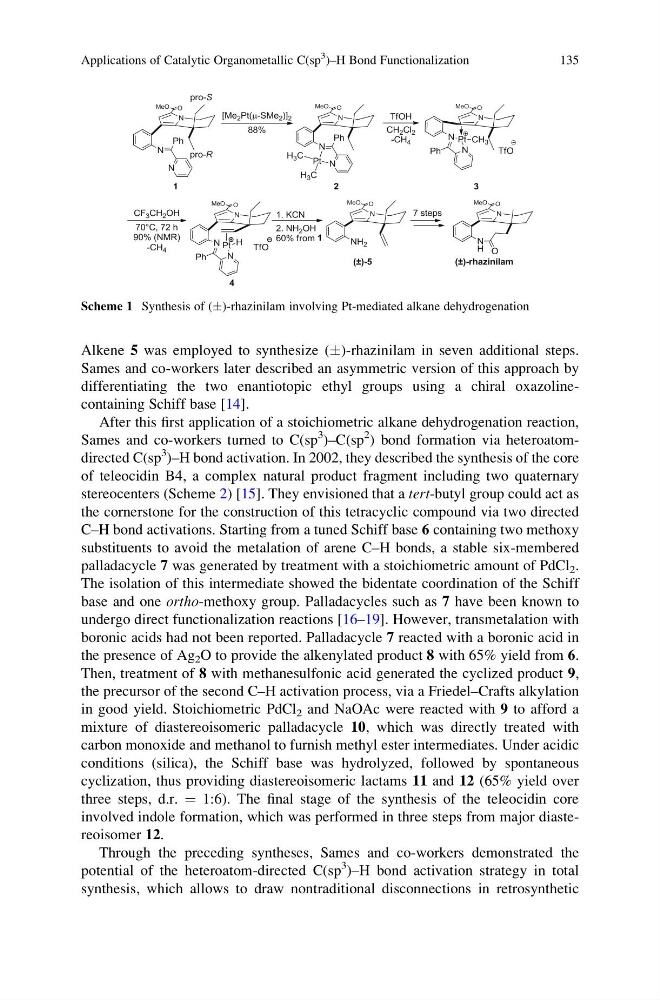
Alkene 5 was employed to synthesize (Æ)-rhazinilam in seven additional steps.
Sames and co-workers later described an asymmetric version of this approach by
differentiating the two enantiotopic ethyl groups using a chiral oxazolinecontaining Schiff base [14].
After this first application of a stoichiometric alkane dehydrogenation reaction,
Sames and co-workers turned to C(sp
3
)–C(sp
2 ) bond formation via heteroatomdirected C(sp
3 )–H bond activation. In 2002, they described the synthesis of the core
of teleocidin B4, a complex natural product fragment including two quaternary
stereocenters (Scheme 2) [15]. They envisioned that a tert-butyl group could act as
the cornerstone for the construction of this tetracyclic compound via two directed
C–H bond activations. Starting from a tuned Schiff base 6 containing two methoxy
substituents to avoid the metalation of arene C–H bonds, a stable six-membered
palladacycle 7 was generated by treatment with a stoichiometric amount of PdCl 2 .
The isolation of this intermediate showed the bidentate coordination of the Schiff
base and one ortho-methoxy group. Palladacycles such as 7 have been known to
undergo direct functionalization reactions [16–19]. However, transmetalation with
boronic acids had not been reported. Palladacycle 7 reacted with a boronic acid in
the presence of Ag 2 O to provide the alkenylated product 8 with 65% yield from 6.
Then, treatment of 8 with methanesulfonic acid generated the cyclized product 9,
the precursor of the second C–H activation process, via a Friedel–Crafts alkylation
in good yield. Stoichiometric PdCl 2 and NaOAc were reacted with 9 to afford a
mixture of diastereoisomeric palladacycle 10, which was directly treated with
carbon monoxide and methanol to furnish methyl ester intermediates. Under acidic
conditions (silica), the Schiff base was hydrolyzed, followed by spontaneous
cyclization, thus providing diastereoisomeric lactams 11 and 12 (65% yield over
three steps, d.r. ¼ 1:6). The final stage of the synthesis of the teleocidin core
involved indole formation, which was performed in three steps from major diastereoisomer 12.
Through the preceding syntheses, Sames and co-workers demonstrated the
potential of the heteroatom-directed C(sp
3 )–H bond activation strategy in total
synthesis, which allows to draw nontraditional disconnections in retrosynthetic
Scheme 1 Synthesis of (Æ)-rhazinilam involving Pt-mediated alkane dehydrogenation
Applications of Catalytic Organometallic C(sp
3
)–H Bond Functionalization
135
Sames and co-workers later described an asymmetric version of this approach by
differentiating the two enantiotopic ethyl groups using a chiral oxazolinecontaining Schiff base [14].
After this first application of a stoichiometric alkane dehydrogenation reaction,
Sames and co-workers turned to C(sp
3
)–C(sp
2 ) bond formation via heteroatomdirected C(sp
3 )–H bond activation. In 2002, they described the synthesis of the core
of teleocidin B4, a complex natural product fragment including two quaternary
stereocenters (Scheme 2) [15]. They envisioned that a tert-butyl group could act as
the cornerstone for the construction of this tetracyclic compound via two directed
C–H bond activations. Starting from a tuned Schiff base 6 containing two methoxy
substituents to avoid the metalation of arene C–H bonds, a stable six-membered
palladacycle 7 was generated by treatment with a stoichiometric amount of PdCl 2 .
The isolation of this intermediate showed the bidentate coordination of the Schiff
base and one ortho-methoxy group. Palladacycles such as 7 have been known to
undergo direct functionalization reactions [16–19]. However, transmetalation with
boronic acids had not been reported. Palladacycle 7 reacted with a boronic acid in
the presence of Ag 2 O to provide the alkenylated product 8 with 65% yield from 6.
Then, treatment of 8 with methanesulfonic acid generated the cyclized product 9,
the precursor of the second C–H activation process, via a Friedel–Crafts alkylation
in good yield. Stoichiometric PdCl 2 and NaOAc were reacted with 9 to afford a
mixture of diastereoisomeric palladacycle 10, which was directly treated with
carbon monoxide and methanol to furnish methyl ester intermediates. Under acidic
conditions (silica), the Schiff base was hydrolyzed, followed by spontaneous
cyclization, thus providing diastereoisomeric lactams 11 and 12 (65% yield over
three steps, d.r. ¼ 1:6). The final stage of the synthesis of the teleocidin core
involved indole formation, which was performed in three steps from major diastereoisomer 12.
Through the preceding syntheses, Sames and co-workers demonstrated the
potential of the heteroatom-directed C(sp
3 )–H bond activation strategy in total
synthesis, which allows to draw nontraditional disconnections in retrosynthetic
Scheme 1 Synthesis of (Æ)-rhazinilam involving Pt-mediated alkane dehydrogenation
Applications of Catalytic Organometallic C(sp
3
)–H Bond Functionalization
135