

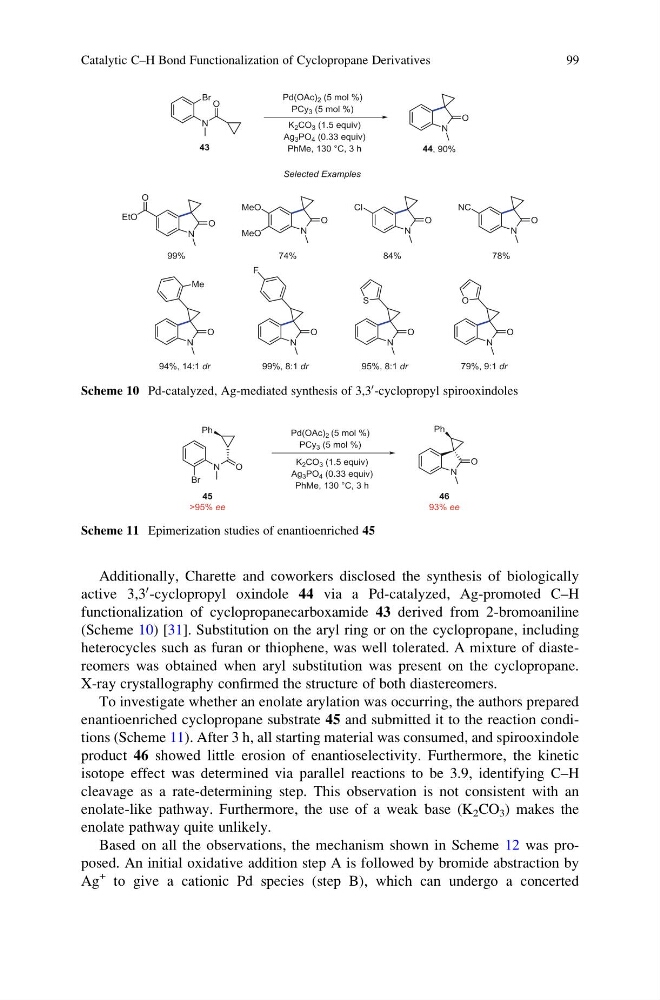
Additionally, Charette and coworkers disclosed the synthesis of biologically
active 3,3
0 -cyclopropyl oxindole 44 via a Pd-catalyzed, Ag-promoted C–H
functionalization of cyclopropanecarboxamide 43 derived from 2-bromoaniline
(Scheme 10) [31]. Substitution on the aryl ring or on the cyclopropane, including
heterocycles such as furan or thiophene, was well tolerated. A mixture of diastereomers was obtained when aryl substitution was present on the cyclopropane.
X-ray crystallography confirmed the structure of both diastereomers.
To investigate whether an enolate arylation was occurring, the authors prepared
enantioenriched cyclopropane substrate 45 and submitted it to the reaction conditions (Scheme 11). After 3 h, all starting material was consumed, and spirooxindole
product 46 showed little erosion of enantioselectivity. Furthermore, the kinetic
isotope effect was determined via parallel reactions to be 3.9, identifying C–H
cleavage as a rate-determining step. This observation is not consistent with an
enolate-like pathway. Furthermore, the use of a weak base (K 2 CO 3 ) makes the
enolate pathway quite unlikely.
Based on all the observations, the mechanism shown in Scheme 12 was proposed. An initial oxidative addition step A is followed by bromide abstraction by
Ag
+ to give a cationic Pd species (step B), which can undergo a concerted
Scheme 10 Pd-catalyzed, Ag-mediated synthesis of 3,3
0 -cyclopropyl spirooxindoles
Scheme 11 Epimerization studies of enantioenriched 45
Catalytic C–H Bond Functionalization of Cyclopropane Derivatives
99
active 3,3
0 -cyclopropyl oxindole 44 via a Pd-catalyzed, Ag-promoted C–H
functionalization of cyclopropanecarboxamide 43 derived from 2-bromoaniline
(Scheme 10) [31]. Substitution on the aryl ring or on the cyclopropane, including
heterocycles such as furan or thiophene, was well tolerated. A mixture of diastereomers was obtained when aryl substitution was present on the cyclopropane.
X-ray crystallography confirmed the structure of both diastereomers.
To investigate whether an enolate arylation was occurring, the authors prepared
enantioenriched cyclopropane substrate 45 and submitted it to the reaction conditions (Scheme 11). After 3 h, all starting material was consumed, and spirooxindole
product 46 showed little erosion of enantioselectivity. Furthermore, the kinetic
isotope effect was determined via parallel reactions to be 3.9, identifying C–H
cleavage as a rate-determining step. This observation is not consistent with an
enolate-like pathway. Furthermore, the use of a weak base (K 2 CO 3 ) makes the
enolate pathway quite unlikely.
Based on all the observations, the mechanism shown in Scheme 12 was proposed. An initial oxidative addition step A is followed by bromide abstraction by
Ag
+ to give a cationic Pd species (step B), which can undergo a concerted
Scheme 10 Pd-catalyzed, Ag-mediated synthesis of 3,3
0 -cyclopropyl spirooxindoles
Scheme 11 Epimerization studies of enantioenriched 45
Catalytic C–H Bond Functionalization of Cyclopropane Derivatives
99