

79
3 Formation of DNA Lesions, its Prevention and Repair
3.5.1 Protein Translocation
It has been proposed that proteins find their target by diffusing along DNA in several possible ways such as hopping or jumping, sliding, intersegment transfer etc.
[183]. Protein translocation by hopping involves scanning of DNA by the protein
by making various microscopic associations and dissociations [183]. During hopping, proteins need to be associated with DNA initially by a non-specific binding.
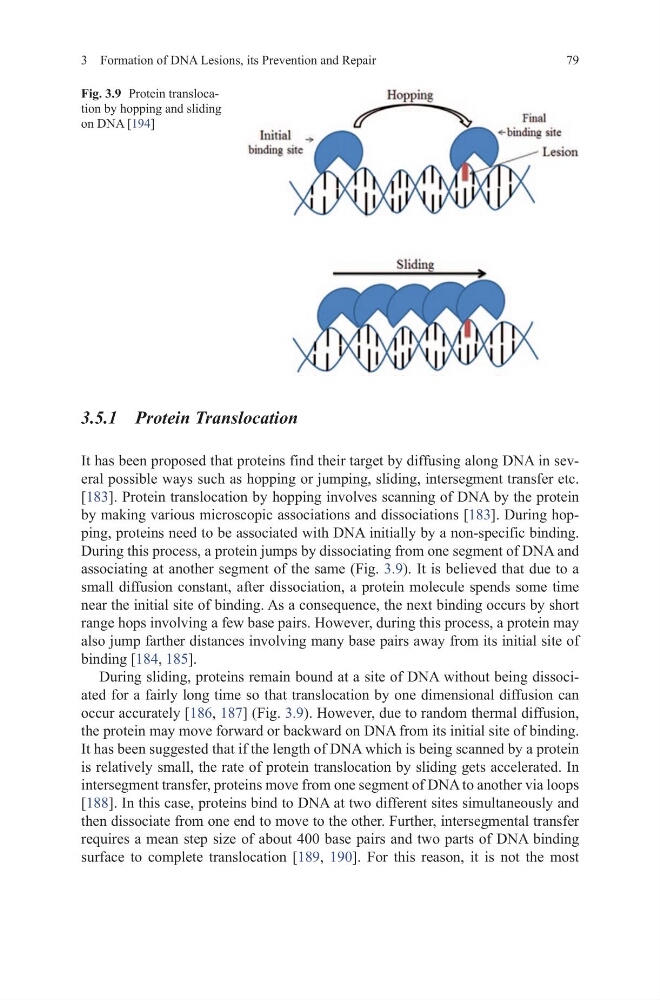
During this process, a protein jumps by dissociating from one segment of DNA and
associating at another segment of the same (Fig. 3.9). It is believed that due to a
small diffusion constant, after dissociation, a protein molecule spends some time
near the initial site of binding. As a consequence, the next binding occurs by short
range hops involving a few base pairs. However, during this process, a protein may
also jump farther distances involving many base pairs away from its initial site of
binding [184, 185].
During sliding, proteins remain bound at a site of DNA without being dissociated for a fairly long time so that translocation by one dimensional diffusion can
occur accurately [186, 187] (Fig. 3.9). However, due to random thermal diffusion,
the protein may move forward or backward on DNA from its initial site of binding.
It has been suggested that if the length of DNA which is being scanned by a protein
is relatively small, the rate of protein translocation by sliding gets accelerated. In
intersegment transfer, proteins move from one segment of DNA to another via loops
[188]. In this case, proteins bind to DNA at two different sites simultaneously and
then dissociate from one end to move to the other. Further, intersegmental transfer
requires a mean step size of about 400 base pairs and two parts of DNA binding
surface to complete translocation [189, 190]. For this reason, it is not the most
Fig. 3.9 Protein translocation by hopping and sliding
on DNA [194]
3 Formation of DNA Lesions, its Prevention and Repair
3.5.1 Protein Translocation
It has been proposed that proteins find their target by diffusing along DNA in several possible ways such as hopping or jumping, sliding, intersegment transfer etc.
[183]. Protein translocation by hopping involves scanning of DNA by the protein
by making various microscopic associations and dissociations [183]. During hopping, proteins need to be associated with DNA initially by a non-specific binding.
During this process, a protein jumps by dissociating from one segment of DNA and
associating at another segment of the same (Fig. 3.9). It is believed that due to a
small diffusion constant, after dissociation, a protein molecule spends some time
near the initial site of binding. As a consequence, the next binding occurs by short
range hops involving a few base pairs. However, during this process, a protein may
also jump farther distances involving many base pairs away from its initial site of
binding [184, 185].
During sliding, proteins remain bound at a site of DNA without being dissociated for a fairly long time so that translocation by one dimensional diffusion can
occur accurately [186, 187] (Fig. 3.9). However, due to random thermal diffusion,
the protein may move forward or backward on DNA from its initial site of binding.
It has been suggested that if the length of DNA which is being scanned by a protein
is relatively small, the rate of protein translocation by sliding gets accelerated. In
intersegment transfer, proteins move from one segment of DNA to another via loops
[188]. In this case, proteins bind to DNA at two different sites simultaneously and
then dissociate from one end to move to the other. Further, intersegmental transfer
requires a mean step size of about 400 base pairs and two parts of DNA binding
surface to complete translocation [189, 190]. For this reason, it is not the most
Fig. 3.9 Protein translocation by hopping and sliding
on DNA [194]