

50
M. P. Evstigneev and A. V. Shestopalova
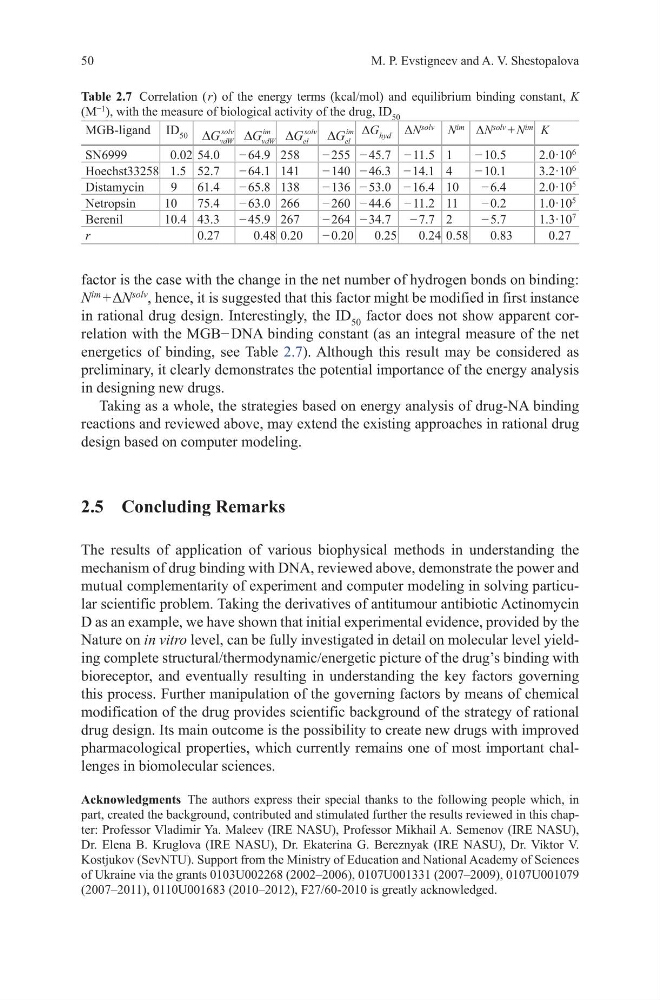
factor is the case with the change in the net number of hydrogen bonds on binding:
N
im
+ ΔN
solv
, hence, it is suggested that this factor might be modified in first instance
in rational drug design. Interestingly, the ID 50 factor does not show apparent correlation with the MGB− DNA binding constant (as an integral measure of the net
energetics of binding, see Table 2.7). Although this result may be considered as
preliminary, it clearly demonstrates the potential importance of the energy analysis
in designing new drugs.
Taking as a whole, the strategies based on energy analysis of drug-NA binding
reactions and reviewed above, may extend the existing approaches in rational drug
design based on computer modeling.
2.5 Concluding Remarks
The results of application of various biophysical methods in understanding the
mechanism of drug binding with DNA, reviewed above, demonstrate the power and
mutual complementarity of experiment and computer modeling in solving particular scientific problem. Taking the derivatives of antitumour antibiotic Actinomycin
D as an example, we have shown that initial experimental evidence, provided by the
Nature on in vitro level, can be fully investigated in detail on molecular level yielding complete structural/thermodynamic/energetic picture of the drug’s binding with
bioreceptor, and eventually resulting in understanding the key factors governing
this process. Further manipulation of the governing factors by means of chemical
modification of the drug provides scientific background of the strategy of rational
drug design. Its main outcome is the possibility to create new drugs with improved
pharmacological properties, which currently remains one of most important challenges in biomolecular sciences.
Acknowledgments The authors express their special thanks to the following people which, in
part, created the background, contributed and stimulated further the results reviewed in this chapter: Professor Vladimir Ya. Maleev (IRE NASU), Professor Mikhail A. Semenov (IRE NASU),
Dr. Elena B. Kruglova (IRE NASU), Dr. Ekaterina G. Bereznyak (IRE NASU), Dr. Viktor V.
Kostjukov (SevNTU). Support from the Ministry of Education and National Academy of Sciences
of Ukraine via the grants 0103U002268 (2002–2006), 0107U001331 (2007–2009), 0107U001079
(2007–2011), 0110U001683 (2010–2012), F27/60-2010 is greatly acknowledged.
Table 2.7 Correlation ( r) of the energy terms (kcal/mol) and equilibrium binding constant, K
(М
−1
), with the measure of biological activity of the drug, ID 50
MGB-ligand ID 50 ∆G vdW
solv
∆G vdW
im
∆G el
solv
∆G el
im ΔG hyd ΔN
solv
N
im
ΔN
solv
+ N
im
K
SN6999
0.02 54.0
− 64.9 258
− 255 − 45.7 − 11.5 1
− 10.5
2.0·10
6
Hoechst33258 1.5 52.7
− 64.1 141
− 140 − 46.3 − 14.1 4
− 10.1
3.2·10
6
Distamycin
9
61.4
− 65.8 138
− 136 − 53.0 − 16.4 10
− 6.4
2.0·10
5
Netropsin
10
75.4
− 63.0 266
− 260 − 44.6 − 11.2 11
− 0.2
1.0·10
5
Berenil
10.4 43.3
− 45.9 267
− 264 − 34.7 − 7.7 2
− 5.7
1.3·10
7
r
0.27
0.48 0.20
− 0.20
0.25
0.24 0.58
0.83
0.27
M. P. Evstigneev and A. V. Shestopalova
factor is the case with the change in the net number of hydrogen bonds on binding:
N
im
+ ΔN
solv
, hence, it is suggested that this factor might be modified in first instance
in rational drug design. Interestingly, the ID 50 factor does not show apparent correlation with the MGB− DNA binding constant (as an integral measure of the net
energetics of binding, see Table 2.7). Although this result may be considered as
preliminary, it clearly demonstrates the potential importance of the energy analysis
in designing new drugs.
Taking as a whole, the strategies based on energy analysis of drug-NA binding
reactions and reviewed above, may extend the existing approaches in rational drug
design based on computer modeling.
2.5 Concluding Remarks
The results of application of various biophysical methods in understanding the
mechanism of drug binding with DNA, reviewed above, demonstrate the power and
mutual complementarity of experiment and computer modeling in solving particular scientific problem. Taking the derivatives of antitumour antibiotic Actinomycin
D as an example, we have shown that initial experimental evidence, provided by the
Nature on in vitro level, can be fully investigated in detail on molecular level yielding complete structural/thermodynamic/energetic picture of the drug’s binding with
bioreceptor, and eventually resulting in understanding the key factors governing
this process. Further manipulation of the governing factors by means of chemical
modification of the drug provides scientific background of the strategy of rational
drug design. Its main outcome is the possibility to create new drugs with improved
pharmacological properties, which currently remains one of most important challenges in biomolecular sciences.
Acknowledgments The authors express their special thanks to the following people which, in
part, created the background, contributed and stimulated further the results reviewed in this chapter: Professor Vladimir Ya. Maleev (IRE NASU), Professor Mikhail A. Semenov (IRE NASU),
Dr. Elena B. Kruglova (IRE NASU), Dr. Ekaterina G. Bereznyak (IRE NASU), Dr. Viktor V.
Kostjukov (SevNTU). Support from the Ministry of Education and National Academy of Sciences
of Ukraine via the grants 0103U002268 (2002–2006), 0107U001331 (2007–2009), 0107U001079
(2007–2011), 0110U001683 (2010–2012), F27/60-2010 is greatly acknowledged.
Table 2.7 Correlation ( r) of the energy terms (kcal/mol) and equilibrium binding constant, K
(М
−1
), with the measure of biological activity of the drug, ID 50
MGB-ligand ID 50 ∆G vdW
solv
∆G vdW
im
∆G el
solv
∆G el
im ΔG hyd ΔN
solv
N
im
ΔN
solv
+ N
im
K
SN6999
0.02 54.0
− 64.9 258
− 255 − 45.7 − 11.5 1
− 10.5
2.0·10
6
Hoechst33258 1.5 52.7
− 64.1 141
− 140 − 46.3 − 14.1 4
− 10.1
3.2·10
6
Distamycin
9
61.4
− 65.8 138
− 136 − 53.0 − 16.4 10
− 6.4
2.0·10
5
Netropsin
10
75.4
− 63.0 266
− 260 − 44.6 − 11.2 11
− 0.2
1.0·10
5
Berenil
10.4 43.3
− 45.9 267
− 264 − 34.7 − 7.7 2
− 5.7
1.3·10
7
r
0.27
0.48 0.20
− 0.20
0.25
0.24 0.58
0.83
0.27