

541
16 Cheminformatics: At the Crossroad of Eras
4. Toxicity-relevant bioassays for thousands of chemicals from Toxcast [13] and
Tox21 [14, 15] projects, which can be complemented by in vivo toxicity data
from the ToxRefDB [16] database,
5. Chemical-protein interactions structured as systems chemical biology networks
for different organisms using STITCH [17] and KEGG [18] databases.
All these different resources define a huge chemogenomics data matrix of several
tens of millions of unique compounds ( row) and a few thousands targets and other
biological endpoints ( columns). This sparse matrix is ideal for virtual screening but
is still far too incomplete to represent the overall diversity of the chemical universe
of drug-like molecules (recently estimated to be close to 10
33
compounds) [19].
Recently, Reymond’s research group attempted to enumerate all possible chemical
structures solely incorporating C, O, N, S and halogen atoms. Their most recent
efforts led to the generation of the GDB-17 database [20] containing more than
166 billion compounds, each including a maximum of 17 heavy atoms. Of course,
only a fraction of GDB-17 compounds corresponds to drug-like molecules, whereas
representative subsets of this database are ideal libraries for fragment-based molecular docking.
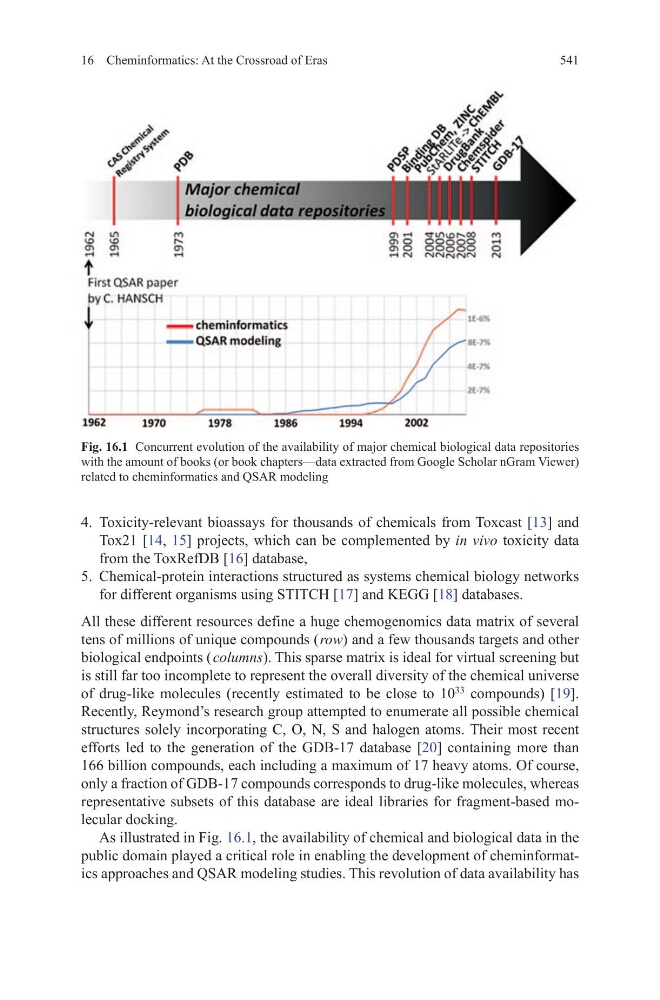
As illustrated in Fig. 16.1, the availability of chemical and biological data in the
public domain played a critical role in enabling the development of cheminformatics approaches and QSAR modeling studies. This revolution of data availability has
Fig. 16.1 Concurrent evolution of the availability of major chemical biological data repositories
with the amount of books (or book chapters—data extracted from Google Scholar nGram Viewer)
related to cheminformatics and QSAR modeling
16 Cheminformatics: At the Crossroad of Eras
4. Toxicity-relevant bioassays for thousands of chemicals from Toxcast [13] and
Tox21 [14, 15] projects, which can be complemented by in vivo toxicity data
from the ToxRefDB [16] database,
5. Chemical-protein interactions structured as systems chemical biology networks
for different organisms using STITCH [17] and KEGG [18] databases.
All these different resources define a huge chemogenomics data matrix of several
tens of millions of unique compounds ( row) and a few thousands targets and other
biological endpoints ( columns). This sparse matrix is ideal for virtual screening but
is still far too incomplete to represent the overall diversity of the chemical universe
of drug-like molecules (recently estimated to be close to 10
33
compounds) [19].
Recently, Reymond’s research group attempted to enumerate all possible chemical
structures solely incorporating C, O, N, S and halogen atoms. Their most recent
efforts led to the generation of the GDB-17 database [20] containing more than
166 billion compounds, each including a maximum of 17 heavy atoms. Of course,
only a fraction of GDB-17 compounds corresponds to drug-like molecules, whereas
representative subsets of this database are ideal libraries for fragment-based molecular docking.
As illustrated in Fig. 16.1, the availability of chemical and biological data in the
public domain played a critical role in enabling the development of cheminformatics approaches and QSAR modeling studies. This revolution of data availability has
Fig. 16.1 Concurrent evolution of the availability of major chemical biological data repositories
with the amount of books (or book chapters—data extracted from Google Scholar nGram Viewer)
related to cheminformatics and QSAR modeling