

523
15 (How to) Profit from Molecular Dynamics-based Ensemble Docking
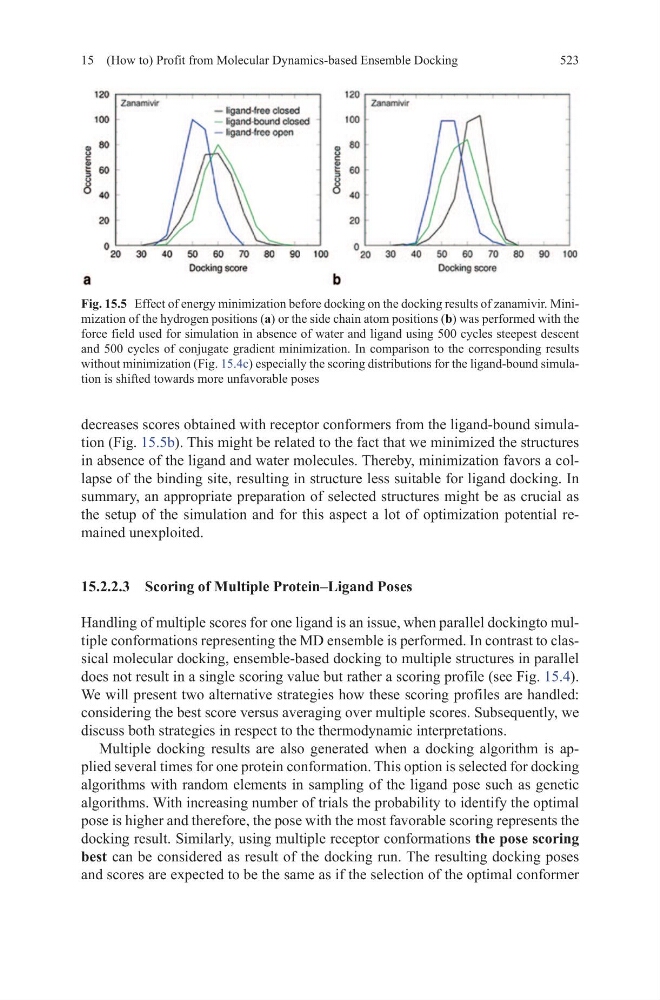
decreases scores obtained with receptor conformers from the ligand-bound simulation (Fig. 15.5b). This might be related to the fact that we minimized the structures
in absence of the ligand and water molecules. Thereby, minimization favors a collapse of the binding site, resulting in structure less suitable for ligand docking. In
summary, an appropriate preparation of selected structures might be as crucial as
the setup of the simulation and for this aspect a lot of optimization potential remained unexploited.
15.2.2.3 Scoring of Multiple Protein–Ligand Poses
Handling of multiple scores for one ligand is an issue, when parallel dockingto multiple conformations representing the MD ensemble is performed. In contrast to classical molecular docking, ensemble-based docking to multiple structures in parallel
does not result in a single scoring value but rather a scoring profile (see Fig. 15.4).
We will present two alternative strategies how these scoring profiles are handled:
considering the best score versus averaging over multiple scores. Subsequently, we
discuss both strategies in respect to the thermodynamic interpretations.
Multiple docking results are also generated when a docking algorithm is applied several times for one protein conformation. This option is selected for docking
algorithms with random elements in sampling of the ligand pose such as genetic
algorithms. With increasing number of trials the probability to identify the optimal
pose is higher and therefore, the pose with the most favorable scoring represents the
docking result. Similarly, using multiple receptor conformations the pose scoring
best can be considered as result of the docking run. The resulting docking poses
and scores are expected to be the same as if the selection of the optimal conformer
Fig. 15.5 Effect of energy minimization before docking on the docking results of zanamivir. Minimization of the hydrogen positions (a) or the side chain atom positions (b) was performed with the
force field used for simulation in absence of water and ligand using 500 cycles steepest descent
and 500 cycles of conjugate gradient minimization. In comparison to the corresponding results
without minimization (Fig. 15.4c) especially the scoring distributions for the ligand-bound simulation is shifted towards more unfavorable poses
15 (How to) Profit from Molecular Dynamics-based Ensemble Docking
decreases scores obtained with receptor conformers from the ligand-bound simulation (Fig. 15.5b). This might be related to the fact that we minimized the structures
in absence of the ligand and water molecules. Thereby, minimization favors a collapse of the binding site, resulting in structure less suitable for ligand docking. In
summary, an appropriate preparation of selected structures might be as crucial as
the setup of the simulation and for this aspect a lot of optimization potential remained unexploited.
15.2.2.3 Scoring of Multiple Protein–Ligand Poses
Handling of multiple scores for one ligand is an issue, when parallel dockingto multiple conformations representing the MD ensemble is performed. In contrast to classical molecular docking, ensemble-based docking to multiple structures in parallel
does not result in a single scoring value but rather a scoring profile (see Fig. 15.4).
We will present two alternative strategies how these scoring profiles are handled:
considering the best score versus averaging over multiple scores. Subsequently, we
discuss both strategies in respect to the thermodynamic interpretations.
Multiple docking results are also generated when a docking algorithm is applied several times for one protein conformation. This option is selected for docking
algorithms with random elements in sampling of the ligand pose such as genetic
algorithms. With increasing number of trials the probability to identify the optimal
pose is higher and therefore, the pose with the most favorable scoring represents the
docking result. Similarly, using multiple receptor conformations the pose scoring
best can be considered as result of the docking run. The resulting docking poses
and scores are expected to be the same as if the selection of the optimal conformer
Fig. 15.5 Effect of energy minimization before docking on the docking results of zanamivir. Minimization of the hydrogen positions (a) or the side chain atom positions (b) was performed with the
force field used for simulation in absence of water and ligand using 500 cycles steepest descent
and 500 cycles of conjugate gradient minimization. In comparison to the corresponding results
without minimization (Fig. 15.4c) especially the scoring distributions for the ligand-bound simulation is shifted towards more unfavorable poses