

518
S. von Grafenstein et al.
representatives versus two X-ray structures representing the start and target state
of the targeted MD simulation [59]. Six duster representatives were extracted from
a targeted MD trajectory by RMSD-based clustering. Xu et al. applied an RMSDbased clustering to reduce the number of snapshots from different trajectories of
10 ns or 30 ns simulation time to proceed with a fairly equal number of 200–250
representatives for the subsequent validation [38].
We performed an RMSD-based clustering on the active site atoms revealing the
representative structures shown in Fig. 15.1a–d. The clustering was performed with
CPPTRAJ from AmberTools13 [35] and followed an agglomerative clustering algorithm using complete linkage with an RMSD of 1.5 Å for the formation of a new
cluster. For each cluster one central conformation is defined as representative. Using this representation for the subsequent docking the number of necessary docking
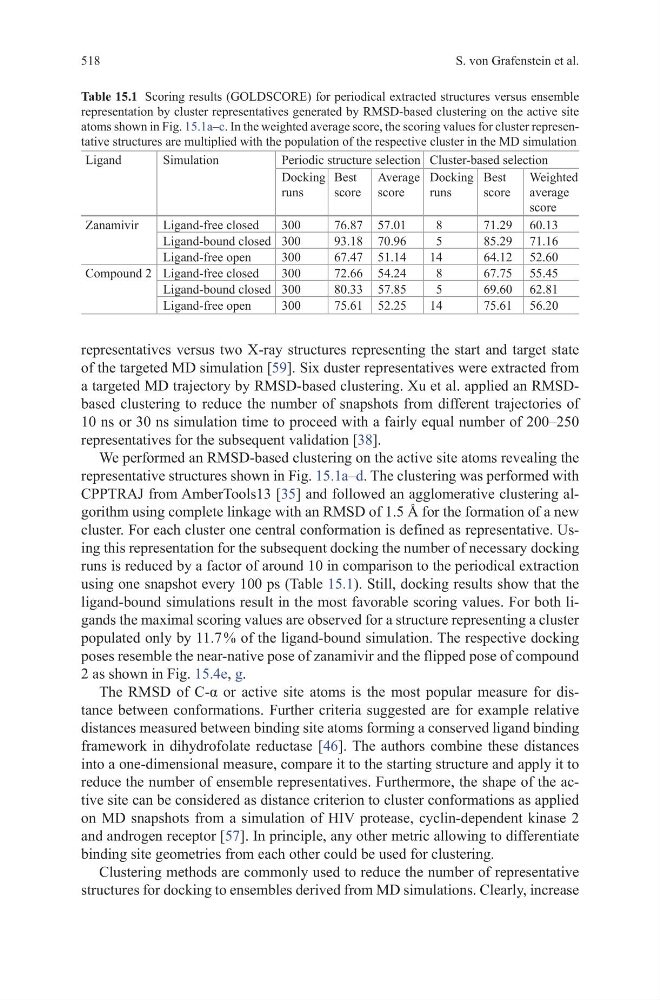
runs is reduced by a factor of around 10 in comparison to the periodical extraction
using one snapshot every 100 ps (Table 15.1). Still, docking results show that the
ligand-bound simulations result in the most favorable scoring values. For both ligands the maximal scoring values are observed for a structure representing a cluster
populated only by 11.7 % of the ligand-bound simulation. The respective docking
poses resemble the near-native pose of zanamivir and the flipped pose of compound
2 as shown in Fig. 15.4e, g.
The RMSD of C-α or active site atoms is the most popular measure for distance between conformations. Further criteria suggested are for example relative
distances measured between binding site atoms forming a conserved ligand binding
framework in dihydrofolate reductase [46]. The authors combine these distances
into a one-dimensional measure, compare it to the starting structure and apply it to
reduce the number of ensemble representatives. Furthermore, the shape of the active site can be considered as distance criterion to cluster conformations as applied
on MD snapshots from a simulation of HIV protease, cyclin-dependent kinase 2
and androgen receptor [57]. In principle, any other metric allowing to differentiate
binding site geometries from each other could be used for clustering.
Clustering methods are commonly used to reduce the number of representative
structures for docking to ensembles derived from MD simulations. Clearly, increase
Table 15.1 Scoring results (GOLDSCORE) for periodical extracted structures versus ensemble
representation by cluster representatives generated by RMSD-based clustering on the active site
atoms shown in Fig. 15.1a–c. In the weighted average score, the scoring values for cluster representative structures are multiplied with the population of the respective cluster in the MD simulation
Ligand
Simulation
Periodic structure selection Cluster-based selection
Docking
runs
Best
score
Average
score
Docking
runs
Best
score
Weighted
average
score
Zanamivir
Ligand-free closed
300
76.87 57.01
8
71.29 60.13
Ligand-bound closed 300
93.18 70.96
5
85.29 71.16
Ligand-free open
300
67.47 51.14
14
64.12 52.60
Compound 2 Ligand-free closed
300
72.66 54.24
8
67.75 55.45
Ligand-bound closed 300
80.33 57.85
5
69.60 62.81
Ligand-free open
300
75.61 52.25
14
75.61 56.20
S. von Grafenstein et al.
representatives versus two X-ray structures representing the start and target state
of the targeted MD simulation [59]. Six duster representatives were extracted from
a targeted MD trajectory by RMSD-based clustering. Xu et al. applied an RMSDbased clustering to reduce the number of snapshots from different trajectories of
10 ns or 30 ns simulation time to proceed with a fairly equal number of 200–250
representatives for the subsequent validation [38].
We performed an RMSD-based clustering on the active site atoms revealing the
representative structures shown in Fig. 15.1a–d. The clustering was performed with
CPPTRAJ from AmberTools13 [35] and followed an agglomerative clustering algorithm using complete linkage with an RMSD of 1.5 Å for the formation of a new
cluster. For each cluster one central conformation is defined as representative. Using this representation for the subsequent docking the number of necessary docking
runs is reduced by a factor of around 10 in comparison to the periodical extraction
using one snapshot every 100 ps (Table 15.1). Still, docking results show that the
ligand-bound simulations result in the most favorable scoring values. For both ligands the maximal scoring values are observed for a structure representing a cluster
populated only by 11.7 % of the ligand-bound simulation. The respective docking
poses resemble the near-native pose of zanamivir and the flipped pose of compound
2 as shown in Fig. 15.4e, g.
The RMSD of C-α or active site atoms is the most popular measure for distance between conformations. Further criteria suggested are for example relative
distances measured between binding site atoms forming a conserved ligand binding
framework in dihydrofolate reductase [46]. The authors combine these distances
into a one-dimensional measure, compare it to the starting structure and apply it to
reduce the number of ensemble representatives. Furthermore, the shape of the active site can be considered as distance criterion to cluster conformations as applied
on MD snapshots from a simulation of HIV protease, cyclin-dependent kinase 2
and androgen receptor [57]. In principle, any other metric allowing to differentiate
binding site geometries from each other could be used for clustering.
Clustering methods are commonly used to reduce the number of representative
structures for docking to ensembles derived from MD simulations. Clearly, increase
Table 15.1 Scoring results (GOLDSCORE) for periodical extracted structures versus ensemble
representation by cluster representatives generated by RMSD-based clustering on the active site
atoms shown in Fig. 15.1a–c. In the weighted average score, the scoring values for cluster representative structures are multiplied with the population of the respective cluster in the MD simulation
Ligand
Simulation
Periodic structure selection Cluster-based selection
Docking
runs
Best
score
Average
score
Docking
runs
Best
score
Weighted
average
score
Zanamivir
Ligand-free closed
300
76.87 57.01
8
71.29 60.13
Ligand-bound closed 300
93.18 70.96
5
85.29 71.16
Ligand-free open
300
67.47 51.14
14
64.12 52.60
Compound 2 Ligand-free closed
300
72.66 54.24
8
67.75 55.45
Ligand-bound closed 300
80.33 57.85
5
69.60 62.81
Ligand-free open
300
75.61 52.25
14
75.61 56.20