

513
15 (How to) Profit from Molecular Dynamics-based Ensemble Docking
reviews dealing with the integration of receptor flexibility in molecular docking discuss this aspect extensively [8, 24, 73]. Here, we try to systematically classify different strategies and discuss their application in respect to conformations generated
by MD simulations. However, some of the concepts are applied mainly to collections of structures derived by experimental sources (X-ray or NMR structures) rather than to ensembles generated by MD simulations. In this chapter we will present
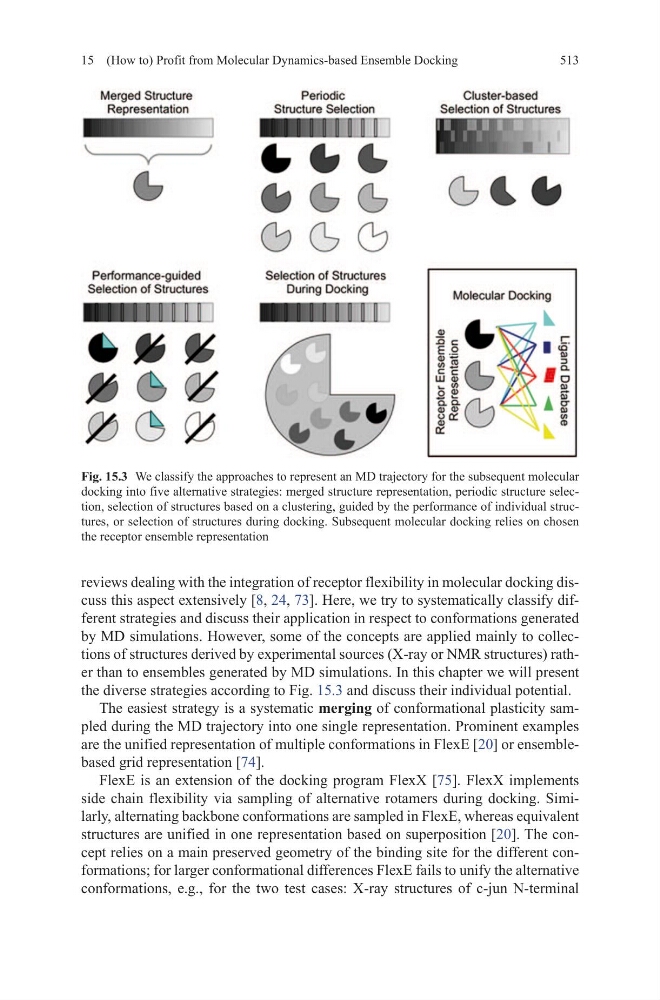
the diverse strategies according to Fig. 15.3 and discuss their individual potential.
The easiest strategy is a systematic merging of conformational plasticity sampled during the MD trajectory into one single representation. Prominent examples
are the unified representation of multiple conformations in FlexE [20] or ensemblebased grid representation [74].
FlexE is an extension of the docking program FlexX [75]. FlexX implements
side chain flexibility via sampling of alternative rotamers during docking. Similarly, alternating backbone conformations are sampled in FlexE, whereas equivalent
structures are unified in one representation based on superposition [20]. The concept relies on a main preserved geometry of the binding site for the different conformations; for larger conformational differences FlexE fails to unify the alternative
conformations, e.g., for the two test cases: X-ray structures of c-jun N-terminal
Fig. 15.3 We classify the approaches to represent an MD trajectory for the subsequent molecular
docking into five alternative strategies: merged structure representation, periodic structure selection, selection of structures based on a clustering, guided by the performance of individual structures, or selection of structures during docking. Subsequent molecular docking relies on chosen
the receptor ensemble representation
15 (How to) Profit from Molecular Dynamics-based Ensemble Docking
reviews dealing with the integration of receptor flexibility in molecular docking discuss this aspect extensively [8, 24, 73]. Here, we try to systematically classify different strategies and discuss their application in respect to conformations generated
by MD simulations. However, some of the concepts are applied mainly to collections of structures derived by experimental sources (X-ray or NMR structures) rather than to ensembles generated by MD simulations. In this chapter we will present
the diverse strategies according to Fig. 15.3 and discuss their individual potential.
The easiest strategy is a systematic merging of conformational plasticity sampled during the MD trajectory into one single representation. Prominent examples
are the unified representation of multiple conformations in FlexE [20] or ensemblebased grid representation [74].
FlexE is an extension of the docking program FlexX [75]. FlexX implements
side chain flexibility via sampling of alternative rotamers during docking. Similarly, alternating backbone conformations are sampled in FlexE, whereas equivalent
structures are unified in one representation based on superposition [20]. The concept relies on a main preserved geometry of the binding site for the different conformations; for larger conformational differences FlexE fails to unify the alternative
conformations, e.g., for the two test cases: X-ray structures of c-jun N-terminal
Fig. 15.3 We classify the approaches to represent an MD trajectory for the subsequent molecular
docking into five alternative strategies: merged structure representation, periodic structure selection, selection of structures based on a clustering, guided by the performance of individual structures, or selection of structures during docking. Subsequent molecular docking relies on chosen
the receptor ensemble representation