

509
15 (How to) Profit from Molecular Dynamics-based Ensemble Docking
et al. limited the flexibility on residues within 3.5 or 6 Å around the ligand while
keeping the ligand and the co-factor restrained. They compared those simulations
regarding the subsequent docking performance which showed an increase in the
rate of improper binding poses with an increased flexible region. These results were
not completely consistent and seem to depend on the quality of the starting structure. When homology models or NMR structures were used as starting structures,
docking results improved with the inclusion of more residues within the flexible
part [46]. Similarly, Armen et al. observed a reduced fraction of poses close to the
native structure when they allowed the complete protein to be flexible in comparison to models with restricted flexibility [47]. Both studies used simulation conditions without specifying a water model, and we agree with the authors of the second
study that especially the fully flexible model will benefit from an alternative simulation protocol, e.g., inclusion of solvent. We recommend the use of explicit solvent
environment or at least an implicit solvent model. Otherwise, an all-atom simulation with an empty active site will in general tend to collapse over the active site.
Explicit water models increase the computing time. Therefore, a water cap around
the active site is applied in some studies to reduce the water fraction in comparison
to a simulation in a water-filled periodic simulation box [38, 48]. However, this
restriction in contrast to a fully solvated state was not yet evaluated in respect to
docking results. The crucial role of water in docking experiments is well accepted
[49] and therefore will also be discussed for preparation of structures for molecular
docking (see Sect. 15.2.3.2).
Similar to the question of solvent treatment, protonation of amino acid side
chains is an essential step in protein–ligand docking [8, 50]. Therefore, the protonation state should also be critically considered during setup of the simulation.
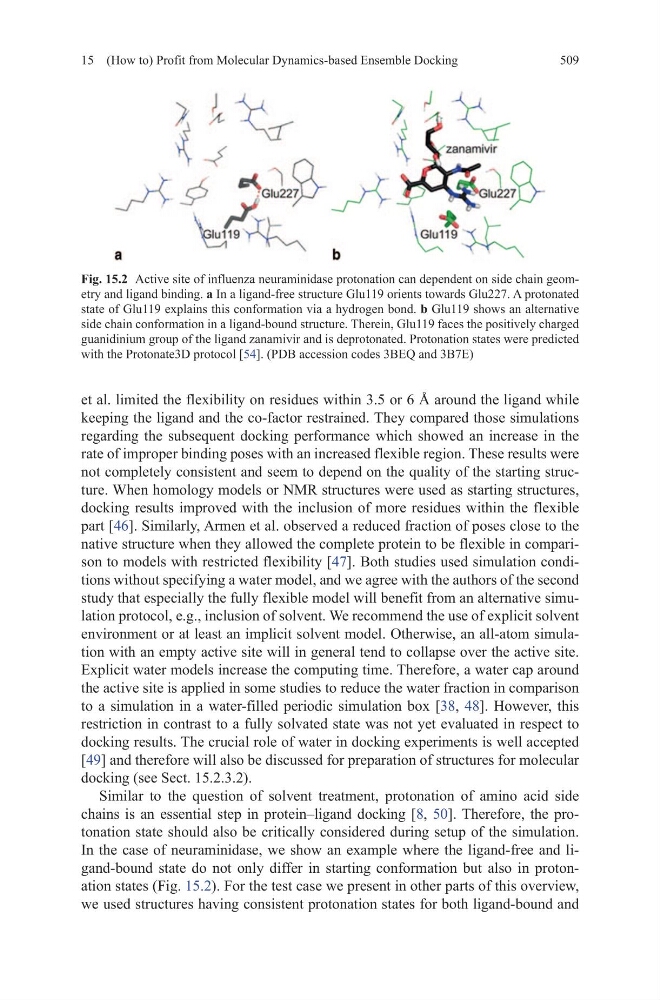
In the case of neuraminidase, we show an example where the ligand-free and ligand-bound state do not only differ in starting conformation but also in protonation states (Fig. 15.2). For the test case we present in other parts of this overview,
we used structures having consistent protonation states for both ligand-bound and
Fig. 15.2 Active site of influenza neuraminidase protonation can dependent on side chain geometry and ligand binding. a In a ligand-free structure Glu119 orients towards Glu227. A protonated
state of Glu119 explains this conformation via a hydrogen bond. b Glu119 shows an alternative
side chain conformation in a ligand-bound structure. Therein, Glu119 faces the positively charged
guanidinium group of the ligand zanamivir and is deprotonated. Protonation states were predicted
with the Protonate3D protocol [54]. (PDB accession codes 3BEQ and 3B7E)
15 (How to) Profit from Molecular Dynamics-based Ensemble Docking
et al. limited the flexibility on residues within 3.5 or 6 Å around the ligand while
keeping the ligand and the co-factor restrained. They compared those simulations
regarding the subsequent docking performance which showed an increase in the
rate of improper binding poses with an increased flexible region. These results were
not completely consistent and seem to depend on the quality of the starting structure. When homology models or NMR structures were used as starting structures,
docking results improved with the inclusion of more residues within the flexible
part [46]. Similarly, Armen et al. observed a reduced fraction of poses close to the
native structure when they allowed the complete protein to be flexible in comparison to models with restricted flexibility [47]. Both studies used simulation conditions without specifying a water model, and we agree with the authors of the second
study that especially the fully flexible model will benefit from an alternative simulation protocol, e.g., inclusion of solvent. We recommend the use of explicit solvent
environment or at least an implicit solvent model. Otherwise, an all-atom simulation with an empty active site will in general tend to collapse over the active site.
Explicit water models increase the computing time. Therefore, a water cap around
the active site is applied in some studies to reduce the water fraction in comparison
to a simulation in a water-filled periodic simulation box [38, 48]. However, this
restriction in contrast to a fully solvated state was not yet evaluated in respect to
docking results. The crucial role of water in docking experiments is well accepted
[49] and therefore will also be discussed for preparation of structures for molecular
docking (see Sect. 15.2.3.2).
Similar to the question of solvent treatment, protonation of amino acid side
chains is an essential step in protein–ligand docking [8, 50]. Therefore, the protonation state should also be critically considered during setup of the simulation.
In the case of neuraminidase, we show an example where the ligand-free and ligand-bound state do not only differ in starting conformation but also in protonation states (Fig. 15.2). For the test case we present in other parts of this overview,
we used structures having consistent protonation states for both ligand-bound and
Fig. 15.2 Active site of influenza neuraminidase protonation can dependent on side chain geometry and ligand binding. a In a ligand-free structure Glu119 orients towards Glu227. A protonated
state of Glu119 explains this conformation via a hydrogen bond. b Glu119 shows an alternative
side chain conformation in a ligand-bound structure. Therein, Glu119 faces the positively charged
guanidinium group of the ligand zanamivir and is deprotonated. Protonation states were predicted
with the Protonate3D protocol [54]. (PDB accession codes 3BEQ and 3B7E)