

482
N. Ya. Golovenko et al.
presence tert-butylamino and isopropylamino groups; (5) In the series of saturated
cycles, heterocycles reduce the degree of penetration compared to carbocycles.
14.4.1.3 Structure-Pharmacokinetic Relationships of Selected
1, 4-Benzodiazepines Derivatives
Today the number of 1,4-benzodiazepines derivatives synthesized in various laboratories of the world is over 3000 and 30 of them are drugs. This allows to choose
the compond or drug, which is the most suitable for a given purpose. However, the
physician must have the appropriate criteria (pharmacodynamics and pharmacokinetics) in order to declare that the drug has a certain advantage. The pharmacodynamic criteria include the duration of action of the benzodiazepines, which fall into
three groups: (a) short-action of 2–10 h (oxazepazepam, temazepam, triazolam);
(b) medium-action of about 10–15 h (alprozalam, bromazepam, lorazepam); and c)
long-action of 15–30 h (clobazam, clonazepam, diazepam, nitrazepam) [68].
The half-life of elimination ( t 1/2 ) of benzodiazepines is a special pharmacokinetic parameter. It clearly divides them into three groups: (a) long half-life 48 h and
above; (b) medium, 24–48 h; and (c) short, less than 24 h [69]. We note also that
clinical pharmacologists have recently linked the development of dependence on
benzodiazepines to t 1/2 [70]. The half-life of elimination is closely related through
the clearance ( Cl) to other pharmacokinetic parameters such as the distribution volume ( V d ) and the bioavailability ( F).
Drugs with a short t 1/2 (alprozalam) are prescribed to patients in doses of 0.2–
0.5 mg peroral 2–3 times per day; triazolam, 0.125–0.5 mg. For drugs with a medium t 1/2 (diazepam), the dose is 2–10 mg 2–4 times per day; long (flunitrazepam,
15–30 mg; gidazepam, 20–50 mg), 3 times per day.
These and other properties of benzodiazepine drugs make it critical to establish
the quantitative relationship between their structure and pharmacokinetic properties
in order to optimize their action and predict the properties of innovative drugs using
QSPR models developed by us.
Herein the effects of structure and physico-chemical properties of substituted
benzodiazepines (27 drugs, Table 14.6) on the change of their pharmacokinetic parameters ( t 1/2 , Cl, V d , F, t max ) in the human body are studied.
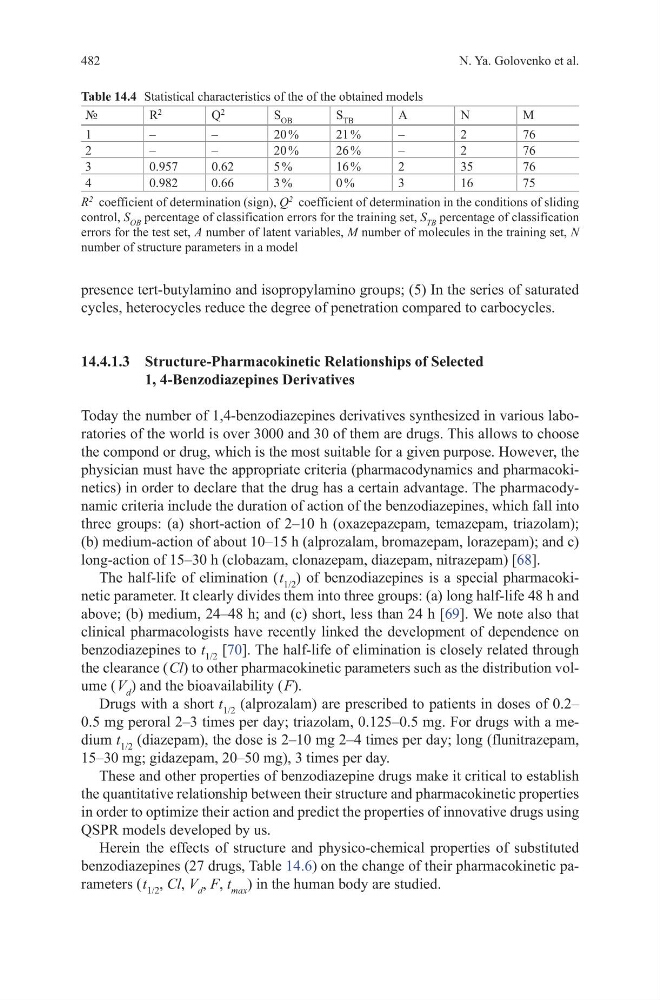
Table 14.4 Statistical characteristics of the of the obtained models
№
R
2
Q
2
S ОВ
S ТВ
A
N
M
1
–
–
20 %
21 %
–
2
76
2
–
–
20 %
26 %
–
2
76
3
0.957
0.62
5 %
16 %
2
35
76
4
0.982
0.66
3 %
0 %
3
16
75
R
2
coefficient of determination (sign), Q
2
coefficient of determination in the conditions of sliding
control, S ОВ percentage of classification errors for the training set, S ТВ percentage of classification
errors for the test set, A number of latent variables, M number of molecules in the training set, N
number of structure parameters in a model
N. Ya. Golovenko et al.
presence tert-butylamino and isopropylamino groups; (5) In the series of saturated
cycles, heterocycles reduce the degree of penetration compared to carbocycles.
14.4.1.3 Structure-Pharmacokinetic Relationships of Selected
1, 4-Benzodiazepines Derivatives
Today the number of 1,4-benzodiazepines derivatives synthesized in various laboratories of the world is over 3000 and 30 of them are drugs. This allows to choose
the compond or drug, which is the most suitable for a given purpose. However, the
physician must have the appropriate criteria (pharmacodynamics and pharmacokinetics) in order to declare that the drug has a certain advantage. The pharmacodynamic criteria include the duration of action of the benzodiazepines, which fall into
three groups: (a) short-action of 2–10 h (oxazepazepam, temazepam, triazolam);
(b) medium-action of about 10–15 h (alprozalam, bromazepam, lorazepam); and c)
long-action of 15–30 h (clobazam, clonazepam, diazepam, nitrazepam) [68].
The half-life of elimination ( t 1/2 ) of benzodiazepines is a special pharmacokinetic parameter. It clearly divides them into three groups: (a) long half-life 48 h and
above; (b) medium, 24–48 h; and (c) short, less than 24 h [69]. We note also that
clinical pharmacologists have recently linked the development of dependence on
benzodiazepines to t 1/2 [70]. The half-life of elimination is closely related through
the clearance ( Cl) to other pharmacokinetic parameters such as the distribution volume ( V d ) and the bioavailability ( F).
Drugs with a short t 1/2 (alprozalam) are prescribed to patients in doses of 0.2–
0.5 mg peroral 2–3 times per day; triazolam, 0.125–0.5 mg. For drugs with a medium t 1/2 (diazepam), the dose is 2–10 mg 2–4 times per day; long (flunitrazepam,
15–30 mg; gidazepam, 20–50 mg), 3 times per day.
These and other properties of benzodiazepine drugs make it critical to establish
the quantitative relationship between their structure and pharmacokinetic properties
in order to optimize their action and predict the properties of innovative drugs using
QSPR models developed by us.
Herein the effects of structure and physico-chemical properties of substituted
benzodiazepines (27 drugs, Table 14.6) on the change of their pharmacokinetic parameters ( t 1/2 , Cl, V d , F, t max ) in the human body are studied.
Table 14.4 Statistical characteristics of the of the obtained models
№
R
2
Q
2
S ОВ
S ТВ
A
N
M
1
–
–
20 %
21 %
–
2
76
2
–
–
20 %
26 %
–
2
76
3
0.957
0.62
5 %
16 %
2
35
76
4
0.982
0.66
3 %
0 %
3
16
75
R
2
coefficient of determination (sign), Q
2
coefficient of determination in the conditions of sliding
control, S ОВ percentage of classification errors for the training set, S ТВ percentage of classification
errors for the test set, A number of latent variables, M number of molecules in the training set, N
number of structure parameters in a model