

480
N. Ya. Golovenko et al.
within the framework of BCS. To the set of studied compounds, 95 representatives
of listed drugs relating to 4 classes of BCS, were included.
Class 1 (High Permeability, High Solubility): Albuterol, Allopurinol,
Amlodipine (Amlo), Amoxicillin, Antipyrine, Dexamethasone, Diltiazem, Zidovudine, Isosorbide mononitrate, Ketoprofen, Lamivudine, Levonorgestrel, Levofloxacin, Metronidazole, Midazolam, Minocycline, Morphine, Nifedipine, Ofloxacin,
Prednisolone, Pгоpylthiouracil, Stavudine, Phenobarbital, Fluconazole, Chinin,
Enalapril, Acetaminophen*, Diazepam*, Isoniazid*, Levodopa*, Metoprolol*,
Paracetamol*, Pyrazinamide*, Salicylic acid*, Ethinylestradiol*.
Class 2 (High Permeability, Low Solubility): Azathioprine, Azithromycin, Alprazolam, Warfarin, Haloperidol, Glipizide, Griseofulvinum, Danazol, Dapsone,
Diclofenac, Indometacin, Itraconzol, Carbamazepine, Carvedilol, Ketoconazole,
Lansoprazol, Mebendazole, Mefloquine, Nalidixic acid, Nevirapine, Piroxicam,
Praziquantel, Ritonavir, Rifampicinum, Spironolactone, Tamoxifen, Terfenadine,
Trimethoprim, Ibuprofen*, Iopanoic acid*, Lovastatin*, Naproxen*, Oxaprozin*,
Flubiprofen*, Cisapride*.
Class 3 (Low Permeability, High Solubility): Atropine, Aciclovir, Valsartan, Gancyclovir, Didanosine, Dicloxacillin, Zalcitabine, Lomefloxacin, Methyldopa, Methotrexatum, Nadolol, Pravastatin, Ranitidine, Tetracycline, Famotidine, Cefazolin,
Ciprofloxacin, Erythromycin, Atenolol*, Hydrochlorothiazide*, Metformin*.
Class 4 (Low Permeability, Low Solubility): Sulfasalazine, Таlinololum, Furosemide, Chlorothiazide. (drugs marked with asterisks * are included to the test set).
They were selected randomly and not used for constructing of models, they were
only used to examine the predictive ability of models.
In order to determinate both parameters simultaneously, at first, for all molecules, simplex (local) and some integral (describing the entire molecule) descriptors
(just over 10 thousand) were calculated by us. Differentiation of atoms in simplex
was conducted based on the following characteristics: (1) the type of atom; (2) partial charge; (3) lipophilicity of atom, (4) atomic refraction; (5) possibility of atom to
act as a donor/acceptor of hydrogen in the formation of hydrogen bonds.
Total solubility ( C S ) of the active pharmaceutical ingredient in an aqueous medium and the coefficient of penetration (P) of an active pharmaceutical ingredient
through the lipophilic part of biomembranes have been represented as binary scale
(0—low property value, 1—high property value).
Two models that adequately describe the solubility and penetration of compounds were obtained using classification and regression trees approach (Fig. 14.4).
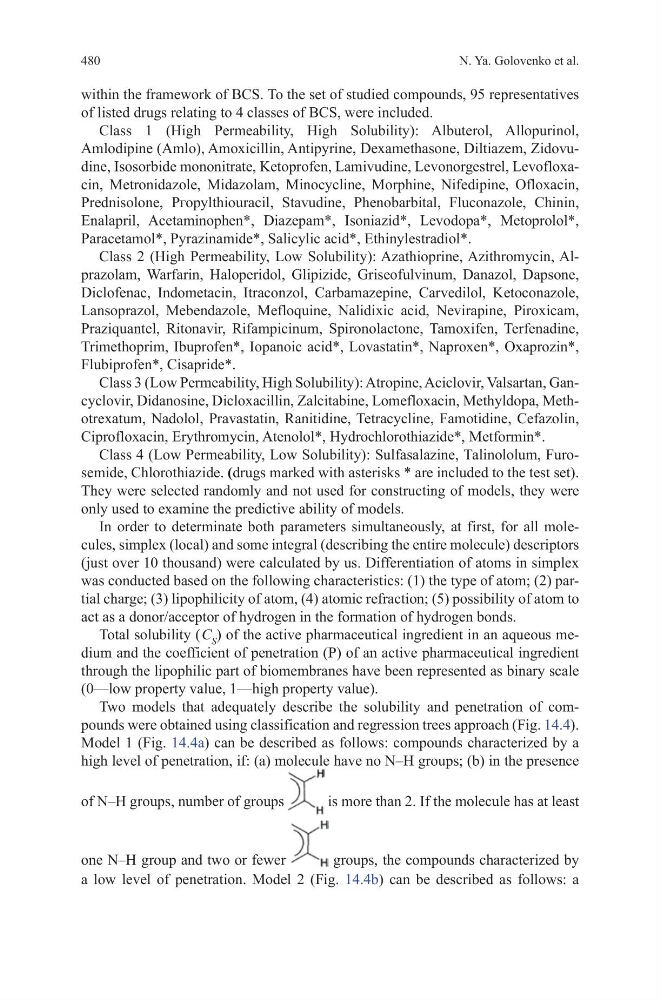
Model 1 (Fig. 14.4a) can be described as follows: compounds characterized by a
high level of penetration, if: (a) molecule have no N–H groups; (b) in the presence
of N–H groups, number of groups
is more than 2. If the molecule has at least
one N–H group and two or fewer
groups, the compounds characterized by
a low level of penetration. Model 2 (Fig. 14.4b) can be described as follows: a
N. Ya. Golovenko et al.
within the framework of BCS. To the set of studied compounds, 95 representatives
of listed drugs relating to 4 classes of BCS, were included.
Class 1 (High Permeability, High Solubility): Albuterol, Allopurinol,
Amlodipine (Amlo), Amoxicillin, Antipyrine, Dexamethasone, Diltiazem, Zidovudine, Isosorbide mononitrate, Ketoprofen, Lamivudine, Levonorgestrel, Levofloxacin, Metronidazole, Midazolam, Minocycline, Morphine, Nifedipine, Ofloxacin,
Prednisolone, Pгоpylthiouracil, Stavudine, Phenobarbital, Fluconazole, Chinin,
Enalapril, Acetaminophen*, Diazepam*, Isoniazid*, Levodopa*, Metoprolol*,
Paracetamol*, Pyrazinamide*, Salicylic acid*, Ethinylestradiol*.
Class 2 (High Permeability, Low Solubility): Azathioprine, Azithromycin, Alprazolam, Warfarin, Haloperidol, Glipizide, Griseofulvinum, Danazol, Dapsone,
Diclofenac, Indometacin, Itraconzol, Carbamazepine, Carvedilol, Ketoconazole,
Lansoprazol, Mebendazole, Mefloquine, Nalidixic acid, Nevirapine, Piroxicam,
Praziquantel, Ritonavir, Rifampicinum, Spironolactone, Tamoxifen, Terfenadine,
Trimethoprim, Ibuprofen*, Iopanoic acid*, Lovastatin*, Naproxen*, Oxaprozin*,
Flubiprofen*, Cisapride*.
Class 3 (Low Permeability, High Solubility): Atropine, Aciclovir, Valsartan, Gancyclovir, Didanosine, Dicloxacillin, Zalcitabine, Lomefloxacin, Methyldopa, Methotrexatum, Nadolol, Pravastatin, Ranitidine, Tetracycline, Famotidine, Cefazolin,
Ciprofloxacin, Erythromycin, Atenolol*, Hydrochlorothiazide*, Metformin*.
Class 4 (Low Permeability, Low Solubility): Sulfasalazine, Таlinololum, Furosemide, Chlorothiazide. (drugs marked with asterisks * are included to the test set).
They were selected randomly and not used for constructing of models, they were
only used to examine the predictive ability of models.
In order to determinate both parameters simultaneously, at first, for all molecules, simplex (local) and some integral (describing the entire molecule) descriptors
(just over 10 thousand) were calculated by us. Differentiation of atoms in simplex
was conducted based on the following characteristics: (1) the type of atom; (2) partial charge; (3) lipophilicity of atom, (4) atomic refraction; (5) possibility of atom to
act as a donor/acceptor of hydrogen in the formation of hydrogen bonds.
Total solubility ( C S ) of the active pharmaceutical ingredient in an aqueous medium and the coefficient of penetration (P) of an active pharmaceutical ingredient
through the lipophilic part of biomembranes have been represented as binary scale
(0—low property value, 1—high property value).
Two models that adequately describe the solubility and penetration of compounds were obtained using classification and regression trees approach (Fig. 14.4).
Model 1 (Fig. 14.4a) can be described as follows: compounds characterized by a
high level of penetration, if: (a) molecule have no N–H groups; (b) in the presence
of N–H groups, number of groups
is more than 2. If the molecule has at least
one N–H group and two or fewer
groups, the compounds characterized by
a low level of penetration. Model 2 (Fig. 14.4b) can be described as follows: a