

466
N. Ya. Golovenko et al.
Bioavailability is the degree to which or the rate at which an API from corresponding drug dosage form and at the targeted place of administration in systemic circulation becomes available in the biophase. Such definition reflects relative character of
the notion of biological availability of drugs. In experiments, intestinal absorption
is usually measured by fraction absorption, % F, which is defined by the fraction of
total mass absorbed to the given dose of the drug.
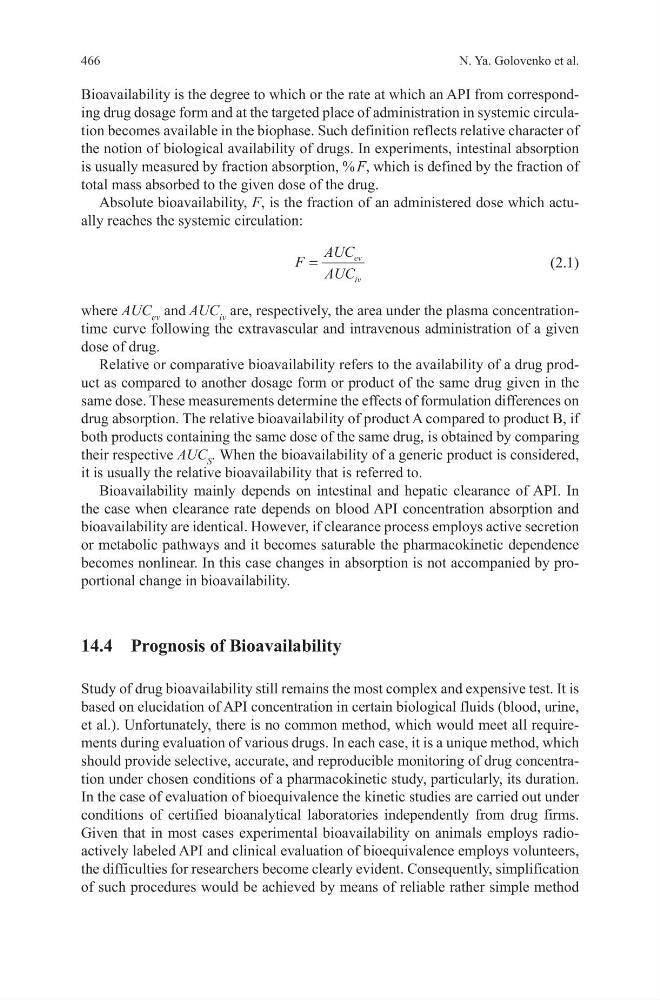
Absolute bioavailability, F, is the fraction of an administered dose which actually reaches the systemic circulation:
(2.1)
where AUC ev and AUC iv are, respectively, the area under the plasma concentrationtime curve following the extravascular and intravenous administration of a given
dose of drug.
Relative or comparative bioavailability refers to the availability of a drug product as compared to another dosage form or product of the same drug given in the
same dose. These measurements determine the effects of formulation differences on
drug absorption. The relative bioavailability of product A compared to product B, if
both products containing the same dose of the same drug, is obtained by comparing
their respective AUC S . When the bioavailability of a generic product is considered,
it is usually the relative bioavailability that is referred to.
Bioavailability mainly depends on intestinal and hepatic clearance of API. In
the case when clearance rate depends on blood API concentration absorption and
bioavailability are identical. However, if clearance process employs active secretion
or metabolic pathways and it becomes saturable the pharmacokinetic dependence
becomes nonlinear. In this case changes in absorption is not accompanied by proportional change in bioavailability.
14.4 Prognosis of Bioavailability
Study of drug bioavailability still remains the most complex and expensive test. It is
based on elucidation of API concentration in certain biological fluids (blood, urine,
et al.). Unfortunately, there is no common method, which would meet all requirements during evaluation of various drugs. In each case, it is a unique method, which
should provide selective, accurate, and reproducible monitoring of drug concentration under chosen conditions of a pharmacokinetic study, particularly, its duration.
In the case of evaluation of bioequivalence the kinetic studies are carried out under
conditions of certified bioanalytical laboratories independently from drug firms.
Given that in most cases experimental bioavailability on animals employs radioactively labeled API and clinical evaluation of bioequivalence employs volunteers,
the difficulties for researchers become clearly evident. Consequently, simplification
of such procedures would be achieved by means of reliable rather simple method
F
AUC
AUC
ev
iv
=
N. Ya. Golovenko et al.
Bioavailability is the degree to which or the rate at which an API from corresponding drug dosage form and at the targeted place of administration in systemic circulation becomes available in the biophase. Such definition reflects relative character of
the notion of biological availability of drugs. In experiments, intestinal absorption
is usually measured by fraction absorption, % F, which is defined by the fraction of
total mass absorbed to the given dose of the drug.
Absolute bioavailability, F, is the fraction of an administered dose which actually reaches the systemic circulation:
(2.1)
where AUC ev and AUC iv are, respectively, the area under the plasma concentrationtime curve following the extravascular and intravenous administration of a given
dose of drug.
Relative or comparative bioavailability refers to the availability of a drug product as compared to another dosage form or product of the same drug given in the
same dose. These measurements determine the effects of formulation differences on
drug absorption. The relative bioavailability of product A compared to product B, if
both products containing the same dose of the same drug, is obtained by comparing
their respective AUC S . When the bioavailability of a generic product is considered,
it is usually the relative bioavailability that is referred to.
Bioavailability mainly depends on intestinal and hepatic clearance of API. In
the case when clearance rate depends on blood API concentration absorption and
bioavailability are identical. However, if clearance process employs active secretion
or metabolic pathways and it becomes saturable the pharmacokinetic dependence
becomes nonlinear. In this case changes in absorption is not accompanied by proportional change in bioavailability.
14.4 Prognosis of Bioavailability
Study of drug bioavailability still remains the most complex and expensive test. It is
based on elucidation of API concentration in certain biological fluids (blood, urine,
et al.). Unfortunately, there is no common method, which would meet all requirements during evaluation of various drugs. In each case, it is a unique method, which
should provide selective, accurate, and reproducible monitoring of drug concentration under chosen conditions of a pharmacokinetic study, particularly, its duration.
In the case of evaluation of bioequivalence the kinetic studies are carried out under
conditions of certified bioanalytical laboratories independently from drug firms.
Given that in most cases experimental bioavailability on animals employs radioactively labeled API and clinical evaluation of bioequivalence employs volunteers,
the difficulties for researchers become clearly evident. Consequently, simplification
of such procedures would be achieved by means of reliable rather simple method
F
AUC
AUC
ev
iv
=