

454
I. I. Baskin and N. I. Zhokhova
Several ways to prevent this phenomenon have been suggested in literature, including Bayesian regularization of hyper-parameters [73] and hyper-parameter averaging [74]. Algorithms of multiple kernel learning [75] might also be useful in this
case. For small datasets the preferred solution would be to apply the full Bayesian
approach [66], where the hyper-parameters are integrated out rather than optimized.
Integration of approaches to prevent the model selection bias is one of the most
important tasks for further development of the CMF approach.
13.4.8 Combining with Different Machine Learning Methods
The CMF approach is easily extensible thanks to its modularity. By combining different types of molecular fields, different types of kernels with different types of
kernel-based machine learning methods, one can obtain various methods for building SAR/QSAR/QSPR models and conducting virtual screening. Although some of
such methods may be similar to the existing ones, nonetheless it is likely that some
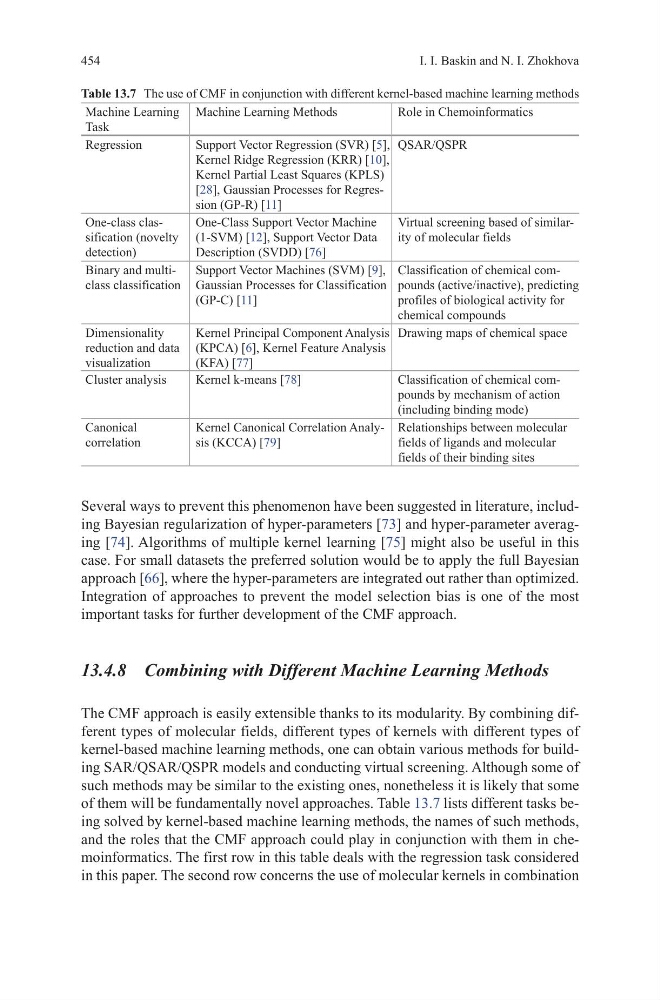
of them will be fundamentally novel approaches. Table 13.7 lists different tasks being solved by kernel-based machine learning methods, the names of such methods,
and the roles that the CMF approach could play in conjunction with them in chemoinformatics. The first row in this table deals with the regression task considered
in this paper. The second row concerns the use of molecular kernels in combination
Table 13.7 The use of CMF in conjunction with different kernel-based machine learning methods
Machine Learning
Task
Machine Learning Methods
Role in Chemoinformatics
Regression
Support Vector Regression (SVR) [5],
Kernel Ridge Regression (KRR) [10],
Kernel Partial Least Squares (KPLS)
[28], Gaussian Processes for Regression (GP-R) [11]
QSAR/QSPR
One-class classification (novelty
detection)
One-Class Support Vector Machine
(1-SVM) [12], Support Vector Data
Description (SVDD) [76]
Virtual screening based of similarity of molecular fields
Binary and multiclass classification
Support Vector Machines (SVM) [9],
Gaussian Processes for Classification
(GP-C) [11]
Classification of chemical compounds (active/inactive), predicting
profiles of biological activity for
chemical compounds
Dimensionality
reduction and data
visualization
Kernel Principal Component Analysis
(KPCA) [6], Kernel Feature Analysis
(KFA) [77]
Drawing maps of chemical space
Cluster analysis
Kernel k-means [78]
Classification of chemical compounds by mechanism of action
(including binding mode)
Canonical
correlation
Kernel Canonical Correlation Analysis (KCCA) [79]
Relationships between molecular
fields of ligands and molecular
fields of their binding sites
I. I. Baskin and N. I. Zhokhova
Several ways to prevent this phenomenon have been suggested in literature, including Bayesian regularization of hyper-parameters [73] and hyper-parameter averaging [74]. Algorithms of multiple kernel learning [75] might also be useful in this
case. For small datasets the preferred solution would be to apply the full Bayesian
approach [66], where the hyper-parameters are integrated out rather than optimized.
Integration of approaches to prevent the model selection bias is one of the most
important tasks for further development of the CMF approach.
13.4.8 Combining with Different Machine Learning Methods
The CMF approach is easily extensible thanks to its modularity. By combining different types of molecular fields, different types of kernels with different types of
kernel-based machine learning methods, one can obtain various methods for building SAR/QSAR/QSPR models and conducting virtual screening. Although some of
such methods may be similar to the existing ones, nonetheless it is likely that some
of them will be fundamentally novel approaches. Table 13.7 lists different tasks being solved by kernel-based machine learning methods, the names of such methods,
and the roles that the CMF approach could play in conjunction with them in chemoinformatics. The first row in this table deals with the regression task considered
in this paper. The second row concerns the use of molecular kernels in combination
Table 13.7 The use of CMF in conjunction with different kernel-based machine learning methods
Machine Learning
Task
Machine Learning Methods
Role in Chemoinformatics
Regression
Support Vector Regression (SVR) [5],
Kernel Ridge Regression (KRR) [10],
Kernel Partial Least Squares (KPLS)
[28], Gaussian Processes for Regression (GP-R) [11]
QSAR/QSPR
One-class classification (novelty
detection)
One-Class Support Vector Machine
(1-SVM) [12], Support Vector Data
Description (SVDD) [76]
Virtual screening based of similarity of molecular fields
Binary and multiclass classification
Support Vector Machines (SVM) [9],
Gaussian Processes for Classification
(GP-C) [11]
Classification of chemical compounds (active/inactive), predicting
profiles of biological activity for
chemical compounds
Dimensionality
reduction and data
visualization
Kernel Principal Component Analysis
(KPCA) [6], Kernel Feature Analysis
(KFA) [77]
Drawing maps of chemical space
Cluster analysis
Kernel k-means [78]
Classification of chemical compounds by mechanism of action
(including binding mode)
Canonical
correlation
Kernel Canonical Correlation Analysis (KCCA) [79]
Relationships between molecular
fields of ligands and molecular
fields of their binding sites