

30
M. P. Evstigneev and A. V. Shestopalova
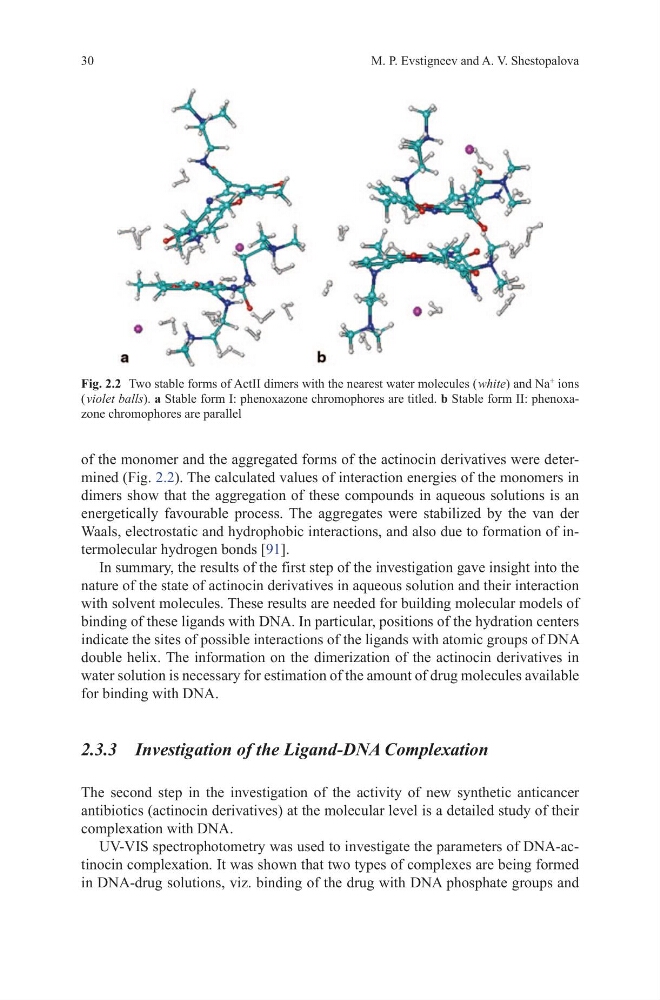
of the monomer and the aggregated forms of the actinocin derivatives were determined (Fig. 2.2). The calculated values of interaction energies of the monomers in
dimers show that the aggregation of these compounds in aqueous solutions is an
energetically favourable process. The aggregates were stabilized by the van der
Waals, electrostatic and hydrophobic interactions, and also due to formation of intermolecular hydrogen bonds [91].
In summary, the results of the first step of the investigation gave insight into the
nature of the state of actinocin derivatives in aqueous solution and their interaction
with solvent molecules. These results are needed for building molecular models of
binding of these ligands with DNA. In particular, positions of the hydration centers
indicate the sites of possible interactions of the ligands with atomic groups of DNA
double helix. The information on the dimerization of the actinocin derivatives in
water solution is necessary for estimation of the amount of drug molecules available
for binding with DNA.
2.3.3 Investigation of the Ligand-DNA Complexation
The second step in the investigation of the activity of new synthetic anticancer
antibiotics (actinocin derivatives) at the molecular level is a detailed study of their
complexation with DNA.
UV-VIS spectrophotometry was used to investigate the parameters of DNA-actinocin complexation. It was shown that two types of complexes are being formed
in DNA-drug solutions, viz. binding of the drug with DNA phosphate groups and
Fig. 2.2 Two stable forms of ActII dimers with the nearest water molecules ( white) and Na
+
ions
( violet balls). a Stable form I: phenoxazone chromophores are titled. b Stable form II: phenoxazone chromophores are parallel
M. P. Evstigneev and A. V. Shestopalova
of the monomer and the aggregated forms of the actinocin derivatives were determined (Fig. 2.2). The calculated values of interaction energies of the monomers in
dimers show that the aggregation of these compounds in aqueous solutions is an
energetically favourable process. The aggregates were stabilized by the van der
Waals, electrostatic and hydrophobic interactions, and also due to formation of intermolecular hydrogen bonds [91].
In summary, the results of the first step of the investigation gave insight into the
nature of the state of actinocin derivatives in aqueous solution and their interaction
with solvent molecules. These results are needed for building molecular models of
binding of these ligands with DNA. In particular, positions of the hydration centers
indicate the sites of possible interactions of the ligands with atomic groups of DNA
double helix. The information on the dimerization of the actinocin derivatives in
water solution is necessary for estimation of the amount of drug molecules available
for binding with DNA.
2.3.3 Investigation of the Ligand-DNA Complexation
The second step in the investigation of the activity of new synthetic anticancer
antibiotics (actinocin derivatives) at the molecular level is a detailed study of their
complexation with DNA.
UV-VIS spectrophotometry was used to investigate the parameters of DNA-actinocin complexation. It was shown that two types of complexes are being formed
in DNA-drug solutions, viz. binding of the drug with DNA phosphate groups and
Fig. 2.2 Two stable forms of ActII dimers with the nearest water molecules ( white) and Na
+
ions
( violet balls). a Stable form I: phenoxazone chromophores are titled. b Stable form II: phenoxazone chromophores are parallel