

418
P. M. Vassiliev et al.
The estimates of the existence of pharmacological activity were made on 11
levels of QL description by three methods: the Bayesian approach, distance method
and chance method [97, 105, 119, 120]. The conclusion on whether the compound
showed a particular activity was made using the conservative strategy and a qualified 2/3 majority. The compound was deemed active/inactive within the framework
of one method if at least 8 out of 11 prediction estimates coincided. The final judgment about the activity of the compound was made if the evaluations of all three
methods coincided; otherwise, the result was regarded as indefinite. An integral
conclusion about the activity of an extract as a whole was made according to the
ratio of the positive and negative final estimates of the 23 compounds.
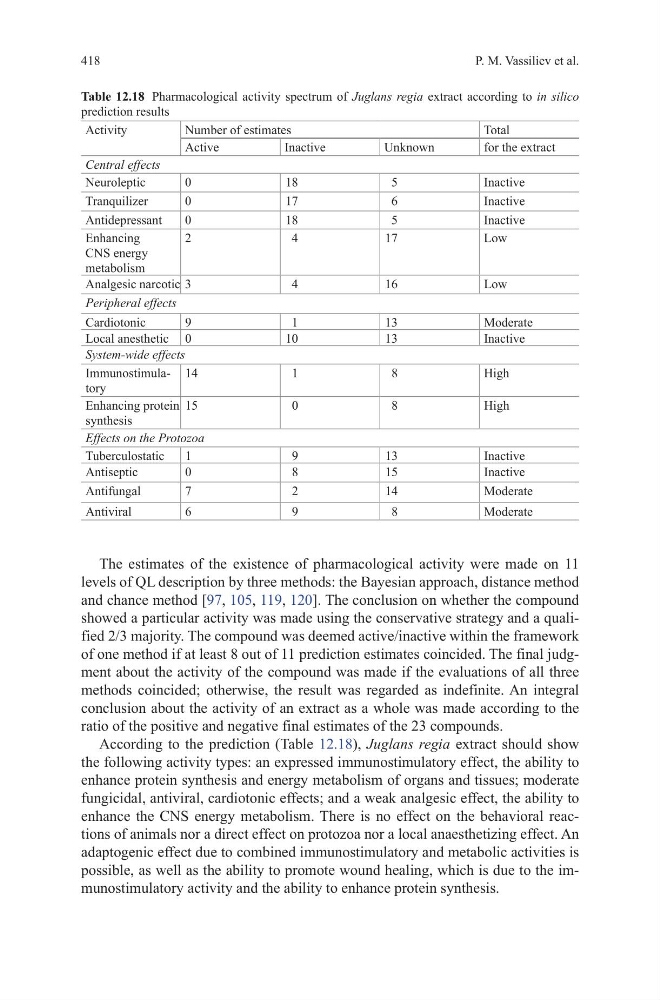
According to the prediction (Table 12.18), Juglans regia extract should show
the following activity types: an expressed immunostimulatory effect, the ability to
enhance protein synthesis and energy metabolism of organs and tissues; moderate
fungicidal, antiviral, cardiotonic effects; and a weak analgesic effect, the ability to
enhance the CNS energy metabolism. There is no effect on the behavioral reactions of animals nor a direct effect on protozoa nor a local anaesthetizing effect. An
adaptogenic effect due to combined immunostimulatory and metabolic activities is
possible, as well as the ability to promote wound healing, which is due to the immunostimulatory activity and the ability to enhance protein synthesis.
Table 12.18 Pharmacological activity spectrum of Juglans regia extract according to in silico
prediction results
Activity
Number of estimates
Total
Active
Inactive
Unknown
for the extract
Central effects
Neuroleptic
0
18
5
Inactive
Tranquilizer
0
17
6
Inactive
Antidepressant
0
18
5
Inactive
Enhancing
CNS energy
metabolism
2
4
17
Low
Analgesic narcotic 3
4
16
Low
Peripheral effects
Cardiotonic
9
1
13
Moderate
Local anesthetic 0
10
13
Inactive
System-wide effects
Immunostimulatory
14
1
8
High
Enhancing protein
synthesis
15
0
8
High
Effects on the Protozoa
Tuberculostatic
1
9
13
Inactive
Antiseptic
0
8
15
Inactive
Antifungal
7
2
14
Moderate
Antiviral
6
9
8
Moderate
P. M. Vassiliev et al.
The estimates of the existence of pharmacological activity were made on 11
levels of QL description by three methods: the Bayesian approach, distance method
and chance method [97, 105, 119, 120]. The conclusion on whether the compound
showed a particular activity was made using the conservative strategy and a qualified 2/3 majority. The compound was deemed active/inactive within the framework
of one method if at least 8 out of 11 prediction estimates coincided. The final judgment about the activity of the compound was made if the evaluations of all three
methods coincided; otherwise, the result was regarded as indefinite. An integral
conclusion about the activity of an extract as a whole was made according to the
ratio of the positive and negative final estimates of the 23 compounds.
According to the prediction (Table 12.18), Juglans regia extract should show
the following activity types: an expressed immunostimulatory effect, the ability to
enhance protein synthesis and energy metabolism of organs and tissues; moderate
fungicidal, antiviral, cardiotonic effects; and a weak analgesic effect, the ability to
enhance the CNS energy metabolism. There is no effect on the behavioral reactions of animals nor a direct effect on protozoa nor a local anaesthetizing effect. An
adaptogenic effect due to combined immunostimulatory and metabolic activities is
possible, as well as the ability to promote wound healing, which is due to the immunostimulatory activity and the ability to enhance protein synthesis.
Table 12.18 Pharmacological activity spectrum of Juglans regia extract according to in silico
prediction results
Activity
Number of estimates
Total
Active
Inactive
Unknown
for the extract
Central effects
Neuroleptic
0
18
5
Inactive
Tranquilizer
0
17
6
Inactive
Antidepressant
0
18
5
Inactive
Enhancing
CNS energy
metabolism
2
4
17
Low
Analgesic narcotic 3
4
16
Low
Peripheral effects
Cardiotonic
9
1
13
Moderate
Local anesthetic 0
10
13
Inactive
System-wide effects
Immunostimulatory
14
1
8
High
Enhancing protein
synthesis
15
0
8
High
Effects on the Protozoa
Tuberculostatic
1
9
13
Inactive
Antiseptic
0
8
15
Inactive
Antifungal
7
2
14
Moderate
Antiviral
6
9
8
Moderate