

416
P. M. Vassiliev et al.
The following Δ max values were obtained: (XIII)—36.9 %, (XIII–GA 1:1)—
55.8 %, (XIII–GA 1:2)—55.9 %, (XIII–GA 1:3)—54.7 % and (XIII–GA 1:4)—
65.5 %. The clathrates of the compositions (XIII–GA 1:1), (XIII–GA 1:2) and
(XIII–GA 1:3) showed the same activity, which was approximately 1.5 times higher
than the activity of the pure compound (XIII), whereas the clathrate of compound
(XIII–GA 1:4) was 1.77 times more active than substance (XIII). The correlation
coefficient between the calculated estimate ∑∑Rank and the experimental value
Δ max amounted to R = 0.965.
Thus, the optimal composition of the (XIII–GA 1:4) clathrate with the highest
level of antioxidant activity was established computationally and confirmed experimentally.
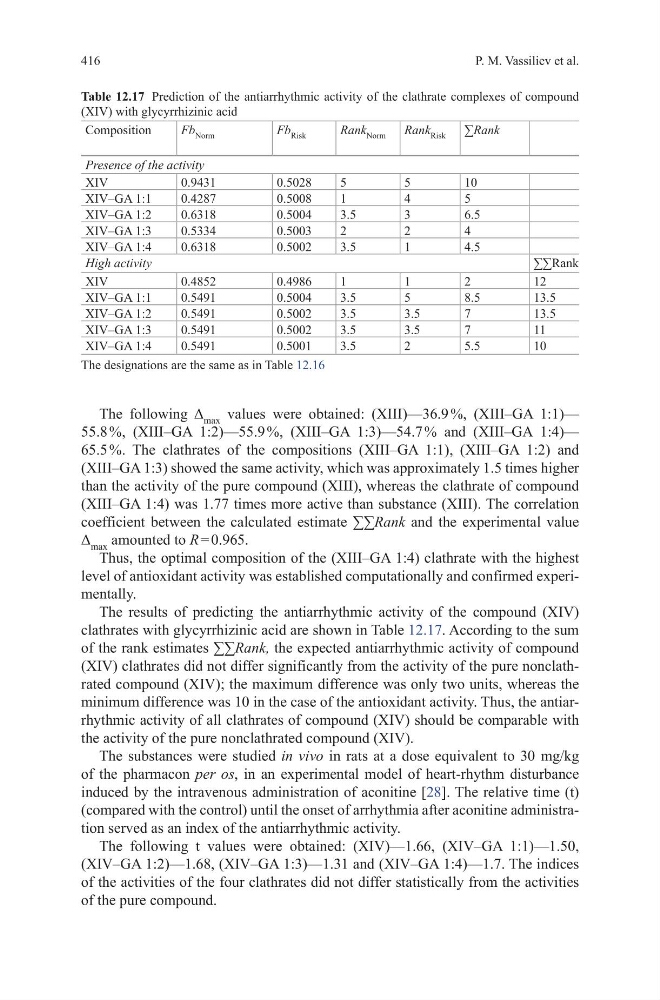
The results of predicting the antiarrhythmic activity of the compound (XIV)
clathrates with glycyrrhizinic acid are shown in Table 12.17. According to the sum
of the rank estimates ∑∑Rank, the expected antiarrhythmic activity of compound
(XIV) clathrates did not differ significantly from the activity of the pure nonclathrated compound (XIV); the maximum difference was only two units, whereas the
minimum difference was 10 in the case of the antioxidant activity. Thus, the antiarrhythmic activity of all clathrates of compound (XIV) should be comparable with
the activity of the pure nonclathrated compound (XIV).
The substances were studied in vivo in rats at a dose equivalent to 30 mg/kg
of the pharmacon per os, in an experimental model of heart-rhythm disturbance
induced by the intravenous administration of aconitine [28]. The relative time (t)
(compared with the control) until the onset of arrhythmia after aconitine administration served as an index of the antiarrhythmic activity.
The following t values were obtained: (XIV)—1.66, (XIV–GA 1:1)—1.50,
(XIV–GA 1:2)—1.68, (XIV–GA 1:3)—1.31 and (XIV–GA 1:4)—1.7. The indices
of the activities of the four clathrates did not differ statistically from the activities
of the pure compound.
Table 12.17 Prediction of the antiarrhythmic activity of the clathrate complexes of compound
(XIV) with glycyrrhizinic acid
Composition
Fb Norm
Fb Risk
Rank Norm Rank Risk ∑Rank
Presence of the activity
XIV
0.9431
0.5028
5
5
10
XIV–GA 1:1
0.4287
0.5008
1
4
5
XIV–GA 1:2
0.6318
0.5004
3.5
3
6.5
XIV–GA 1:3
0.5334
0.5003
2
2
4
XIV–GA 1:4
0.6318
0.5002
3.5
1
4.5
High activity
∑∑Rank
XIV
0.4852
0.4986
1
1
2
12
XIV–GA 1:1
0.5491
0.5004
3.5
5
8.5
13.5
XIV–GA 1:2
0.5491
0.5002
3.5
3.5
7
13.5
XIV–GA 1:3
0.5491
0.5002
3.5
3.5
7
11
XIV–GA 1:4
0.5491
0.5001
3.5
2
5.5
10
The designations are the same as in Table 12.16
P. M. Vassiliev et al.
The following Δ max values were obtained: (XIII)—36.9 %, (XIII–GA 1:1)—
55.8 %, (XIII–GA 1:2)—55.9 %, (XIII–GA 1:3)—54.7 % and (XIII–GA 1:4)—
65.5 %. The clathrates of the compositions (XIII–GA 1:1), (XIII–GA 1:2) and
(XIII–GA 1:3) showed the same activity, which was approximately 1.5 times higher
than the activity of the pure compound (XIII), whereas the clathrate of compound
(XIII–GA 1:4) was 1.77 times more active than substance (XIII). The correlation
coefficient between the calculated estimate ∑∑Rank and the experimental value
Δ max amounted to R = 0.965.
Thus, the optimal composition of the (XIII–GA 1:4) clathrate with the highest
level of antioxidant activity was established computationally and confirmed experimentally.
The results of predicting the antiarrhythmic activity of the compound (XIV)
clathrates with glycyrrhizinic acid are shown in Table 12.17. According to the sum
of the rank estimates ∑∑Rank, the expected antiarrhythmic activity of compound
(XIV) clathrates did not differ significantly from the activity of the pure nonclathrated compound (XIV); the maximum difference was only two units, whereas the
minimum difference was 10 in the case of the antioxidant activity. Thus, the antiarrhythmic activity of all clathrates of compound (XIV) should be comparable with
the activity of the pure nonclathrated compound (XIV).
The substances were studied in vivo in rats at a dose equivalent to 30 mg/kg
of the pharmacon per os, in an experimental model of heart-rhythm disturbance
induced by the intravenous administration of aconitine [28]. The relative time (t)
(compared with the control) until the onset of arrhythmia after aconitine administration served as an index of the antiarrhythmic activity.
The following t values were obtained: (XIV)—1.66, (XIV–GA 1:1)—1.50,
(XIV–GA 1:2)—1.68, (XIV–GA 1:3)—1.31 and (XIV–GA 1:4)—1.7. The indices
of the activities of the four clathrates did not differ statistically from the activities
of the pure compound.
Table 12.17 Prediction of the antiarrhythmic activity of the clathrate complexes of compound
(XIV) with glycyrrhizinic acid
Composition
Fb Norm
Fb Risk
Rank Norm Rank Risk ∑Rank
Presence of the activity
XIV
0.9431
0.5028
5
5
10
XIV–GA 1:1
0.4287
0.5008
1
4
5
XIV–GA 1:2
0.6318
0.5004
3.5
3
6.5
XIV–GA 1:3
0.5334
0.5003
2
2
4
XIV–GA 1:4
0.6318
0.5002
3.5
1
4.5
High activity
∑∑Rank
XIV
0.4852
0.4986
1
1
2
12
XIV–GA 1:1
0.5491
0.5004
3.5
5
8.5
13.5
XIV–GA 1:2
0.5491
0.5002
3.5
3.5
7
13.5
XIV–GA 1:3
0.5491
0.5002
3.5
3.5
7
11
XIV–GA 1:4
0.5491
0.5001
3.5
2
5.5
10
The designations are the same as in Table 12.16