

411
12 Consensus Drug Design Using IT Microcosm
On the basis of the predicted results, 49 substances out of 745 novel, untested
condensed azole derivatives were selected for an experimental study. The substances had 3A for a high activity in all three strategies and a conformity coefficient of
the prediction-estimates spectrum K High > 0.9.
According to the experimental data, of 49 compounds, 48 (98.0 %) showed an
expressed antiplatelet activity Δ (10
−4
) > 10.0 %; of these, 39 compounds (79.6 %)
showed a high activity Δ (10
−4
) > 25.0 %. Of 39 highly active compounds, 19
(48.7 %) showed an activity comparable to that of Aspirin, the drug for comparison,
and 17 compounds (43.6 %) exceeded the antiplatelet activity of Aspirin.
When 312 training-set compounds were tested for their antiplatelet activity, no
computational methods of prediction were used. The primary screening detected
153 and 71 substances with expressed and high activity, respectively; that is, the accuracy of the intuitive prediction amounts to 49.0 % and 22.8 %, respectively. Thus,
the accuracy of the search for an expressed antiplatelet activity with IT Microcosm
was twice as high, and of those with a high antiplatelet activity, it was 3.49 times
higher than the accuracy of intuitive prediction.
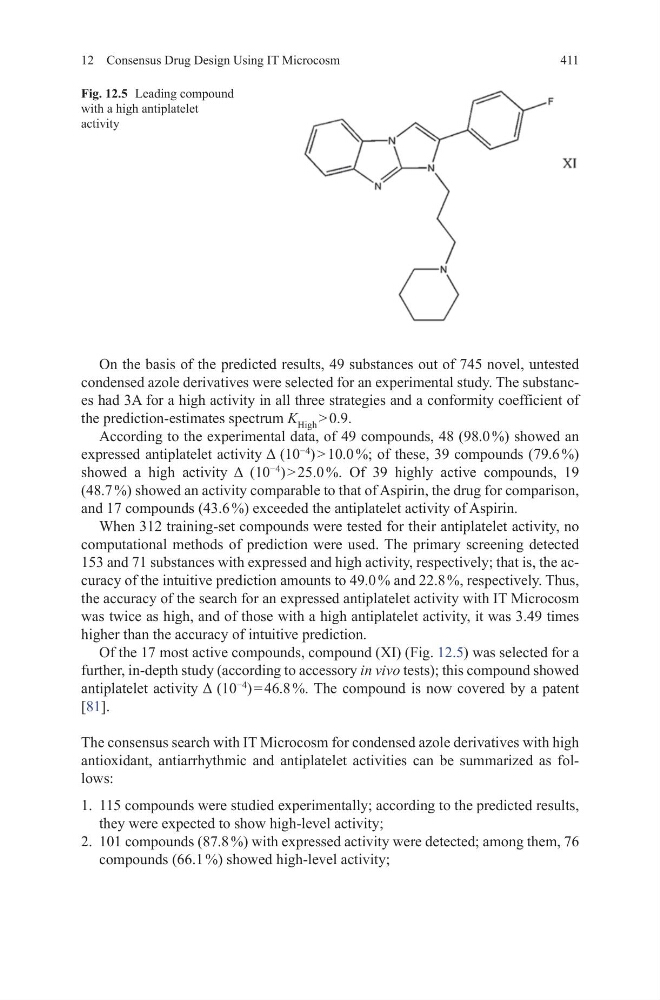
Of the 17 most active compounds, compound (XI) (Fig. 12.5) was selected for a
further, in-depth study (according to accessory in vivo tests); this compound showed
antiplatelet activity Δ (10
−4
) = 46.8 %. The compound is now covered by a patent
[81].
The consensus search with IT Microcosm for condensed azole derivatives with high
antioxidant, antiarrhythmic and antiplatelet activities can be summarized as follows:
1. 115 compounds were studied experimentally; according to the predicted results,
they were expected to show high-level activity;
2. 101 compounds (87.8 %) with expressed activity were detected; among them, 76
compounds (66.1 %) showed high-level activity;
Fig. 12.5 Leading compound
with a high antiplatelet
activity
12 Consensus Drug Design Using IT Microcosm
On the basis of the predicted results, 49 substances out of 745 novel, untested
condensed azole derivatives were selected for an experimental study. The substances had 3A for a high activity in all three strategies and a conformity coefficient of
the prediction-estimates spectrum K High > 0.9.
According to the experimental data, of 49 compounds, 48 (98.0 %) showed an
expressed antiplatelet activity Δ (10
−4
) > 10.0 %; of these, 39 compounds (79.6 %)
showed a high activity Δ (10
−4
) > 25.0 %. Of 39 highly active compounds, 19
(48.7 %) showed an activity comparable to that of Aspirin, the drug for comparison,
and 17 compounds (43.6 %) exceeded the antiplatelet activity of Aspirin.
When 312 training-set compounds were tested for their antiplatelet activity, no
computational methods of prediction were used. The primary screening detected
153 and 71 substances with expressed and high activity, respectively; that is, the accuracy of the intuitive prediction amounts to 49.0 % and 22.8 %, respectively. Thus,
the accuracy of the search for an expressed antiplatelet activity with IT Microcosm
was twice as high, and of those with a high antiplatelet activity, it was 3.49 times
higher than the accuracy of intuitive prediction.
Of the 17 most active compounds, compound (XI) (Fig. 12.5) was selected for a
further, in-depth study (according to accessory in vivo tests); this compound showed
antiplatelet activity Δ (10
−4
) = 46.8 %. The compound is now covered by a patent
[81].
The consensus search with IT Microcosm for condensed azole derivatives with high
antioxidant, antiarrhythmic and antiplatelet activities can be summarized as follows:
1. 115 compounds were studied experimentally; according to the predicted results,
they were expected to show high-level activity;
2. 101 compounds (87.8 %) with expressed activity were detected; among them, 76
compounds (66.1 %) showed high-level activity;
Fig. 12.5 Leading compound
with a high antiplatelet
activity