

409
12 Consensus Drug Design Using IT Microcosm
od, discriminant analysis and substructure analysis. Thus, according to the training set structure, the accuracy of combined primary machine-human prediction of
an expressed antiarrhythmic activity was 48.2 % and was 23.3 % for high activity.
Consequently, the effectiveness of IT Microcosm in a search for compounds with
an expressed antiarrhythmic activity among condensed azole derivatives was 2.07
times greater, and the search for compounds with a high antiarrhythmic activity was
3.43 times more accurate than the combined machine-human prediction performed
with the help of three other QSAR methods.
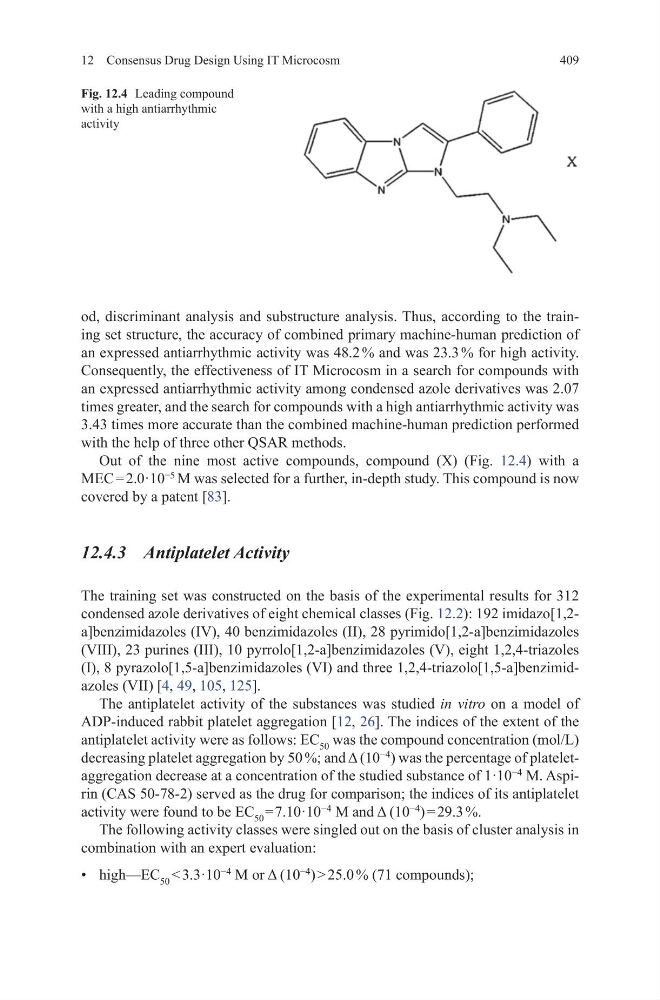
Out of the nine most active compounds, compound (X) (Fig. 12.4) with a
MEC = 2.0·10
−5
M was selected for a further, in-depth study. This compound is now
covered by a patent [83].
12.4.3 Antiplatelet Activity
The training set was constructed on the basis of the experimental results for 312
condensed azole derivatives of eight chemical classes (Fig. 12.2): 192 imidazo[1,2a]benzimidazoles (IV), 40 benzimidazoles (II), 28 pyrimido[1,2-a]benzimidazoles
(VIII), 23 purines (III), 10 pyrrolo[1,2-a]benzimidazoles (V), eight 1,2,4-triazoles
(I), 8 pyrazolo[1,5-a]benzimidazoles (VI) and three 1,2,4-triazolo[1,5-a]benzimidazoles (VII) [4, 49, 105, 125].
The antiplatelet activity of the substances was studied in vitro on a model of
ADP-induced rabbit platelet aggregation [12, 26]. The indices of the extent of the
antiplatelet activity were as follows: EC 50 was the compound concentration (mol/L)
decreasing platelet aggregation by 50 %; and Δ (10
−4
) was the percentage of plateletaggregation decrease at a concentration of the studied substance of 1·10
−4
M. Aspirin (CAS 50-78-2) served as the drug for comparison; the indices of its antiplatelet
activity were found to be EC 50 = 7.10·10
−4
M and Δ (10
−4
) = 29.3 %.
The following activity classes were singled out on the basis of cluster analysis in
combination with an expert evaluation:
• high—EC 50 < 3.3·10
−4
M or Δ (10
−4
) > 25.0 % (71 compounds);
Fig. 12.4 Leading compound
with a high antiarrhythmic
activity
12 Consensus Drug Design Using IT Microcosm
od, discriminant analysis and substructure analysis. Thus, according to the training set structure, the accuracy of combined primary machine-human prediction of
an expressed antiarrhythmic activity was 48.2 % and was 23.3 % for high activity.
Consequently, the effectiveness of IT Microcosm in a search for compounds with
an expressed antiarrhythmic activity among condensed azole derivatives was 2.07
times greater, and the search for compounds with a high antiarrhythmic activity was
3.43 times more accurate than the combined machine-human prediction performed
with the help of three other QSAR methods.
Out of the nine most active compounds, compound (X) (Fig. 12.4) with a
MEC = 2.0·10
−5
M was selected for a further, in-depth study. This compound is now
covered by a patent [83].
12.4.3 Antiplatelet Activity
The training set was constructed on the basis of the experimental results for 312
condensed azole derivatives of eight chemical classes (Fig. 12.2): 192 imidazo[1,2a]benzimidazoles (IV), 40 benzimidazoles (II), 28 pyrimido[1,2-a]benzimidazoles
(VIII), 23 purines (III), 10 pyrrolo[1,2-a]benzimidazoles (V), eight 1,2,4-triazoles
(I), 8 pyrazolo[1,5-a]benzimidazoles (VI) and three 1,2,4-triazolo[1,5-a]benzimidazoles (VII) [4, 49, 105, 125].
The antiplatelet activity of the substances was studied in vitro on a model of
ADP-induced rabbit platelet aggregation [12, 26]. The indices of the extent of the
antiplatelet activity were as follows: EC 50 was the compound concentration (mol/L)
decreasing platelet aggregation by 50 %; and Δ (10
−4
) was the percentage of plateletaggregation decrease at a concentration of the studied substance of 1·10
−4
M. Aspirin (CAS 50-78-2) served as the drug for comparison; the indices of its antiplatelet
activity were found to be EC 50 = 7.10·10
−4
M and Δ (10
−4
) = 29.3 %.
The following activity classes were singled out on the basis of cluster analysis in
combination with an expert evaluation:
• high—EC 50 < 3.3·10
−4
M or Δ (10
−4
) > 25.0 % (71 compounds);
Fig. 12.4 Leading compound
with a high antiarrhythmic
activity