

407
12 Consensus Drug Design Using IT Microcosm
by an experienced experimental pharmacologist based on a conventional comparative
analysis of literature data. Thus, the effectiveness of IT Microcosm in the search for
compounds with an expressed antioxidant activity is 1.51 times greater than the accuracy of intuitive human prediction; its effectiveness in a search for compounds with a
high antioxidant activity is 1.73 times greater.
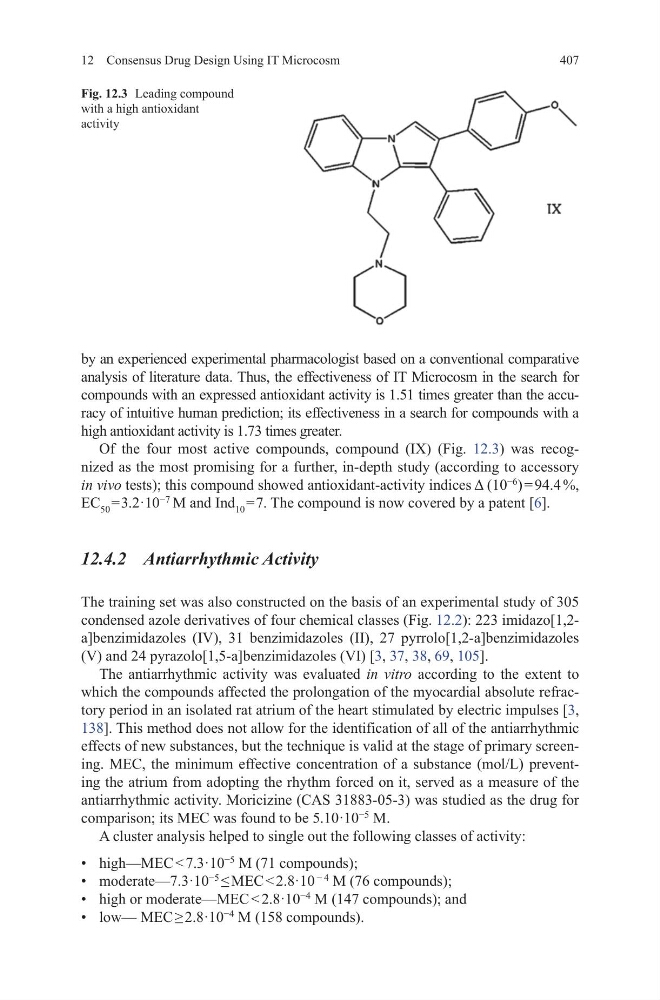
Of the four most active compounds, compound (IX) (Fig. 12.3) was recognized as the most promising for a further, in-depth study (according to accessory
in vivo tests); this compound showed antioxidant-activity indices Δ (10
−6
) = 94.4 %,
EC 50 = 3.2·10
−7
M and Ind 10 = 7. The compound is now covered by a patent [6].
12.4.2 Antiarrhythmic Activity
The training set was also constructed on the basis of an experimental study of 305
condensed azole derivatives of four chemical classes (Fig. 12.2): 223 imidazo[1,2a]benzimidazoles (IV), 31 benzimidazoles (II), 27 pyrrolo[1,2-a]benzimidazoles
(V) and 24 pyrazolo[1,5-a]benzimidazoles (VI) [3, 37, 38, 69, 105].
The antiarrhythmic activity was evaluated in vitro according to the extent to
which the compounds affected the prolongation of the myocardial absolute refractory period in an isolated rat atrium of the heart stimulated by electric impulses [3,
138]. This method does not allow for the identification of all of the antiarrhythmic
effects of new substances, but the technique is valid at the stage of primary screening. MEC, the minimum effective concentration of a substance (mol/L) preventing the atrium from adopting the rhythm forced on it, served as a measure of the
antiarrhythmic activity. Moricizine (CAS 31883-05-3) was studied as the drug for
comparison; its MEC was found to be 5.10·10
−5
M.
A cluster analysis helped to single out the following classes of activity:
• high—MEC < 7.3·10
−5
M (71 compounds);
• moderate—7.3·10
−5
≤ MEC < 2.8·10
− 4
M (76 compounds);
• high or moderate—MEC < 2.8·10
−4
M (147 compounds); and
• low— MEC ≥ 2.8·10
−4
M (158 compounds).
Fig. 12.3 Leading compound
with a high antioxidant
activity
12 Consensus Drug Design Using IT Microcosm
by an experienced experimental pharmacologist based on a conventional comparative
analysis of literature data. Thus, the effectiveness of IT Microcosm in the search for
compounds with an expressed antioxidant activity is 1.51 times greater than the accuracy of intuitive human prediction; its effectiveness in a search for compounds with a
high antioxidant activity is 1.73 times greater.
Of the four most active compounds, compound (IX) (Fig. 12.3) was recognized as the most promising for a further, in-depth study (according to accessory
in vivo tests); this compound showed antioxidant-activity indices Δ (10
−6
) = 94.4 %,
EC 50 = 3.2·10
−7
M and Ind 10 = 7. The compound is now covered by a patent [6].
12.4.2 Antiarrhythmic Activity
The training set was also constructed on the basis of an experimental study of 305
condensed azole derivatives of four chemical classes (Fig. 12.2): 223 imidazo[1,2a]benzimidazoles (IV), 31 benzimidazoles (II), 27 pyrrolo[1,2-a]benzimidazoles
(V) and 24 pyrazolo[1,5-a]benzimidazoles (VI) [3, 37, 38, 69, 105].
The antiarrhythmic activity was evaluated in vitro according to the extent to
which the compounds affected the prolongation of the myocardial absolute refractory period in an isolated rat atrium of the heart stimulated by electric impulses [3,
138]. This method does not allow for the identification of all of the antiarrhythmic
effects of new substances, but the technique is valid at the stage of primary screening. MEC, the minimum effective concentration of a substance (mol/L) preventing the atrium from adopting the rhythm forced on it, served as a measure of the
antiarrhythmic activity. Moricizine (CAS 31883-05-3) was studied as the drug for
comparison; its MEC was found to be 5.10·10
−5
M.
A cluster analysis helped to single out the following classes of activity:
• high—MEC < 7.3·10
−5
M (71 compounds);
• moderate—7.3·10
−5
≤ MEC < 2.8·10
− 4
M (76 compounds);
• high or moderate—MEC < 2.8·10
−4
M (147 compounds); and
• low— MEC ≥ 2.8·10
−4
M (158 compounds).
Fig. 12.3 Leading compound
with a high antioxidant
activity