

28
M. P. Evstigneev and A. V. Shestopalova
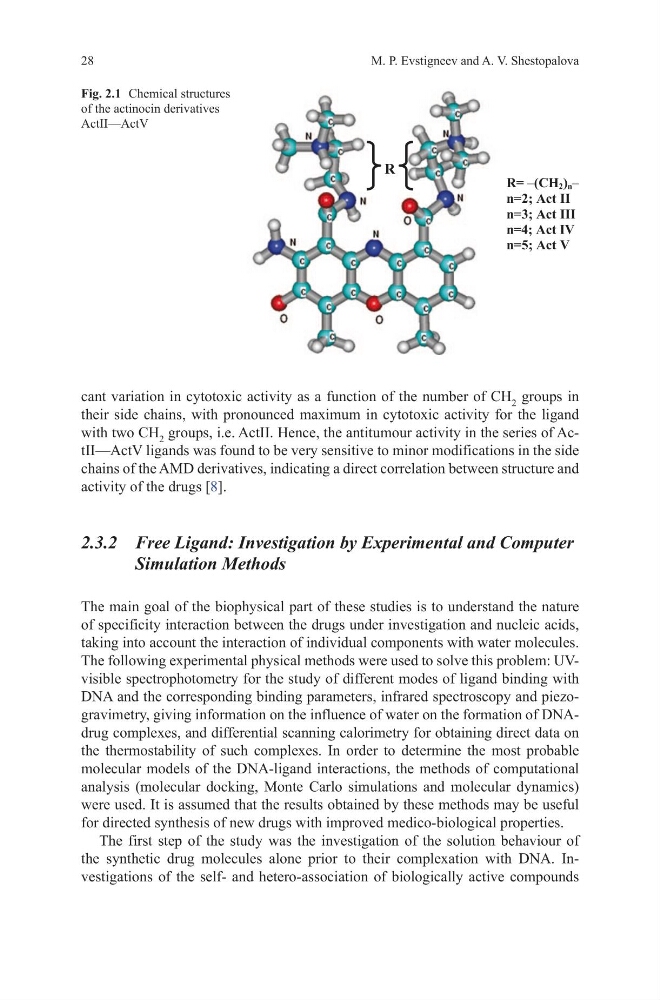
cant variation in cytotoxic activity as a function of the number of CH 2 groups in
their side chains, with pronounced maximum in cytotoxic activity for the ligand
with two CH 2 groups, i.e. ActII. Hence, the antitumour activity in the series of ActII—ActV ligands was found to be very sensitive to minor modifications in the side
chains of the AMD derivatives, indicating a direct correlation between structure and
activity of the drugs [8].
2.3.2 Free Ligand: Investigation by Experimental and Computer
Simulation Methods
The main goal of the biophysical part of these studies is to understand the nature
of specificity interaction between the drugs under investigation and nucleic acids,
taking into account the interaction of individual components with water molecules.
The following experimental physical methods were used to solve this problem: UVvisible spectrophotometry for the study of different modes of ligand binding with
DNA and the corresponding binding parameters, infrared spectroscopy and piezogravimetry, giving information on the influence of water on the formation of DNAdrug complexes, and differential scanning calorimetry for obtaining direct data on
the thermostability of such complexes. In order to determine the most probable
molecular models of the DNA-ligand interactions, the methods of computational
analysis (molecular docking, Monte Carlo simulations and molecular dynamics)
were used. It is assumed that the results obtained by these methods may be useful
for directed synthesis of new drugs with improved medico-biological properties.
The first step of the study was the investigation of the solution behaviour of
the synthetic drug molecules alone prior to their complexation with DNA. Investigations of the self- and hetero-association of biologically active compounds
5
5 ±&+ Q ±
Q $FW,,
Q $FW,,,
Q $FW,9
Q $FW9
Fig. 2.1 Chemical structures
of the actinocin derivatives
ActII—ActV
M. P. Evstigneev and A. V. Shestopalova
cant variation in cytotoxic activity as a function of the number of CH 2 groups in
their side chains, with pronounced maximum in cytotoxic activity for the ligand
with two CH 2 groups, i.e. ActII. Hence, the antitumour activity in the series of ActII—ActV ligands was found to be very sensitive to minor modifications in the side
chains of the AMD derivatives, indicating a direct correlation between structure and
activity of the drugs [8].
2.3.2 Free Ligand: Investigation by Experimental and Computer
Simulation Methods
The main goal of the biophysical part of these studies is to understand the nature
of specificity interaction between the drugs under investigation and nucleic acids,
taking into account the interaction of individual components with water molecules.
The following experimental physical methods were used to solve this problem: UVvisible spectrophotometry for the study of different modes of ligand binding with
DNA and the corresponding binding parameters, infrared spectroscopy and piezogravimetry, giving information on the influence of water on the formation of DNAdrug complexes, and differential scanning calorimetry for obtaining direct data on
the thermostability of such complexes. In order to determine the most probable
molecular models of the DNA-ligand interactions, the methods of computational
analysis (molecular docking, Monte Carlo simulations and molecular dynamics)
were used. It is assumed that the results obtained by these methods may be useful
for directed synthesis of new drugs with improved medico-biological properties.
The first step of the study was the investigation of the solution behaviour of
the synthetic drug molecules alone prior to their complexation with DNA. Investigations of the self- and hetero-association of biologically active compounds
5
5 ±&+ Q ±
Q $FW,,
Q $FW,,,
Q $FW,9
Q $FW9
Fig. 2.1 Chemical structures
of the actinocin derivatives
ActII—ActV