

388
P. M. Vassiliev et al.
reflect the fine specific regularities, the individual peculiarities of the predicted
compound, and the degree of its novelty.
The four classification methods described above are essentially different in the
way the decision rule is constructed; when applied jointly, they compensate for each
other’s errors.
12.2.4 Prediction Strategies
IT Microcosm implements three decision strategies that classify a compound as
either active or inactive on the basis of a prediction estimate spectrum obtained by
different methods [96, 105]. Each strategy is a method of constructing an integral
decision rule in the form of a consensus QSAR model; different types of consensus
are employed.
The conservative prediction strategy uses a simple vote procedure. Here a general nonweighted consensus model is implemented, all 44 prediction estimates are
deemed to be equally significant irrespective of the QL representation level and
prediction method, and a decision is made according to the majority of coinciding
estimates.
For example, if we set θ as the number of positive prediction estimates “A”
that the predicted compound C belongs to class a of active compounds. Within the
framework of the conservative strategy, compound C is considered to be active
if θ ≥ 27, and defined as inactive if θ ≤ 17 (95 % is the confidence interval for the
median in binomial distribution [41]). If the 17 < θ < 27 prediction is discontinuous,
compound C can be considered conditionally active if 22 ≤ θ < 27, and conditionally
inactive if 17 < θ < 22.
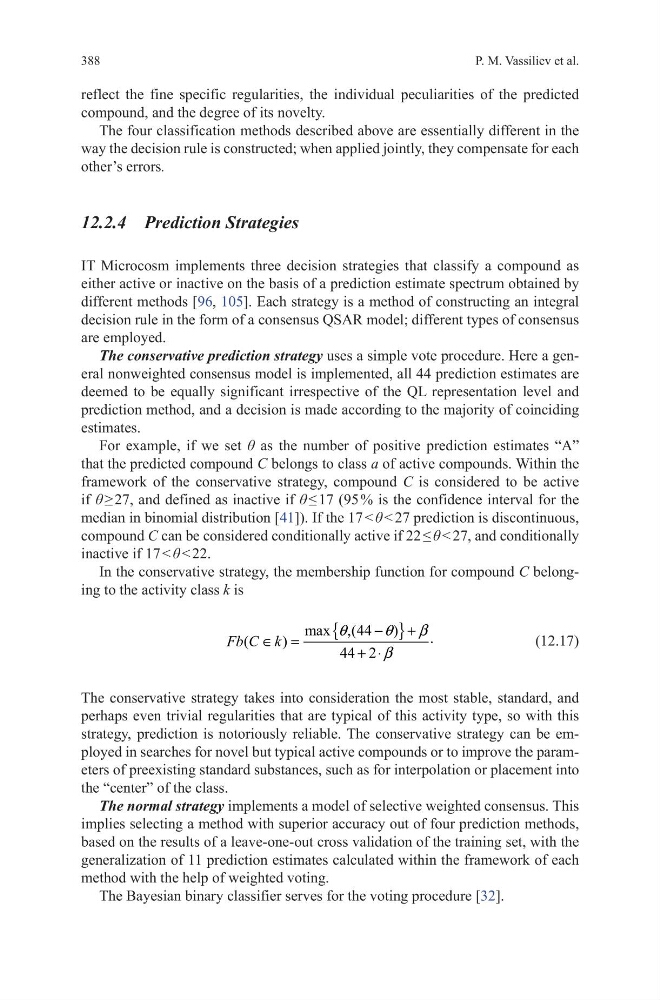
In the conservative strategy, the membership function for compound C belonging to the activity class k is
(12.17)
The conservative strategy takes into consideration the most stable, standard, and
perhaps even trivial regularities that are typical of this activity type, so with this
strategy, prediction is notoriously reliable. The conservative strategy can be employed in searches for novel but typical active compounds or to improve the parameters of preexisting standard substances, such as for interpolation or placement into
the “center” of the class.
The normal strategy implements a model of selective weighted consensus. This
implies selecting a method with superior accuracy out of four prediction methods,
based on the results of a leave-one-out cross validation of the training set, with the
generalization of 11 prediction estimates calculated within the framework of each
method with the help of weighted voting.
The Bayesian binary classifier serves for the voting procedure [32].
{
}
max ,(44 )
.
(
)
44 2
Fb C k
θ
θ
β
β
-
+
∈ =
+ ⋅
P. M. Vassiliev et al.
reflect the fine specific regularities, the individual peculiarities of the predicted
compound, and the degree of its novelty.
The four classification methods described above are essentially different in the
way the decision rule is constructed; when applied jointly, they compensate for each
other’s errors.
12.2.4 Prediction Strategies
IT Microcosm implements three decision strategies that classify a compound as
either active or inactive on the basis of a prediction estimate spectrum obtained by
different methods [96, 105]. Each strategy is a method of constructing an integral
decision rule in the form of a consensus QSAR model; different types of consensus
are employed.
The conservative prediction strategy uses a simple vote procedure. Here a general nonweighted consensus model is implemented, all 44 prediction estimates are
deemed to be equally significant irrespective of the QL representation level and
prediction method, and a decision is made according to the majority of coinciding
estimates.
For example, if we set θ as the number of positive prediction estimates “A”
that the predicted compound C belongs to class a of active compounds. Within the
framework of the conservative strategy, compound C is considered to be active
if θ ≥ 27, and defined as inactive if θ ≤ 17 (95 % is the confidence interval for the
median in binomial distribution [41]). If the 17 < θ < 27 prediction is discontinuous,
compound C can be considered conditionally active if 22 ≤ θ < 27, and conditionally
inactive if 17 < θ < 22.
In the conservative strategy, the membership function for compound C belonging to the activity class k is
(12.17)
The conservative strategy takes into consideration the most stable, standard, and
perhaps even trivial regularities that are typical of this activity type, so with this
strategy, prediction is notoriously reliable. The conservative strategy can be employed in searches for novel but typical active compounds or to improve the parameters of preexisting standard substances, such as for interpolation or placement into
the “center” of the class.
The normal strategy implements a model of selective weighted consensus. This
implies selecting a method with superior accuracy out of four prediction methods,
based on the results of a leave-one-out cross validation of the training set, with the
generalization of 11 prediction estimates calculated within the framework of each
method with the help of weighted voting.
The Bayesian binary classifier serves for the voting procedure [32].
{
}
max ,(44 )
.
(
)
44 2
Fb C k
θ
θ
β
β
-
+
∈ =
+ ⋅