

358
A. Zakharov and A. Lagunin
or biotransformation enzyme, or compounds are predicted as an inhibitor or inducer
of another transporter or drug metabolizing enzyme. The possible pharmacokinetic
drug interactions are concluded in accordance with the result of comparison.
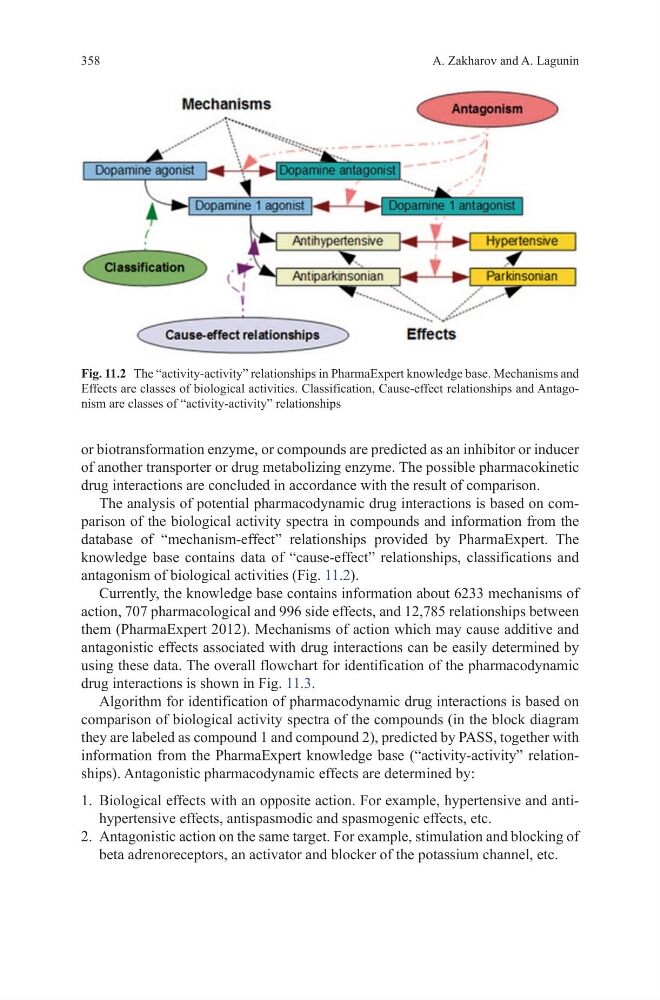
The analysis of potential pharmacodynamic drug interactions is based on comparison of the biological activity spectra in compounds and information from the
database of “mechanism-effect” relationships provided by PharmaExpert. The
knowledge base contains data of “cause-effect” relationships, classifications and
antagonism of biological activities (Fig. 11.2).
Currently, the knowledge base contains information about 6233 mechanisms of
action, 707 pharmacological and 996 side effects, and 12,785 relationships between
them (PharmaExpert 2012). Mechanisms of action which may cause additive and
antagonistic effects associated with drug interactions can be easily determined by
using these data. The overall flowchart for identification of the pharmacodynamic
drug interactions is shown in Fig. 11.3.
Algorithm for identification of pharmacodynamic drug interactions is based on
comparison of biological activity spectra of the compounds (in the block diagram
they are labeled as compound 1 and compound 2), predicted by PASS, together with
information from the PharmaExpert knowledge base (“activity-activity” relationships). Antagonistic pharmacodynamic effects are determined by:
1. Biological effects with an opposite action. For example, hypertensive and antihypertensive effects, antispasmodic and spasmogenic effects, etc.
2. Antagonistic action on the same target. For example, stimulation and blocking of
beta adrenoreceptors, an activator and blocker of the potassium channel, etc.
Fig. 11.2 The “activity-activity” relationships in PharmaExpert knowledge base. Mechanisms and
Effects are classes of biological activities. Classification, Cause-effect relationships and Antagonism are classes of “activity-activity” relationships
A. Zakharov and A. Lagunin
or biotransformation enzyme, or compounds are predicted as an inhibitor or inducer
of another transporter or drug metabolizing enzyme. The possible pharmacokinetic
drug interactions are concluded in accordance with the result of comparison.
The analysis of potential pharmacodynamic drug interactions is based on comparison of the biological activity spectra in compounds and information from the
database of “mechanism-effect” relationships provided by PharmaExpert. The
knowledge base contains data of “cause-effect” relationships, classifications and
antagonism of biological activities (Fig. 11.2).
Currently, the knowledge base contains information about 6233 mechanisms of
action, 707 pharmacological and 996 side effects, and 12,785 relationships between
them (PharmaExpert 2012). Mechanisms of action which may cause additive and
antagonistic effects associated with drug interactions can be easily determined by
using these data. The overall flowchart for identification of the pharmacodynamic
drug interactions is shown in Fig. 11.3.
Algorithm for identification of pharmacodynamic drug interactions is based on
comparison of biological activity spectra of the compounds (in the block diagram
they are labeled as compound 1 and compound 2), predicted by PASS, together with
information from the PharmaExpert knowledge base (“activity-activity” relationships). Antagonistic pharmacodynamic effects are determined by:
1. Biological effects with an opposite action. For example, hypertensive and antihypertensive effects, antispasmodic and spasmogenic effects, etc.
2. Antagonistic action on the same target. For example, stimulation and blocking of
beta adrenoreceptors, an activator and blocker of the potassium channel, etc.
Fig. 11.2 The “activity-activity” relationships in PharmaExpert knowledge base. Mechanisms and
Effects are classes of biological activities. Classification, Cause-effect relationships and Antagonism are classes of “activity-activity” relationships