

351
11 Computational Toxicology in Drug Discovery: Opportunities and Limitations
Typically, the affinity of a pharmaceutical agent to the drug target should exceed
the affinity to antitargets for at least one to two orders of magnitude. The medium
affinity of current drugs to drug targets is about 16 nM, ranging from 16 mM to
1.6 pM [58]. Therefore, GUSAR prediction of interaction with antitarget(s) should
be carefully considered in each individual case taking into account the predicted/
measured affinity of an analyzed compound to the drug target. A particular attention
should be paid to compounds, for which the predicted affinity of interaction with
four or more antitargets exceeded 1 µM.
One of the main limitations for in silico assessment of toxic/side effects based
on prediction of ligand interaction with antitargets is an insufficient knowledge
about “target-side effects” relationships. The computer evaluation of relationships
between the predicted targets or drug-target interactions and known side effects is
carried out using statistical methods of disproportionality analysis. The prediction
of drug-target interactions were made by a similarity assessment with the compounds from ChEMBL database [59], PASS prediction of biological activity spectra
[60] or docking [61]. Another method for revealing associations between targets
and side effects is based on creation of SAR models for compounds interacted with
each target and causing the side effect. For example, if the prediction of interactions with targets and prediction of side effects carried out based on the Bayesian
approach, the relationships between targets and adverse effects can be calculated by
the Pearson correlation coefficient between the conditional probability P (A|Di) and
P (M|Di) models (A—a side effect, M—target, Di—descriptor) [62].
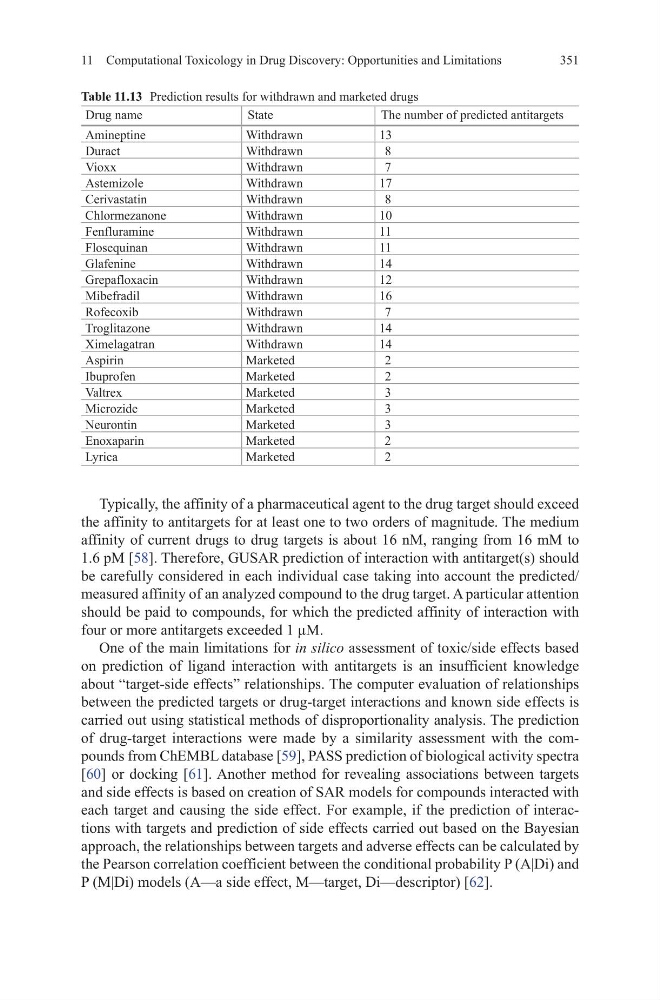
Table 11.13 Prediction results for withdrawn and marketed drugs
Drug name
State
The number of predicted antitargets
Amineptine
Withdrawn
13
Duract
Withdrawn
8
Vioxx
Withdrawn
7
Astemizole
Withdrawn
17
Cerivastatin
Withdrawn
8
Chlormezanone
Withdrawn
10
Fenfluramine
Withdrawn
11
Flosequinan
Withdrawn
11
Glafenine
Withdrawn
14
Grepafloxacin
Withdrawn
12
Mibefradil
Withdrawn
16
Rofecoxib
Withdrawn
7
Troglitazone
Withdrawn
14
Ximelagatran
Withdrawn
14
Aspirin
Marketed
2
Ibuprofen
Marketed
2
Valtrex
Marketed
3
Microzide
Marketed
3
Neurontin
Marketed
3
Enoxaparin
Marketed
2
Lyrica
Marketed
2
11 Computational Toxicology in Drug Discovery: Opportunities and Limitations
Typically, the affinity of a pharmaceutical agent to the drug target should exceed
the affinity to antitargets for at least one to two orders of magnitude. The medium
affinity of current drugs to drug targets is about 16 nM, ranging from 16 mM to
1.6 pM [58]. Therefore, GUSAR prediction of interaction with antitarget(s) should
be carefully considered in each individual case taking into account the predicted/
measured affinity of an analyzed compound to the drug target. A particular attention
should be paid to compounds, for which the predicted affinity of interaction with
four or more antitargets exceeded 1 µM.
One of the main limitations for in silico assessment of toxic/side effects based
on prediction of ligand interaction with antitargets is an insufficient knowledge
about “target-side effects” relationships. The computer evaluation of relationships
between the predicted targets or drug-target interactions and known side effects is
carried out using statistical methods of disproportionality analysis. The prediction
of drug-target interactions were made by a similarity assessment with the compounds from ChEMBL database [59], PASS prediction of biological activity spectra
[60] or docking [61]. Another method for revealing associations between targets
and side effects is based on creation of SAR models for compounds interacted with
each target and causing the side effect. For example, if the prediction of interactions with targets and prediction of side effects carried out based on the Bayesian
approach, the relationships between targets and adverse effects can be calculated by
the Pearson correlation coefficient between the conditional probability P (A|Di) and
P (M|Di) models (A—a side effect, M—target, Di—descriptor) [62].
Table 11.13 Prediction results for withdrawn and marketed drugs
Drug name
State
The number of predicted antitargets
Amineptine
Withdrawn
13
Duract
Withdrawn
8
Vioxx
Withdrawn
7
Astemizole
Withdrawn
17
Cerivastatin
Withdrawn
8
Chlormezanone
Withdrawn
10
Fenfluramine
Withdrawn
11
Flosequinan
Withdrawn
11
Glafenine
Withdrawn
14
Grepafloxacin
Withdrawn
12
Mibefradil
Withdrawn
16
Rofecoxib
Withdrawn
7
Troglitazone
Withdrawn
14
Ximelagatran
Withdrawn
14
Aspirin
Marketed
2
Ibuprofen
Marketed
2
Valtrex
Marketed
3
Microzide
Marketed
3
Neurontin
Marketed
3
Enoxaparin
Marketed
2
Lyrica
Marketed
2