

342
A. Zakharov and A. Lagunin
There are several indexes which are useful to assess the general drug toxicity
in clinical studies or to compare drug-candidates on the basis of experimental or
predicted data:
1. Therapeutic index (TI): TI = LD 50 /ED 50 or TI = LD 10 /ED 90 . The safest drug has
the highest index. Review of QSAR models for prediction of rodent LD 50 values
is presented above.
2. Maximum recommended therapeutic dose (MRTD). The MRDD is essentially equivalent to the NOAEL (no observed adverse effect level) in humans,
a dose beyond which adverse (toxicological) or undesirable pharmacological
effects are observed. The correlation between MRDD and LD 10 is about 94 %.
FDA’s Center for Drug Evaluation and Research provides MRTD database [42]
with information on MRTD for 1220 drugs. QSAR models for prediction of
MDTD are provided by Simulation Plus and ACD/Labs. QSAR models for mice
and rat maximum tolerated dose are provided by Accelrys.
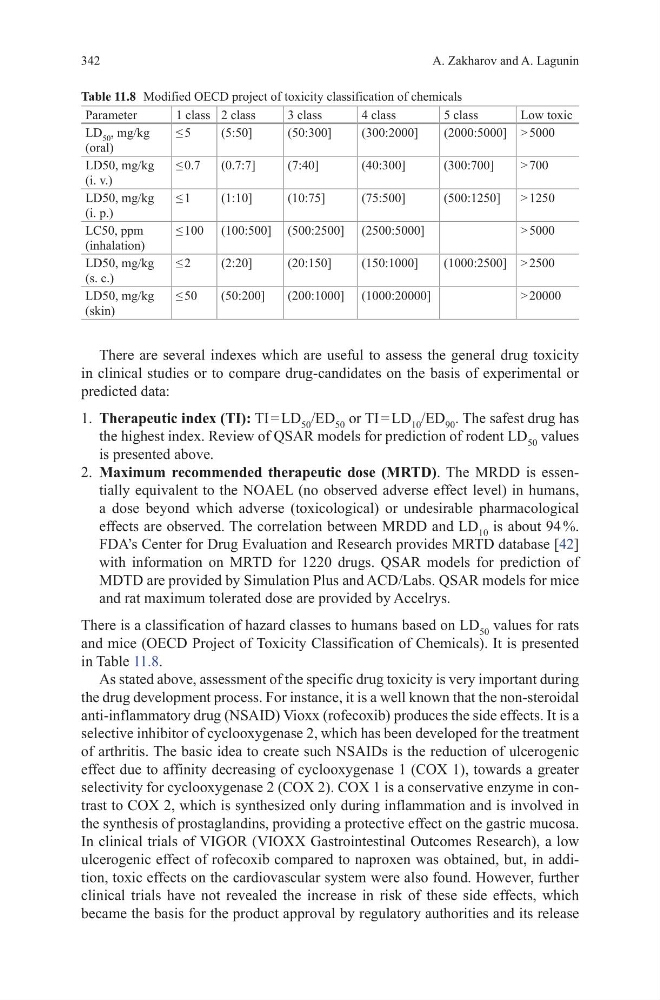
There is a classification of hazard classes to humans based on LD 50 values for rats
and mice (OECD Project of Toxicity Classification of Chemicals). It is presented
in Table 11.8.
As stated above, assessment of the specific drug toxicity is very important during
the drug development process. For instance, it is a well known that the non-steroidal
anti-inflammatory drug (NSAID) Vioxx (rofecoxib) produces the side effects. It is a
selective inhibitor of cyclooxygenase 2, which has been developed for the treatment
of arthritis. The basic idea to create such NSAIDs is the reduction of ulcerogenic
effect due to affinity decreasing of cyclooxygenase 1 (COX 1), towards a greater
selectivity for cyclooxygenase 2 (COX 2). COX 1 is a conservative enzyme in contrast to COX 2, which is synthesized only during inflammation and is involved in
the synthesis of prostaglandins, providing a protective effect on the gastric mucosa.
In clinical trials of VIGOR (VIOXX Gastrointestinal Outcomes Research), a low
ulcerogenic effect of rofecoxib compared to naproxen was obtained, but, in addition, toxic effects on the cardiovascular system were also found. However, further
clinical trials have not revealed the increase in risk of these side effects, which
became the basis for the product approval by regulatory authorities and its release
Table 11.8 Modified OECD project of toxicity classification of chemicals
Parameter
1 class 2 class
3 class
4 class
5 class
Low toxic
LD 50 , mg/kg
(oral)
≤ 5
(5:50]
(50:300]
(300:2000]
(2000:5000] > 5000
LD50, mg/kg
(i. v.)
≤ 0.7
(0.7:7]
(7:40]
(40:300]
(300:700]
> 700
LD50, mg/kg
(i. p.)
≤ 1
(1:10]
(10:75]
(75:500]
(500:1250]
> 1250
LC50, ppm
(inhalation)
≤ 100 (100:500] (500:2500] (2500:5000]
> 5000
LD50, mg/kg
(s. c.)
≤ 2
(2:20]
(20:150]
(150:1000]
(1000:2500] > 2500
LD50, mg/kg
(skin)
≤ 50
(50:200]
(200:1000] (1000:20000]
> 20000
A. Zakharov and A. Lagunin
There are several indexes which are useful to assess the general drug toxicity
in clinical studies or to compare drug-candidates on the basis of experimental or
predicted data:
1. Therapeutic index (TI): TI = LD 50 /ED 50 or TI = LD 10 /ED 90 . The safest drug has
the highest index. Review of QSAR models for prediction of rodent LD 50 values
is presented above.
2. Maximum recommended therapeutic dose (MRTD). The MRDD is essentially equivalent to the NOAEL (no observed adverse effect level) in humans,
a dose beyond which adverse (toxicological) or undesirable pharmacological
effects are observed. The correlation between MRDD and LD 10 is about 94 %.
FDA’s Center for Drug Evaluation and Research provides MRTD database [42]
with information on MRTD for 1220 drugs. QSAR models for prediction of
MDTD are provided by Simulation Plus and ACD/Labs. QSAR models for mice
and rat maximum tolerated dose are provided by Accelrys.
There is a classification of hazard classes to humans based on LD 50 values for rats
and mice (OECD Project of Toxicity Classification of Chemicals). It is presented
in Table 11.8.
As stated above, assessment of the specific drug toxicity is very important during
the drug development process. For instance, it is a well known that the non-steroidal
anti-inflammatory drug (NSAID) Vioxx (rofecoxib) produces the side effects. It is a
selective inhibitor of cyclooxygenase 2, which has been developed for the treatment
of arthritis. The basic idea to create such NSAIDs is the reduction of ulcerogenic
effect due to affinity decreasing of cyclooxygenase 1 (COX 1), towards a greater
selectivity for cyclooxygenase 2 (COX 2). COX 1 is a conservative enzyme in contrast to COX 2, which is synthesized only during inflammation and is involved in
the synthesis of prostaglandins, providing a protective effect on the gastric mucosa.
In clinical trials of VIGOR (VIOXX Gastrointestinal Outcomes Research), a low
ulcerogenic effect of rofecoxib compared to naproxen was obtained, but, in addition, toxic effects on the cardiovascular system were also found. However, further
clinical trials have not revealed the increase in risk of these side effects, which
became the basis for the product approval by regulatory authorities and its release
Table 11.8 Modified OECD project of toxicity classification of chemicals
Parameter
1 class 2 class
3 class
4 class
5 class
Low toxic
LD 50 , mg/kg
(oral)
≤ 5
(5:50]
(50:300]
(300:2000]
(2000:5000] > 5000
LD50, mg/kg
(i. v.)
≤ 0.7
(0.7:7]
(7:40]
(40:300]
(300:700]
> 700
LD50, mg/kg
(i. p.)
≤ 1
(1:10]
(10:75]
(75:500]
(500:1250]
> 1250
LC50, ppm
(inhalation)
≤ 100 (100:500] (500:2500] (2500:5000]
> 5000
LD50, mg/kg
(s. c.)
≤ 2
(2:20]
(20:150]
(150:1000]
(1000:2500] > 2500
LD50, mg/kg
(skin)
≤ 50
(50:200]
(200:1000] (1000:20000]
> 20000