

334
A. Zakharov and A. Lagunin
types of molecular descriptors. The most popular programs are public Mol2d,
which is available from FDA’s National Center for Toxicological Research [23] and
commercial Dragon, provided by Italian company Talete. Several descriptor and
fingerprint generators are also available in KNIME and CHEMBENCH. The list of
mostly known generators of molecular descriptors is presented in Table 11.2.
It is necessary to emphasize that sometimes different descriptors generators provide the same descriptors, but called in different ways. It is considered that one
should avoid the use of collinear descriptors, when correlation between the descriptors for the compounds in a training set is close to 100 % [24]. In addition
to descriptors directly calculated from the molecular structure (the topology of a
molecule, the number of acceptors, etc.), there are experimentally received descriptors or based on computer predictions (both biological (e.g., absorption, resulting
line CaCo-2 cells) and physical-chemical (e.g., LogP)). Currently, 20 computer programs calculates the LogP values and in most cases the prediction results are not
the same [24]. The usage of these descriptors may provide an error and noise into
developed model. In these cases it is necessary to pay attention to coefficients for
these descriptors in QSAR equation. If the descriptor coefficient is equal to or less
than the descriptor’s error, then the descriptor should be deleted from the equation,
since it would result in less accuracy of prediction for compounds from the test set.
Another important feature of descriptors is their intervals. For example, for some
training sets one descriptor (LogD) can range from −3.572 to 3.773, second descriptor (F) can range from − 0.04 to 0.67 and the third (dCox) has values from 0.0000 to
0.0646 [25]. Therefore, for all descriptors which will be used for the model building, it is necessary to carry out the procedure of auto-scaling when the value of all
used descriptors vary in the same range, for example from 0 to 1.
Many systems use computer predictions of toxicity based on a two-dimensional
representation of the chemical structure in the training set. However, the three-dimensional representation of the molecular structure can be sometimes more reasonable and demonstrative regarding to manifestations of toxicological and pharmacoDatabase
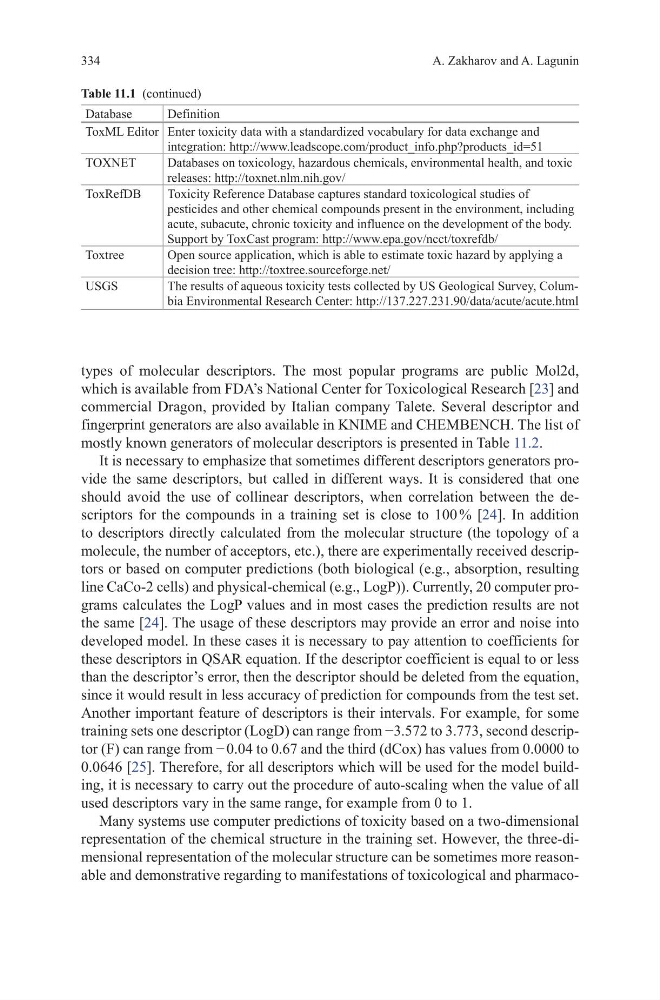
Definition
ToxML Editor Enter toxicity data with a standardized vocabulary for data exchange and
integration: http://www.leadscope.com/product_info.php?products_id=51
TOXNET
Databases on toxicology, hazardous chemicals, environmental health, and toxic
releases: http://toxnet.nlm.nih.gov/
ToxRefDB
Toxicity Reference Database captures standard toxicological studies of
pesticides and other chemical compounds present in the environment, including
acute, subacute, chronic toxicity and influence on the development of the body.
Support by ToxCast program: http://www.epa.gov/ncct/toxrefdb/
Toxtree
Open source application, which is able to estimate toxic hazard by applying a
decision tree: http://toxtree.sourceforge.net/
USGS
The results of aqueous toxicity tests collected by US Geological Survey, Columbia Environmental Research Center: http://137.227.231.90/data/acute/acute.html
Table 11.1 (continued)
A. Zakharov and A. Lagunin
types of molecular descriptors. The most popular programs are public Mol2d,
which is available from FDA’s National Center for Toxicological Research [23] and
commercial Dragon, provided by Italian company Talete. Several descriptor and
fingerprint generators are also available in KNIME and CHEMBENCH. The list of
mostly known generators of molecular descriptors is presented in Table 11.2.
It is necessary to emphasize that sometimes different descriptors generators provide the same descriptors, but called in different ways. It is considered that one
should avoid the use of collinear descriptors, when correlation between the descriptors for the compounds in a training set is close to 100 % [24]. In addition
to descriptors directly calculated from the molecular structure (the topology of a
molecule, the number of acceptors, etc.), there are experimentally received descriptors or based on computer predictions (both biological (e.g., absorption, resulting
line CaCo-2 cells) and physical-chemical (e.g., LogP)). Currently, 20 computer programs calculates the LogP values and in most cases the prediction results are not
the same [24]. The usage of these descriptors may provide an error and noise into
developed model. In these cases it is necessary to pay attention to coefficients for
these descriptors in QSAR equation. If the descriptor coefficient is equal to or less
than the descriptor’s error, then the descriptor should be deleted from the equation,
since it would result in less accuracy of prediction for compounds from the test set.
Another important feature of descriptors is their intervals. For example, for some
training sets one descriptor (LogD) can range from −3.572 to 3.773, second descriptor (F) can range from − 0.04 to 0.67 and the third (dCox) has values from 0.0000 to
0.0646 [25]. Therefore, for all descriptors which will be used for the model building, it is necessary to carry out the procedure of auto-scaling when the value of all
used descriptors vary in the same range, for example from 0 to 1.
Many systems use computer predictions of toxicity based on a two-dimensional
representation of the chemical structure in the training set. However, the three-dimensional representation of the molecular structure can be sometimes more reasonable and demonstrative regarding to manifestations of toxicological and pharmacoDatabase
Definition
ToxML Editor Enter toxicity data with a standardized vocabulary for data exchange and
integration: http://www.leadscope.com/product_info.php?products_id=51
TOXNET
Databases on toxicology, hazardous chemicals, environmental health, and toxic
releases: http://toxnet.nlm.nih.gov/
ToxRefDB
Toxicity Reference Database captures standard toxicological studies of
pesticides and other chemical compounds present in the environment, including
acute, subacute, chronic toxicity and influence on the development of the body.
Support by ToxCast program: http://www.epa.gov/ncct/toxrefdb/
Toxtree
Open source application, which is able to estimate toxic hazard by applying a
decision tree: http://toxtree.sourceforge.net/
USGS
The results of aqueous toxicity tests collected by US Geological Survey, Columbia Environmental Research Center: http://137.227.231.90/data/acute/acute.html
Table 11.1 (continued)