

311
ered as a key fragment in the reaction surface. On the contrary to reaction under
neat conditions, both front- and rear-side pathways therein are one-step processes
at that water assistance results in decreasing of ∆G
≠
values on 8.2 and 11.1 kJ/mol
correspondingly (Fig. 10.11). The performed NPA analysis revealed that the water
cluster accelerated the reaction not only by assisting the proton transfer, but also by
strengthening both the entering and the leaving groups through a charge-transfer
process induced by different strengths between the two proton-transfer processes.
The enhancement of the entering- and leaving-group effects were qualitatively supported by the evaluation of the nucleophilicity index and the stabilization energy,
respectively [54].
For neutral hydrolysis of oxirane Lundin and co-workers have been investigated
two mechanisms, one where OH
−
and H
+
are formed as a results of hydrolysis reaction, and a second where the heterolytic decomposition of the epoxide occurs in
concert with protolysis of water which is the limiting bare reaction [32]. In contrast
to aminolysis reactions there is no transition state on potential energy surface which
correspond to transoid hydrolysis and formation of ions OH
−
and H
+
. Transition
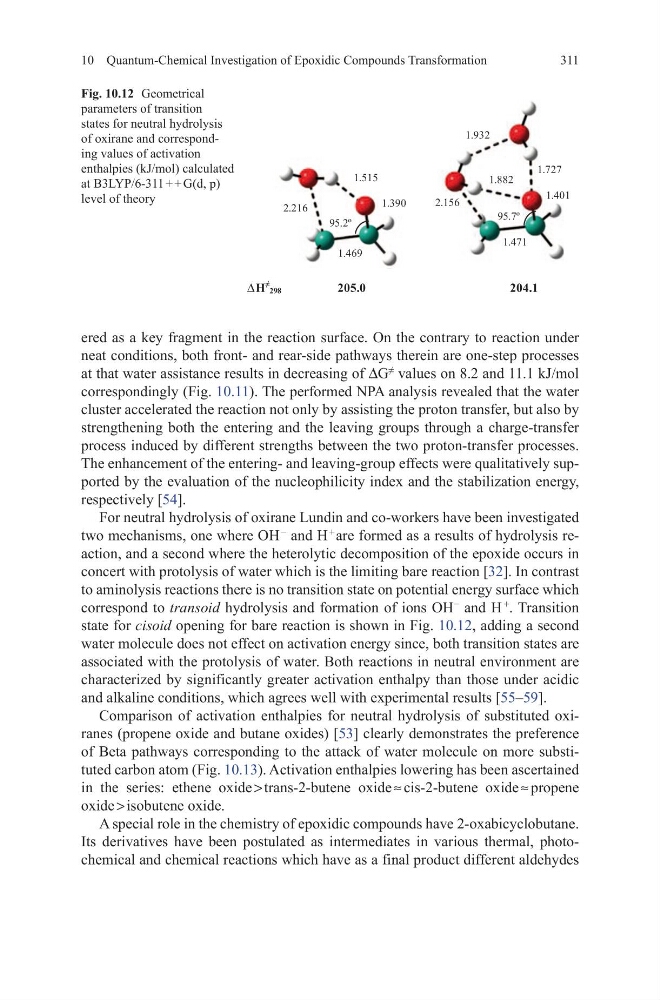
state for cisoid opening for bare reaction is shown in Fig. 10.12, adding a second
water molecule does not effect on activation energy since, both transition states are
associated with the protolysis of water. Both reactions in neutral environment are
characterized by significantly greater activation enthalpy than those under acidic
and alkaline conditions, which agrees well with experimental results [55–59].
Comparison of activation enthalpies for neutral hydrolysis of substituted oxiranes (propene oxide and butane oxides) [53] clearly demonstrates the preference
of Beta pathways corresponding to the attack of water molecule on more substituted carbon atom (Fig. 10.13). Activation enthalpies lowering has been ascertained
in the series: ethene oxide > trans-2-butene oxide ≈ cis-2-butene oxide ≈ propene
oxide > isobutene oxide.
A special role in the chemistry of epoxidic compounds have 2-oxabicyclobutane.
Its derivatives have been postulated as intermediates in various thermal, photochemical and chemical reactions which have as a final product different aldehydes
+
∆
Fig. 10.12 Geometrical
parameters of transition
states for neutral hydrolysis
of oxirane and corresponding values of activation
enthalpies (kJ/mol) calculated
at B3LYP/6-311 + + G(d, p)
level of theory
10 Quantum-Chemical Investigation of Epoxidic Compounds Transformation
ered as a key fragment in the reaction surface. On the contrary to reaction under
neat conditions, both front- and rear-side pathways therein are one-step processes
at that water assistance results in decreasing of ∆G
≠
values on 8.2 and 11.1 kJ/mol
correspondingly (Fig. 10.11). The performed NPA analysis revealed that the water
cluster accelerated the reaction not only by assisting the proton transfer, but also by
strengthening both the entering and the leaving groups through a charge-transfer
process induced by different strengths between the two proton-transfer processes.
The enhancement of the entering- and leaving-group effects were qualitatively supported by the evaluation of the nucleophilicity index and the stabilization energy,
respectively [54].
For neutral hydrolysis of oxirane Lundin and co-workers have been investigated
two mechanisms, one where OH
−
and H
+
are formed as a results of hydrolysis reaction, and a second where the heterolytic decomposition of the epoxide occurs in
concert with protolysis of water which is the limiting bare reaction [32]. In contrast
to aminolysis reactions there is no transition state on potential energy surface which
correspond to transoid hydrolysis and formation of ions OH
−
and H
+
. Transition
state for cisoid opening for bare reaction is shown in Fig. 10.12, adding a second
water molecule does not effect on activation energy since, both transition states are
associated with the protolysis of water. Both reactions in neutral environment are
characterized by significantly greater activation enthalpy than those under acidic
and alkaline conditions, which agrees well with experimental results [55–59].
Comparison of activation enthalpies for neutral hydrolysis of substituted oxiranes (propene oxide and butane oxides) [53] clearly demonstrates the preference
of Beta pathways corresponding to the attack of water molecule on more substituted carbon atom (Fig. 10.13). Activation enthalpies lowering has been ascertained
in the series: ethene oxide > trans-2-butene oxide ≈ cis-2-butene oxide ≈ propene
oxide > isobutene oxide.
A special role in the chemistry of epoxidic compounds have 2-oxabicyclobutane.
Its derivatives have been postulated as intermediates in various thermal, photochemical and chemical reactions which have as a final product different aldehydes
+
∆
Fig. 10.12 Geometrical
parameters of transition
states for neutral hydrolysis
of oxirane and corresponding values of activation
enthalpies (kJ/mol) calculated
at B3LYP/6-311 + + G(d, p)
level of theory
10 Quantum-Chemical Investigation of Epoxidic Compounds Transformation