

303
that the necessary and sufficient number of solvent molecules be adjusted. While
studying the reaction of oxirane (1) with methanol [41], the most acceptable results
were obtained when the first solvate shell of methoxide ion contained four solvent
molecules (methanol) and the less basic oxirane oxygen atom was solvated with
one methanol molecule, i.e., the model CH 3 O 3 (CH 3 OH) n + oxirane(CH 3 OH) m (n = 4,
m = 1) has been used. The same model has been applied to examine alkaline methanolysis of epoxy derivatives (3–10).
Localized therein transition states have more pronounced loose character if compare to calculations in vacuo and using COSMO approximation (Table 10.4). Calculated values of ∆Н
≠
are in good agreement with logarithms of the experimental
relative rate constants.
It should be noted that the activation barrier for the reaction of endo isomer (7),
calculated in the supermolecular approximation, is lower by 9.62 kJ/mol than the
corresponding barrier calculated for exo isomer (8). Comparison of these results
with those obtained by in vacuo calculations shows that steric factor is actually
determinative for the reactivity of strained epoxynorbornanes (7, 8). Only this factor is taken into account in terms of the supermolecular approach, where solvent
molecules are included in the explicit form. As a result, the effective volume of the
reagent considerably increases (Fig. 10.5).
Such supermolecular model has been successfully applied for investigation of
chemo-, region- and stereoselectivity of dicyclopentadiene diepoxide (11) alkaline
methanolysis [42, 43] and reaction of spirooxiranes (12–19) with methoxy anion
[44].
lgk
r
n
rel = −
×
+
=
=
≠
0 14
2 3 14
096
5
.
.
.
∆H
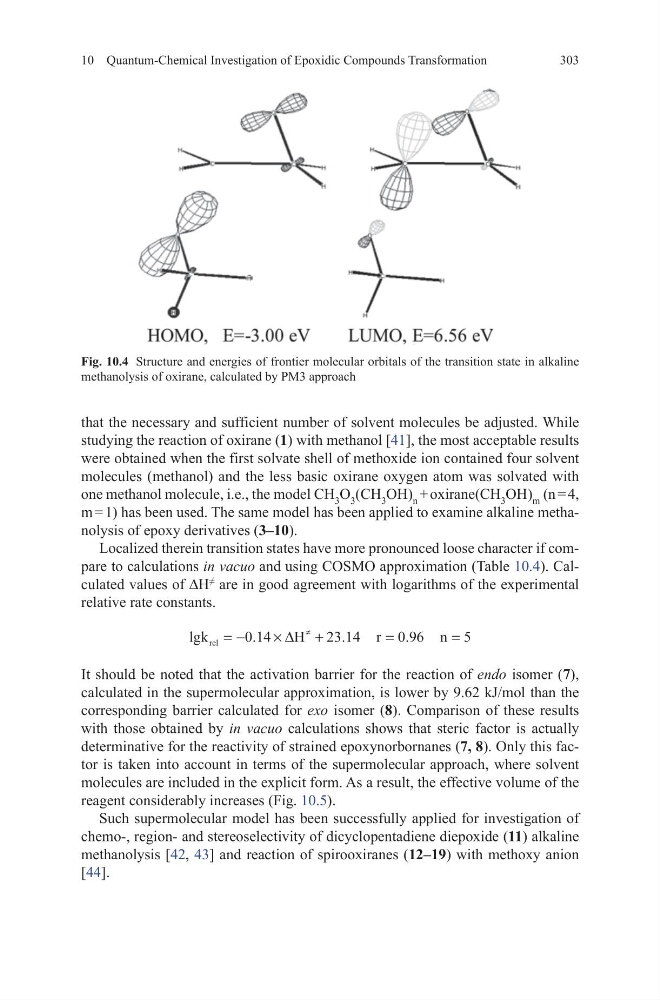
Fig. 10.4 Structure and energies of frontier molecular orbitals of the transition state in alkaline
methanolysis of oxirane, calculated by РМ3 approach
10 Quantum-Chemical Investigation of Epoxidic Compounds Transformation
that the necessary and sufficient number of solvent molecules be adjusted. While
studying the reaction of oxirane (1) with methanol [41], the most acceptable results
were obtained when the first solvate shell of methoxide ion contained four solvent
molecules (methanol) and the less basic oxirane oxygen atom was solvated with
one methanol molecule, i.e., the model CH 3 O 3 (CH 3 OH) n + oxirane(CH 3 OH) m (n = 4,
m = 1) has been used. The same model has been applied to examine alkaline methanolysis of epoxy derivatives (3–10).
Localized therein transition states have more pronounced loose character if compare to calculations in vacuo and using COSMO approximation (Table 10.4). Calculated values of ∆Н
≠
are in good agreement with logarithms of the experimental
relative rate constants.
It should be noted that the activation barrier for the reaction of endo isomer (7),
calculated in the supermolecular approximation, is lower by 9.62 kJ/mol than the
corresponding barrier calculated for exo isomer (8). Comparison of these results
with those obtained by in vacuo calculations shows that steric factor is actually
determinative for the reactivity of strained epoxynorbornanes (7, 8). Only this factor is taken into account in terms of the supermolecular approach, where solvent
molecules are included in the explicit form. As a result, the effective volume of the
reagent considerably increases (Fig. 10.5).
Such supermolecular model has been successfully applied for investigation of
chemo-, region- and stereoselectivity of dicyclopentadiene diepoxide (11) alkaline
methanolysis [42, 43] and reaction of spirooxiranes (12–19) with methoxy anion
[44].
lgk
r
n
rel = −
×
+
=
=
≠
0 14
2 3 14
096
5
.
.
.
∆H
Fig. 10.4 Structure and energies of frontier molecular orbitals of the transition state in alkaline
methanolysis of oxirane, calculated by РМ3 approach
10 Quantum-Chemical Investigation of Epoxidic Compounds Transformation