

264
M. Melicherčík et al.
1
st
shell 2.87 nm, 2
nd
shell 2.39 nm). The tilt for V 24 &DPPC/gel increased to 4.33 nm
and for V 24 /DPPC/LC the tilt decreased to 45.88° (by 1.8°). All these findings agrees
with RMS deviation data—the systems reached (at least some meta-) stable state.
Barlow et al. published study of helix conformation from PDB database [86]. Although they studied 48 helices, only 15 % keep conformation near to ideal α-helix.
From rest of them 10 % have different lengths, 17 % have been kinked and 58 %
were curved. These results are not fully comparable with ours. The reason is that
they didn’t study helices transmembrane proteins and the amino acid composition
was quite different.
Tieleman et al. [73] performed 2 ns MD simulation of α-helix with long hydrophobic segments (Flu 26 and Flu 34 ) in POPC bilayers. They observed considerable
extension of the membrane thickness around Flu 26 peptide and declination by 10°.
At the same time, they did not observe extension of the thickness for the peptide
Flu 34 with longer hydrophobic length, but the peptide molecules declined by 25°. As
summarized by Killian [39] from experimental and simulation data, there is change
of the membrane thickness near the protein in systems with WALP protein and only
a small tilt is created. However Lys flanked peptides such (in his case only L 24 ,
(LA) 12 ) do not change the membrane thickness so extensively, and rather increase
the peptide tilt. This agrees with our results, namely the mismatch of thickness of
hydrophobic parts is compensated by peptides tilt.
Petrache et al. [92] also discussed possible drawback of the molecular dynamics simulations. First there are problems connected with the rather short time of
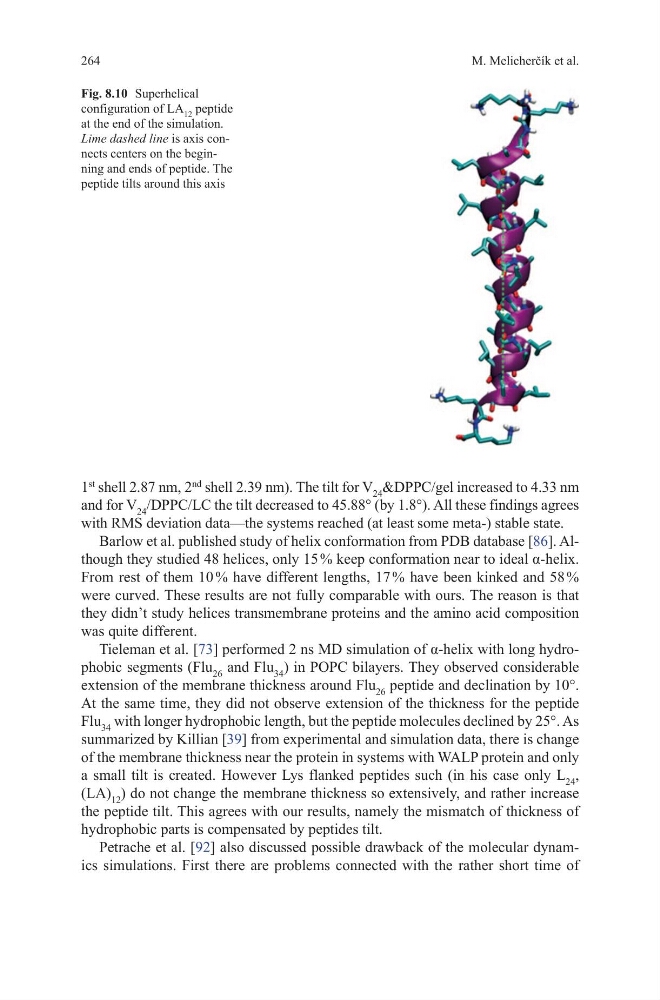
Fig. 8.10 Superhelical
configuration of LA 12 peptide
at the end of the simulation.
Lime dashed line is axis connects centers on the beginning and ends of peptide. The
peptide tilts around this axis
M. Melicherčík et al.
1
st
shell 2.87 nm, 2
nd
shell 2.39 nm). The tilt for V 24 &DPPC/gel increased to 4.33 nm
and for V 24 /DPPC/LC the tilt decreased to 45.88° (by 1.8°). All these findings agrees
with RMS deviation data—the systems reached (at least some meta-) stable state.
Barlow et al. published study of helix conformation from PDB database [86]. Although they studied 48 helices, only 15 % keep conformation near to ideal α-helix.
From rest of them 10 % have different lengths, 17 % have been kinked and 58 %
were curved. These results are not fully comparable with ours. The reason is that
they didn’t study helices transmembrane proteins and the amino acid composition
was quite different.
Tieleman et al. [73] performed 2 ns MD simulation of α-helix with long hydrophobic segments (Flu 26 and Flu 34 ) in POPC bilayers. They observed considerable
extension of the membrane thickness around Flu 26 peptide and declination by 10°.
At the same time, they did not observe extension of the thickness for the peptide
Flu 34 with longer hydrophobic length, but the peptide molecules declined by 25°. As
summarized by Killian [39] from experimental and simulation data, there is change
of the membrane thickness near the protein in systems with WALP protein and only
a small tilt is created. However Lys flanked peptides such (in his case only L 24 ,
(LA) 12 ) do not change the membrane thickness so extensively, and rather increase
the peptide tilt. This agrees with our results, namely the mismatch of thickness of
hydrophobic parts is compensated by peptides tilt.
Petrache et al. [92] also discussed possible drawback of the molecular dynamics simulations. First there are problems connected with the rather short time of
Fig. 8.10 Superhelical
configuration of LA 12 peptide
at the end of the simulation.
Lime dashed line is axis connects centers on the beginning and ends of peptide. The
peptide tilts around this axis