

226
A. B. Rozhenko
the human immunodeficiency virus reverse transcriptase (HIV-1 RT). Authors [86]
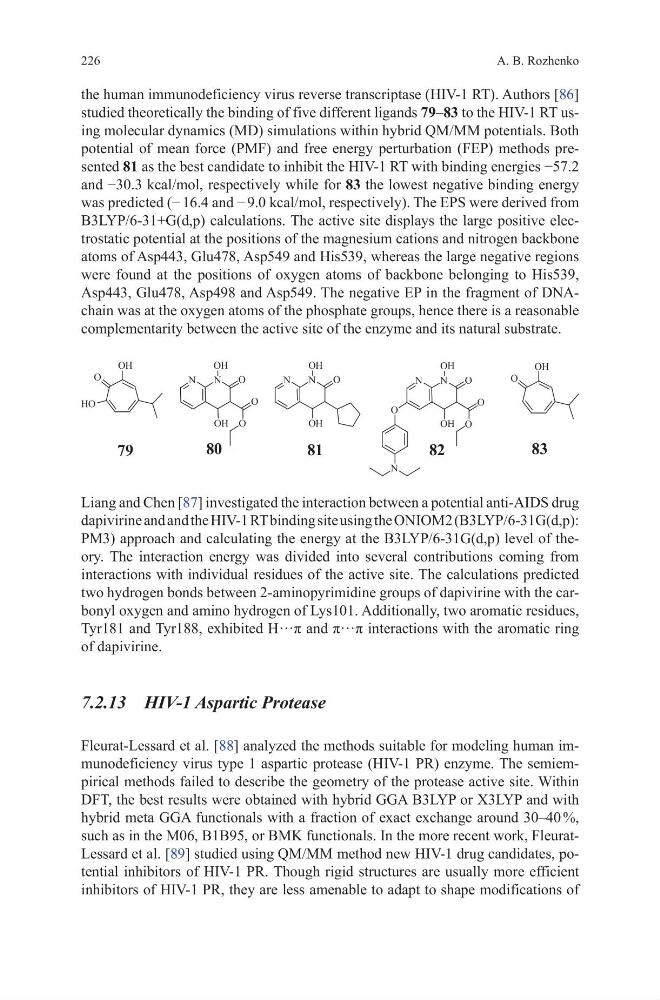
studied theoretically the binding of five different ligands 79–83 to the HIV-1 RT using molecular dynamics (MD) simulations within hybrid QM/MM potentials. Both
potential of mean force (PMF) and free energy perturbation (FEP) methods presented 81 as the best candidate to inhibit the HIV-1 RT with binding energies −57.2
and −30.3 kcal/mol, respectively while for 83 the lowest negative binding energy
was predicted (− 16.4 and − 9.0 kcal/mol, respectively). The EPS were derived from
B3LYP/6-31+G(d,p) calculations. The active site displays the large positive electrostatic potential at the positions of the magnesium cations and nitrogen backbone
atoms of Asp443, Glu478, Asp549 and His539, whereas the large negative regions
were found at the positions of oxygen atoms of backbone belonging to His539,
Asp443, Glu478, Asp498 and Asp549. The negative EP in the fragment of DNAchain was at the oxygen atoms of the phosphate groups, hence there is a reasonable
complementarity between the active site of the enzyme and its natural substrate.
2
+2
2+
1
1
2
2+
2
2
2+
1
1
2
2+
2+
2
2+
1
1
2
2+
2
2
2+
2
1
Liang and Chen [87] investigated the interaction between a potential anti-AIDS drug
dapivirine and and the HIV-1 RT binding site using the ONIOM2 (B3LYP/6-31G(d,p):
PM3) approach and calculating the energy at the B3LYP/6-31G(d,p) level of theory. The interaction energy was divided into several contributions coming from
interactions with individual residues of the active site. The calculations predicted
two hydrogen bonds between 2-aminopyrimidine groups of dapivirine with the carbonyl oxygen and amino hydrogen of Lys101. Additionally, two aromatic residues,
Tyr181 and Tyr188, exhibited H … π and π … π interactions with the aromatic ring
of dapivirine.
7.2.13 HIV-1 Aspartic Protease
Fleurat-Lessard et al. [88] analyzed the methods suitable for modeling human immunodeficiency virus type 1 aspartic protease (HIV-1 PR) enzyme. The semiempirical methods failed to describe the geometry of the protease active site. Within
DFT, the best results were obtained with hybrid GGA B3LYP or X3LYP and with
hybrid meta GGA functionals with a fraction of exact exchange around 30–40 %,
such as in the M06, B1B95, or BMK functionals. In the more recent work, FleuratLessard et al. [89] studied using QM/MM method new HIV-1 drug candidates, potential inhibitors of HIV-1 PR. Though rigid structures are usually more efficient
inhibitors of HIV-1 PR, they are less amenable to adapt to shape modifications of
A. B. Rozhenko
the human immunodeficiency virus reverse transcriptase (HIV-1 RT). Authors [86]
studied theoretically the binding of five different ligands 79–83 to the HIV-1 RT using molecular dynamics (MD) simulations within hybrid QM/MM potentials. Both
potential of mean force (PMF) and free energy perturbation (FEP) methods presented 81 as the best candidate to inhibit the HIV-1 RT with binding energies −57.2
and −30.3 kcal/mol, respectively while for 83 the lowest negative binding energy
was predicted (− 16.4 and − 9.0 kcal/mol, respectively). The EPS were derived from
B3LYP/6-31+G(d,p) calculations. The active site displays the large positive electrostatic potential at the positions of the magnesium cations and nitrogen backbone
atoms of Asp443, Glu478, Asp549 and His539, whereas the large negative regions
were found at the positions of oxygen atoms of backbone belonging to His539,
Asp443, Glu478, Asp498 and Asp549. The negative EP in the fragment of DNAchain was at the oxygen atoms of the phosphate groups, hence there is a reasonable
complementarity between the active site of the enzyme and its natural substrate.
2
+2
2+
1
1
2
2+
2
2
2+
1
1
2
2+
2+
2
2+
1
1
2
2+
2
2
2+
2
1
Liang and Chen [87] investigated the interaction between a potential anti-AIDS drug
dapivirine and and the HIV-1 RT binding site using the ONIOM2 (B3LYP/6-31G(d,p):
PM3) approach and calculating the energy at the B3LYP/6-31G(d,p) level of theory. The interaction energy was divided into several contributions coming from
interactions with individual residues of the active site. The calculations predicted
two hydrogen bonds between 2-aminopyrimidine groups of dapivirine with the carbonyl oxygen and amino hydrogen of Lys101. Additionally, two aromatic residues,
Tyr181 and Tyr188, exhibited H … π and π … π interactions with the aromatic ring
of dapivirine.
7.2.13 HIV-1 Aspartic Protease
Fleurat-Lessard et al. [88] analyzed the methods suitable for modeling human immunodeficiency virus type 1 aspartic protease (HIV-1 PR) enzyme. The semiempirical methods failed to describe the geometry of the protease active site. Within
DFT, the best results were obtained with hybrid GGA B3LYP or X3LYP and with
hybrid meta GGA functionals with a fraction of exact exchange around 30–40 %,
such as in the M06, B1B95, or BMK functionals. In the more recent work, FleuratLessard et al. [89] studied using QM/MM method new HIV-1 drug candidates, potential inhibitors of HIV-1 PR. Though rigid structures are usually more efficient
inhibitors of HIV-1 PR, they are less amenable to adapt to shape modifications of