

6
A. Monari and X. Assfeld
1.4.1 Link Atom (And Related Schemes)
The simplest way to saturate the dangling bonds is to add monovalent atoms, most
of the time Hydrogen atoms, called link atoms [31–37]. These atoms are artificial
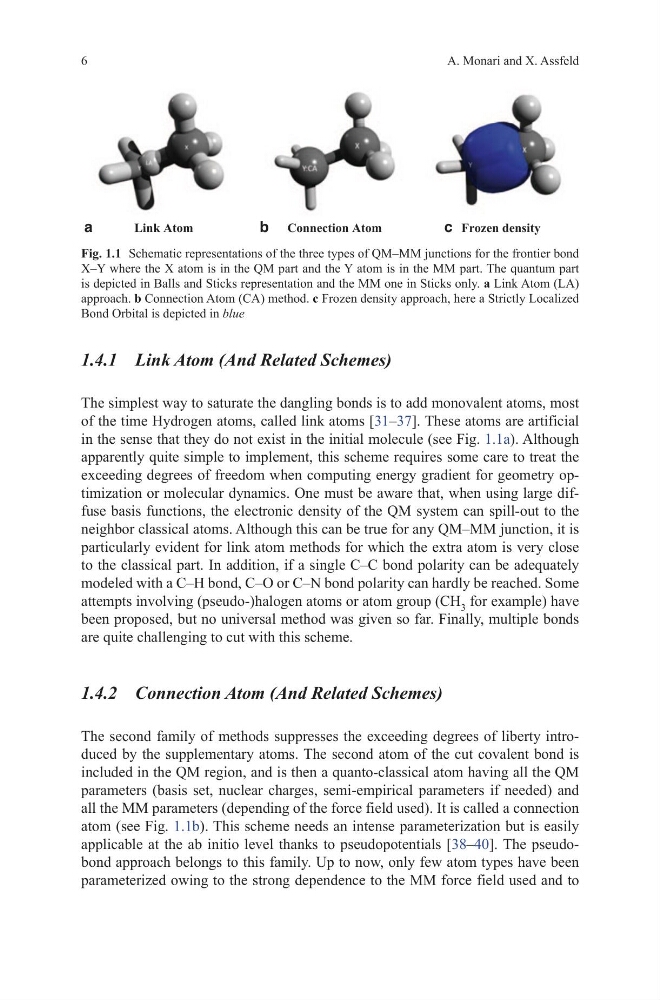
in the sense that they do not exist in the initial molecule (see Fig. 1.1a). Although
apparently quite simple to implement, this scheme requires some care to treat the
exceeding degrees of freedom when computing energy gradient for geometry optimization or molecular dynamics. One must be aware that, when using large diffuse basis functions, the electronic density of the QM system can spill-out to the
neighbor classical atoms. Although this can be true for any QM–MM junction, it is
particularly evident for link atom methods for which the extra atom is very close
to the classical part. In addition, if a single C–C bond polarity can be adequately
modeled with a C–H bond, C–O or C–N bond polarity can hardly be reached. Some
attempts involving (pseudo-)halogen atoms or atom group (CH 3 for example) have
been proposed, but no universal method was given so far. Finally, multiple bonds
are quite challenging to cut with this scheme.
1.4.2 Connection Atom (And Related Schemes)
The second family of methods suppresses the exceeding degrees of liberty introduced by the supplementary atoms. The second atom of the cut covalent bond is
included in the QM region, and is then a quanto-classical atom having all the QM
parameters (basis set, nuclear charges, semi-empirical parameters if needed) and
all the MM parameters (depending of the force field used). It is called a connection
atom (see Fig. 1.1b). This scheme needs an intense parameterization but is easily
applicable at the ab initio level thanks to pseudopotentials [38–40]. The pseudobond approach belongs to this family. Up to now, only few atom types have been
parameterized owing to the strong dependence to the MM force field used and to
a
/LQN$WRP
b &RQQHFWLRQ$WRP
c )UR]HQGHQVLW\
Fig. 1.1 Schematic representations of the three types of QM–MM junctions for the frontier bond
X–Y where the X atom is in the QM part and the Y atom is in the MM part. The quantum part
is depicted in Balls and Sticks representation and the MM one in Sticks only. a Link Atom (LA)
approach. b Connection Atom (CA) method. c Frozen density approach, here a Strictly Localized
Bond Orbital is depicted in blue
A. Monari and X. Assfeld
1.4.1 Link Atom (And Related Schemes)
The simplest way to saturate the dangling bonds is to add monovalent atoms, most
of the time Hydrogen atoms, called link atoms [31–37]. These atoms are artificial
in the sense that they do not exist in the initial molecule (see Fig. 1.1a). Although
apparently quite simple to implement, this scheme requires some care to treat the
exceeding degrees of freedom when computing energy gradient for geometry optimization or molecular dynamics. One must be aware that, when using large diffuse basis functions, the electronic density of the QM system can spill-out to the
neighbor classical atoms. Although this can be true for any QM–MM junction, it is
particularly evident for link atom methods for which the extra atom is very close
to the classical part. In addition, if a single C–C bond polarity can be adequately
modeled with a C–H bond, C–O or C–N bond polarity can hardly be reached. Some
attempts involving (pseudo-)halogen atoms or atom group (CH 3 for example) have
been proposed, but no universal method was given so far. Finally, multiple bonds
are quite challenging to cut with this scheme.
1.4.2 Connection Atom (And Related Schemes)
The second family of methods suppresses the exceeding degrees of liberty introduced by the supplementary atoms. The second atom of the cut covalent bond is
included in the QM region, and is then a quanto-classical atom having all the QM
parameters (basis set, nuclear charges, semi-empirical parameters if needed) and
all the MM parameters (depending of the force field used). It is called a connection
atom (see Fig. 1.1b). This scheme needs an intense parameterization but is easily
applicable at the ab initio level thanks to pseudopotentials [38–40]. The pseudobond approach belongs to this family. Up to now, only few atom types have been
parameterized owing to the strong dependence to the MM force field used and to
a
/LQN$WRP
b &RQQHFWLRQ$WRP
c )UR]HQGHQVLW\
Fig. 1.1 Schematic representations of the three types of QM–MM junctions for the frontier bond
X–Y where the X atom is in the QM part and the Y atom is in the MM part. The quantum part
is depicted in Balls and Sticks representation and the MM one in Sticks only. a Link Atom (LA)
approach. b Connection Atom (CA) method. c Frozen density approach, here a Strictly Localized
Bond Orbital is depicted in blue