

162
T. A. Zubatiuk et al.
where G i is the calculated Gibbs free energy of the i-th conformer and P i is the
population of this conformer (0 ≤ P i ≤ 1). The relative stability of conformers and
tautomers were calculated at 298 K.
Starting geometries of protonated nucleotides were generated from each stable
conformer of non-protonated molecule by addition of a proton to the heteroatom.
Therefore, it is possible to expect that every tautomer of protonated nucleotides will
have two to four stable conformers. However, results of calculations demonstrated
(Table 5.15) that protonation results in significant changes of the number of stable
conformers. As follows from obtained results, up to six conformers are observed for
tautomers of protonated pyrimidine nucleotides and only one to two conformers for
tautomers of mGMP and mAMP.
5.6.1 Protonated mTMP
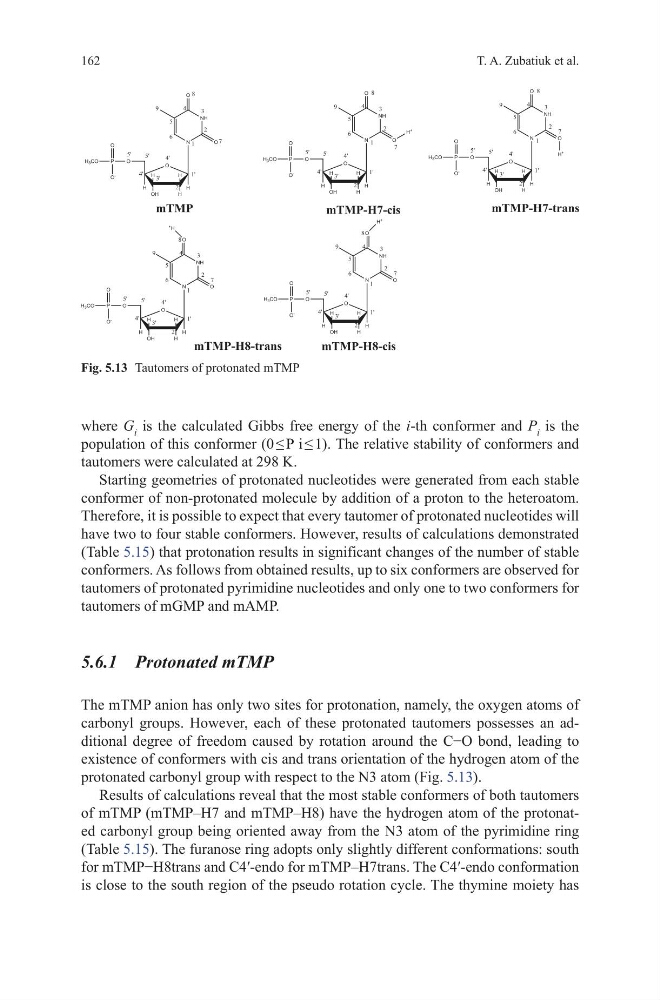
The mTMP anion has only two sites for protonation, namely, the oxygen atoms of
carbonyl groups. However, each of these protonated tautomers possesses an additional degree of freedom caused by rotation around the C−O bond, leading to
existence of conformers with cis and trans orientation of the hydrogen atom of the
protonated carbonyl group with respect to the N3 atom (Fig. 5.13).
Results of calculations reveal that the most stable conformers of both tautomers
of mTMP (mTMP–H7 and mTMP–H8) have the hydrogen atom of the protonated carbonyl group being oriented away from the N3 atom of the pyrimidine ring
(Table 5.15). The furanose ring adopts only slightly different conformations: south
for mTMP−H8trans and C4′-endo for mTMP–H7trans. The C4′-endo conformation
is close to the south region of the pseudo rotation cycle. The thymine moiety has
Fig. 5.13 Tautomers of protonated mTMP
T. A. Zubatiuk et al.
where G i is the calculated Gibbs free energy of the i-th conformer and P i is the
population of this conformer (0 ≤ P i ≤ 1). The relative stability of conformers and
tautomers were calculated at 298 K.
Starting geometries of protonated nucleotides were generated from each stable
conformer of non-protonated molecule by addition of a proton to the heteroatom.
Therefore, it is possible to expect that every tautomer of protonated nucleotides will
have two to four stable conformers. However, results of calculations demonstrated
(Table 5.15) that protonation results in significant changes of the number of stable
conformers. As follows from obtained results, up to six conformers are observed for
tautomers of protonated pyrimidine nucleotides and only one to two conformers for
tautomers of mGMP and mAMP.
5.6.1 Protonated mTMP
The mTMP anion has only two sites for protonation, namely, the oxygen atoms of
carbonyl groups. However, each of these protonated tautomers possesses an additional degree of freedom caused by rotation around the C−O bond, leading to
existence of conformers with cis and trans orientation of the hydrogen atom of the
protonated carbonyl group with respect to the N3 atom (Fig. 5.13).
Results of calculations reveal that the most stable conformers of both tautomers
of mTMP (mTMP–H7 and mTMP–H8) have the hydrogen atom of the protonated carbonyl group being oriented away from the N3 atom of the pyrimidine ring
(Table 5.15). The furanose ring adopts only slightly different conformations: south
for mTMP−H8trans and C4′-endo for mTMP–H7trans. The C4′-endo conformation
is close to the south region of the pseudo rotation cycle. The thymine moiety has
Fig. 5.13 Tautomers of protonated mTMP