

155
5 Molecular Structures, Relative Stability, and Proton Affinities of Nucleotides
and pyrimidine nucleotides is observed. In all cases purine nucleotides require more
energy for deformation of backbone (largest difference is observed for ZI- and ZIIDNA—about 5 kcal/mol). In the case of north conformers of purine nucleotides in
Z-DNA a similar to south/anti conformations values of energy are found. For the syn
conformers of purine nucleotides in Z-form of DNA drastic changes between mAMP
and mGMP are observed. In the case of mAMP, energy of deformation is less than
1 kcal/mol, but for mGMP the analogous energy amounts more than 10 kcal/mol.
Interestingly, the energy of deformation of isolated base pairs of: A–T and G–C
in each form of DNA is almost identical. They amount to 3.6 kcal/mol for A-DNA,
10.9–11.4 kcal/mol for BI- and BII-DNA, and 15.8–17.2 kcal/mol for Z-types of DNA
(Table 5.8). Thus, a formation of isolated Watson–Crick A–T and G–C base pairs of
nucleotides is practically equivalent from viewpoint of energy required for deformation of nucleotides geometry. However, a presence of polar environment makes a distinction between deformation energy of nucleotides in A–T and G–C pairs (Table 5.8).
The comparison of geometrical parameters of nucleotides in equilibrium and
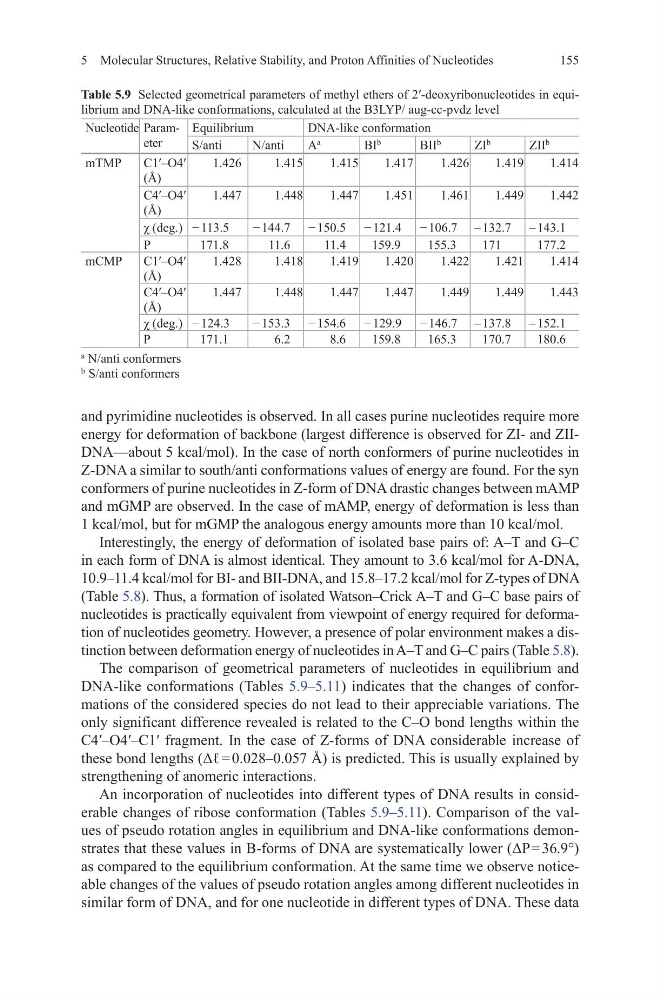
DNA-like conformations (Tables 5.9–5.11) indicates that the changes of conformations of the considered species do not lead to their appreciable variations. The
only significant difference revealed is related to the C–O bond lengths within the
C4′–O4′–C1′ fragment. In the case of Z-forms of DNA considerable increase of
these bond lengths (Δℓ = 0.028–0.057 Å) is predicted. This is usually explained by
strengthening of anomeric interactions.
An incorporation of nucleotides into different types of DNA results in considerable changes of ribose conformation (Tables 5.9–5.11). Comparison of the values of pseudo rotation angles in equilibrium and DNA-like conformations demonstrates that these values in B-forms of DNA are systematically lower (ΔP = 36.9°)
as compared to the equilibrium conformation. At the same time we observe noticeable changes of the values of pseudo rotation angles among different nucleotides in
similar form of DNA, and for one nucleotide in different types of DNA. These data
Table 5.9 Selected geometrical parameters of methyl ethers of 2′-deoxyribonucleotides in equilibrium and DNA-like conformations, calculated at the B3LYP/ aug-cc-pvdz level
Nucleotide Parameter
Equilibrium
DNA-like conformation
S/anti
N/anti
A
a
BI
b
BII
b
ZI
b
ZII
b
mTMP
C1′–O4′
(Å)
1.426
1.415
1.415
1.417
1.426
1.419
1.414
C4′–O4′
(Å)
1.447
1.448
1.447
1.451
1.461
1.449
1.442
χ (deg.) − 113.5
− 144.7 − 150.5 − 121.4 − 106.7 – 132.7 – 143.1
P
171.8
11.6
11.4
159.9
155.3
171
177.2
mCMP
C1′–O4′
(Å)
1.428
1.418
1.419
1.420
1.422
1.421
1.414
C4′–O4′
(Å)
1.447
1.448
1.447
1.447
1.449
1.449
1.443
χ (deg.) − 124.3
− 153.3 − 154.6 − 129.9 − 146.7 – 137.8 – 152.1
P
171.1
6.2
8.6
159.8
165.3
170.7
180.6
a
N/anti conformers
b
S/anti conformers
5 Molecular Structures, Relative Stability, and Proton Affinities of Nucleotides
and pyrimidine nucleotides is observed. In all cases purine nucleotides require more
energy for deformation of backbone (largest difference is observed for ZI- and ZIIDNA—about 5 kcal/mol). In the case of north conformers of purine nucleotides in
Z-DNA a similar to south/anti conformations values of energy are found. For the syn
conformers of purine nucleotides in Z-form of DNA drastic changes between mAMP
and mGMP are observed. In the case of mAMP, energy of deformation is less than
1 kcal/mol, but for mGMP the analogous energy amounts more than 10 kcal/mol.
Interestingly, the energy of deformation of isolated base pairs of: A–T and G–C
in each form of DNA is almost identical. They amount to 3.6 kcal/mol for A-DNA,
10.9–11.4 kcal/mol for BI- and BII-DNA, and 15.8–17.2 kcal/mol for Z-types of DNA
(Table 5.8). Thus, a formation of isolated Watson–Crick A–T and G–C base pairs of
nucleotides is practically equivalent from viewpoint of energy required for deformation of nucleotides geometry. However, a presence of polar environment makes a distinction between deformation energy of nucleotides in A–T and G–C pairs (Table 5.8).
The comparison of geometrical parameters of nucleotides in equilibrium and
DNA-like conformations (Tables 5.9–5.11) indicates that the changes of conformations of the considered species do not lead to their appreciable variations. The
only significant difference revealed is related to the C–O bond lengths within the
C4′–O4′–C1′ fragment. In the case of Z-forms of DNA considerable increase of
these bond lengths (Δℓ = 0.028–0.057 Å) is predicted. This is usually explained by
strengthening of anomeric interactions.
An incorporation of nucleotides into different types of DNA results in considerable changes of ribose conformation (Tables 5.9–5.11). Comparison of the values of pseudo rotation angles in equilibrium and DNA-like conformations demonstrates that these values in B-forms of DNA are systematically lower (ΔP = 36.9°)
as compared to the equilibrium conformation. At the same time we observe noticeable changes of the values of pseudo rotation angles among different nucleotides in
similar form of DNA, and for one nucleotide in different types of DNA. These data
Table 5.9 Selected geometrical parameters of methyl ethers of 2′-deoxyribonucleotides in equilibrium and DNA-like conformations, calculated at the B3LYP/ aug-cc-pvdz level
Nucleotide Parameter
Equilibrium
DNA-like conformation
S/anti
N/anti
A
a
BI
b
BII
b
ZI
b
ZII
b
mTMP
C1′–O4′
(Å)
1.426
1.415
1.415
1.417
1.426
1.419
1.414
C4′–O4′
(Å)
1.447
1.448
1.447
1.451
1.461
1.449
1.442
χ (deg.) − 113.5
− 144.7 − 150.5 − 121.4 − 106.7 – 132.7 – 143.1
P
171.8
11.6
11.4
159.9
155.3
171
177.2
mCMP
C1′–O4′
(Å)
1.428
1.418
1.419
1.420
1.422
1.421
1.414
C4′–O4′
(Å)
1.447
1.448
1.447
1.447
1.449
1.449
1.443
χ (deg.) − 124.3
− 153.3 − 154.6 − 129.9 − 146.7 – 137.8 – 152.1
P
171.1
6.2
8.6
159.8
165.3
170.7
180.6
a
N/anti conformers
b
S/anti conformers