

153
5 Molecular Structures, Relative Stability, and Proton Affinities of Nucleotides
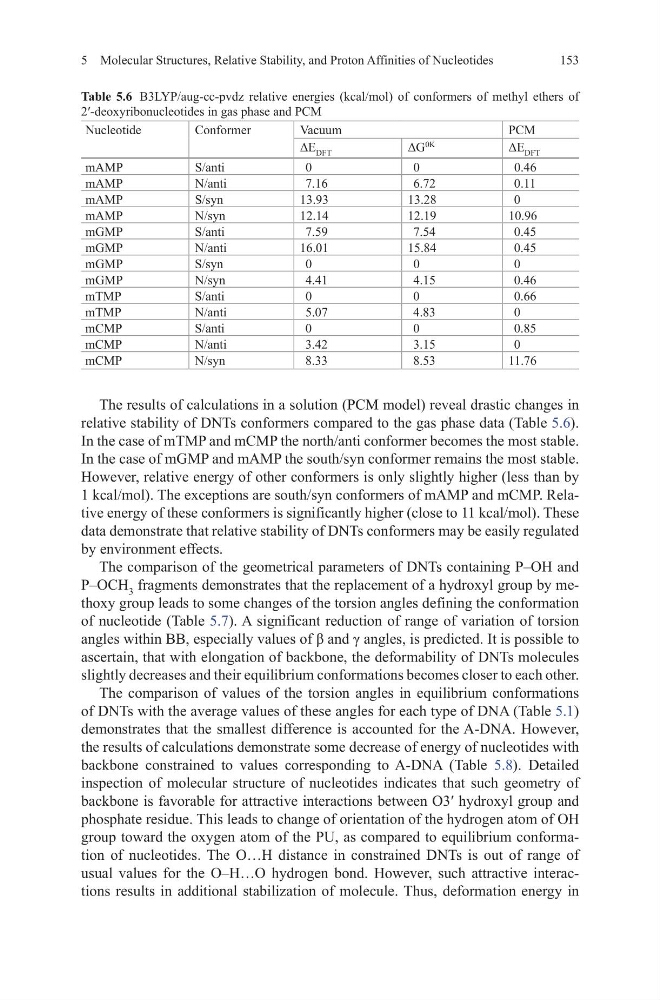
The results of calculations in a solution (PCM model) reveal drastic changes in
relative stability of DNTs conformers compared to the gas phase data (Table 5.6).
In the case of mTMP and mCMP the north/anti conformer becomes the most stable.
In the case of mGMP and mAMP the south/syn conformer remains the most stable.
However, relative energy of other conformers is only slightly higher (less than by
1 kcal/mol). The exceptions are south/syn conformers of mAMP and mCMP. Relative energy of these conformers is significantly higher (close to 11 kcal/mol). These
data demonstrate that relative stability of DNTs conformers may be easily regulated
by environment effects.
The comparison of the geometrical parameters of DNTs containing P–OH and
P–OCH 3 fragments demonstrates that the replacement of a hydroxyl group by methoxy group leads to some changes of the torsion angles defining the conformation
of nucleotide (Table 5.7). A significant reduction of range of variation of torsion
angles within BB, especially values of β and γ angles, is predicted. It is possible to
ascertain, that with elongation of backbone, the deformability of DNTs molecules
slightly decreases and their equilibrium conformations becomes closer to each other.
The comparison of values of the torsion angles in equilibrium conformations
of DNTs with the average values of these angles for each type of DNA (Table 5.1)
demonstrates that the smallest difference is accounted for the A-DNA. However,
the results of calculations demonstrate some decrease of energy of nucleotides with
backbone constrained to values corresponding to A-DNA (Table 5.8). Detailed
inspection of molecular structure of nucleotides indicates that such geometry of
backbone is favorable for attractive interactions between O3′ hydroxyl group and
phosphate residue. This leads to change of orientation of the hydrogen atom of OH
group toward the oxygen atom of the PU, as compared to equilibrium conformation of nucleotides. The O…H distance in constrained DNTs is out of range of
usual values for the O–H…O hydrogen bond. However, such attractive interactions results in additional stabilization of molecule. Thus, deformation energy in
Table 5.6 B3LYP/aug-cc-pvdz relative energies (kcal/mol) of conformers of methyl ethers of
2′-deoxyribonucleotides in gas phase and PCM
Nucleotide
Conformer
Vacuum
PCM
ΔE DFT
ΔG
0K
ΔE DFT
mAMP
S/anti
0
0
0.46
mAMP
N/anti
7.16
6.72
0.11
mAMP
S/syn
13.93
13.28
0
mAMP
N/syn
12.14
12.19
10.96
mGMP
S/anti
7.59
7.54
0.45
mGMP
N/anti
16.01
15.84
0.45
mGMP
S/syn
0
0
0
mGMP
N/syn
4.41
4.15
0.46
mTMP
S/anti
0
0
0.66
mTMP
N/anti
5.07
4.83
0
mCMP
S/anti
0
0
0.85
mCMP
N/anti
3.42
3.15
0
mCMP
N/syn
8.33
8.53
11.76
5 Molecular Structures, Relative Stability, and Proton Affinities of Nucleotides
The results of calculations in a solution (PCM model) reveal drastic changes in
relative stability of DNTs conformers compared to the gas phase data (Table 5.6).
In the case of mTMP and mCMP the north/anti conformer becomes the most stable.
In the case of mGMP and mAMP the south/syn conformer remains the most stable.
However, relative energy of other conformers is only slightly higher (less than by
1 kcal/mol). The exceptions are south/syn conformers of mAMP and mCMP. Relative energy of these conformers is significantly higher (close to 11 kcal/mol). These
data demonstrate that relative stability of DNTs conformers may be easily regulated
by environment effects.
The comparison of the geometrical parameters of DNTs containing P–OH and
P–OCH 3 fragments demonstrates that the replacement of a hydroxyl group by methoxy group leads to some changes of the torsion angles defining the conformation
of nucleotide (Table 5.7). A significant reduction of range of variation of torsion
angles within BB, especially values of β and γ angles, is predicted. It is possible to
ascertain, that with elongation of backbone, the deformability of DNTs molecules
slightly decreases and their equilibrium conformations becomes closer to each other.
The comparison of values of the torsion angles in equilibrium conformations
of DNTs with the average values of these angles for each type of DNA (Table 5.1)
demonstrates that the smallest difference is accounted for the A-DNA. However,
the results of calculations demonstrate some decrease of energy of nucleotides with
backbone constrained to values corresponding to A-DNA (Table 5.8). Detailed
inspection of molecular structure of nucleotides indicates that such geometry of
backbone is favorable for attractive interactions between O3′ hydroxyl group and
phosphate residue. This leads to change of orientation of the hydrogen atom of OH
group toward the oxygen atom of the PU, as compared to equilibrium conformation of nucleotides. The O…H distance in constrained DNTs is out of range of
usual values for the O–H…O hydrogen bond. However, such attractive interactions results in additional stabilization of molecule. Thus, deformation energy in
Table 5.6 B3LYP/aug-cc-pvdz relative energies (kcal/mol) of conformers of methyl ethers of
2′-deoxyribonucleotides in gas phase and PCM
Nucleotide
Conformer
Vacuum
PCM
ΔE DFT
ΔG
0K
ΔE DFT
mAMP
S/anti
0
0
0.46
mAMP
N/anti
7.16
6.72
0.11
mAMP
S/syn
13.93
13.28
0
mAMP
N/syn
12.14
12.19
10.96
mGMP
S/anti
7.59
7.54
0.45
mGMP
N/anti
16.01
15.84
0.45
mGMP
S/syn
0
0
0
mGMP
N/syn
4.41
4.15
0.46
mTMP
S/anti
0
0
0.66
mTMP
N/anti
5.07
4.83
0
mCMP
S/anti
0
0
0.85
mCMP
N/anti
3.42
3.15
0
mCMP
N/syn
8.33
8.53
11.76